Categories
Uncategorized

From There to Formentera

June was my last of five months traveling through Europe. The trip started in early February 1978, several days before my folks flew to Paris to visit Danica. She was studying at the Sorbonne for a year abroad. I arrived in Luxembourg and made my way south to meet them.

Our first three weeks involved a rented car on a circular route around central Europe. At age 24, I was once again riding in the back seat with a sibling, as Dad drove, and Mom mapped the route along the south of France into Italy.

Jack and Bill Kombol enjoying a beer in our Lyon hotel, February 8, 1978. In just over a year, Dad would be dead.

Our primary stops would be in Croatia (at the time still part of Yugoslavia), to visit relatives on the Kombol side. After seeing kin in Pula, Rijeka, and Fužine, we traveled north to Zagreb, where Dad met his first cousin, Zdenko Kauzlaric, and wife, Ljubica, for the first time. They had one son, Dubravko “Woody” Kauzlaric, a second cousin and the same age as me, who became a lifelong friend. Twelve years later, Jennifer and I visited him and his wife, Zlata, in Zagreb while on our honeymoon. Then, several years later, Woody and Zlata emigrated to Washington, settling in Edmonds.

Jack Kombol with his first cousins, Marta (Kauzlaric) Hangi (left) and Zendko & Ljubica Kauzlaric. Saturday, February 18, 1978 in Zagreb.

After Mom and Dad left, I began my solo travels with one-month stays in Paris, rural Wales (including a side trip to Ireland), London, back through Paris and Amsterdam, then concluded with a getaway to a tiny island off the coast of Spain. By the fifth month of traveling alone, with no set destination, nomadic wanderings had become indistinguishable from a daily routine.

My budget was a frugal $10 per day, not including travel. It worked best with several-week or full-month stays, rather than two- and three-day stops in ten tourist dens. After finding free or very cheap accommodation, I was better able to immerse myself in one locale, limiting expensive travel.

Heading south to Barcelona

In late May, I left Paris on a train bound for Perpignan in southern France. My strategy was to hitchhike to Barcelona from there. It was a 120-mile trek, but thumbed rides were tough to snag. Most pick-ups dropped me a few frustrating kilometers down the road. By the first night, I was still in France. I decided to save money by sleeping outside a small village. Dumb idea! As thunderstorms crackled in the distance, I high-tailed it back to town and fortunately found a small hotel. Though it was late, they served me a simple dinner. After which, I watched the evening skies fill with lightning as buckets of rain poured down.

The second day of thumbing rides was more successful. I found myself in Tossa de Mar, just north of Barcelona. I chose a nondescript pensione and settled into my second-floor berth. Like typical cheap motels, their tiny rooms opened to an outdoor passageway. I took a walk, planning to find a cheap dinner. Passing by a room with an open door, I greeted the young man seated inside.  The sandy-haired guy was about my age and welcomed me in. He introduced himself as Paul Nielsen from Denmark and spoke near-perfect English. He’d recently left the Cannes Film Festival and was traveling south to Barcelona.

We talked of earlier travels, likely destinations, and cultural differences. He popped a question about American baseball, saying he didn’t understand the sport or its appeal. I slowly explained the various positions, players, and rules, but words alone couldn’t capture the game’s essence or its flavor. Baseball is, after all, the only sport where defense controls the ball.

I decided to illustrate a mock game as a radio broadcaster reciting real names of players from a team I still admired, the Detroit Tigers. To fully simulate the real experience, I announced as if I were a broadcaster in an imagined booth.  I further choreographed the pitcher’s wind-up, a batter’s stance, the mighty swing, a sharp drive to right field, with a slide into second for a two-out double. My mimicked broadcast lasted for 10 or 15 minutes, all the while answering Paul’s questions and clarifying the sport’s nuances. By game’s end, we were laughing out loud and planning our next adventure.

Paul had a fancy camera, so we walked down to the pensione owners’ apartment, where he took photos of the sweet old couple who spoke only broken English. In a letter from Paul that I received a year later (with photos he’d later take of me), he related how he’d printed and mailed the couple his 8” x 10” prints and, several weeks later, received “the biggest box of candy and cakes I ever saw.”

Paul owned an impressive single-lens reflex camera and prided himself on his photography. He shot this photo of me in a corn field on the edge of town. June 1978.

Spain’s second-largest city, Barcelona, is situated on the Mediterranean coast in the far northeast. It was my intended home for the next month. That was before Paul interjected and sold me on the charms of a little-visited island off Spain’s east coast. I’d never heard of Formentera, an island about the size of the Enumclaw plateau. Paul described it as a forgotten outpost populated by ex-pats, laidback travelers, working-class Spaniards, and a handful of hippies. It was the polar opposite of the touristy atmosphere in Ibiza, the party island with noisy nightclubs, or Mallorca, the biggest island in the chain.

Paul suggested I spend a few days checking out Barcelona, then head to Formentera. We promised to meet on Las Ramblas, a one-mile pedestrian boulevard lined with shops, restaurants, and nightclubs. If that failed, our backup plan was to reunite in San Francisco Xavier, the island’s largest town. Despite its grand name, San Francisco was little more than a village with a café and store. Paul advised me to lodge with a widow who rented rooms in a two-story building located across from the town’s central café.

The next morning, I hitchhiked to Barcelona and found a room in a hostel off the Las Ramblas. I spent three days in this Catalonian city, admiring the strange architecture of Antoni Gaudí, whose inspiration came from mimicking nature’s patterns. I marveled over this imaginative Cathedral with soaring Gothic spires, not realizing it was Gaudí’s La Sagrada Familia, his greatest project. Construction started in 1882 and was still not finished when I returned to Barcelona with my wife, 48 years later, in 2026.

Jennifer and Bill in front of La Sagrada Familia, Barcelona, May 2026.

After three days, I miraculously bumped into Paul while strolling along Las Ramblas. He’d been delayed by a case of the clap from a girl he’d hooked up with in Cannes. He was going to see a doctor, but promised to join me in San Francisco. We shared an evening meal. Then I boarded the ferry for the 12-hour ride to Formentera that sailed each night at 10 pm. I slept on a deck chair under starlit skies.

On Formentera, I made my way to San Francisco and spoke to the widow who rented upstairs rooms. Paul had stayed with her before. Her pensione was a nondescript two-story, adobe-walled building a stone’s throw from the town’s lone café. Using the three years of Spanish I’d learned in high school, I secured a room for the next several weeks. It was a decent-sized chamber with two beds and a small window. The outside shower and the toilet were downstairs and behind the premises.

The island’s population was small, somewhat less than 5,000 inhabitants. There were few hotels of size. Tourism was limited owing to a lack of destinations. Cars and trucks were rare, as most people used bicycles to get around. Life slowed to a crawl on Formentera.

Formentera fishermen dragged up this leatherback sea turtle, the largest turtle specie.

Paul arrived a few days later, and we spent our time leisurely hanging out at the small café, watching World Cup soccer on a small black-and-white television. It was 1978, and the quadrennial World Cup soccer-fest was underway. When important games were broadcast, dozens of men and boys crowded around the bar to cheer or groan at each missed goal. It was my first exposure to this worldwide sporting spectacle that has eluded most Americans until of late.

Discovering coffee’s profound pleasure

My love affair with coffee began in that Spanish café. At 24 years, I’d never enjoyed the taste, nor adopted the habit, having drunk but a few cups beforehand. All that changed when I discovered coffee’s profound pleasure after ordering a café con leche. The hot, scalded milk tamed the pungent taste of strong espresso, so I began ordering them with increasing frequency.

Bill Kombol with sunglasses as a chess game is played to the left.

Outside the café, chess games were regularly played. Having been on our high school chess team, I naturally joined in. Each morning, I played a few games, with the caffeine from coffee enhancing my concentration. With each successive win, I gained a reputation among the local talent, and every morning, a new challenger appeared. After a week or so without a loss, a game was arranged with one of the town’s best. A crowd of onlookers hovered about. Over 90 minutes, we battled until a natural draw was reached. We exchanged handshakes as locals patted us both on the back. Afterward, we approached the bar together and ordered two cervezas. It was an idyllic life.

In time, Paul and I met a Norwegian, also pronounced Paul, but spelled Pål, who had a bed in a nearby room. The three of us became fast friends, riding bikes, swimming, snorkeling, and taking long walks through the surrounding countryside. We explored together and had a jolly good time just goofing off. Formentera’s nightlife was practically non-existent, so we planned an overnight excursion to Ibiza Town, the capital of the island, Ibiza. On the appointed afternoon, Pål the Norwegian turned up sick, so Paul and I hopped the short ferry ride there.

Pål the Norwegian on the left with Paul Nielsen, the Dane on the right. On one of our bicycle explorations of Formentera.

Ibiza Town was party central. Crowded streets overflowed with hipsters, shysters, dropouts, and every kind of reveler. Following an early dinner, we found our bearings and wandered in and out and through dozens of clubs and bars. Everywhere we turned, neon signs and garish lights held the night in perpetual motion as we tripped the light fantastic. The partying never really stopped, though it slowed in the wee hours. The summer solstice was nearly upon us, so days were long and nights were brief. By sunrise, we were still awake, walking along the castle walls, while gazing down at the blue Mediterranean sea. Exhausted, we caught the first ferry back to Formentera and slept until late afternoon.

The postcard I mailed home when my travels neared their end.

I wrote one postcard home from Formentera.

June 23, 1978 — Dear Mom & Dad – This postcard has been a couple of weeks in the making, but nice weather and the slow pace of island life have prevented its completion.

Formentera is the most rural and least inhabited of those islands known as the Balearics, situated halfway between Spain and Italy. I’ve been living in this small pensione (with no running water) with this Danish guy and this Norwegian, both of whom speak impeccable English.

Our days are divided between sitting in cafes, playing chess, long bike rides, snorkeling, and several other non-strenuous activities. We live in San Francisco, the largest of the very small communities on this island. I miss you a lot and will enjoy recounting these times I’m having.

– Bill

Time to head home

After five months traveling through Europe, I missed my family. I missed my friends. I missed my American life. As July approached, it was time to head home.

I was also aware of a creeping idleness. My carefree lifestyle, albeit frugal, had been funded by a year of working at Seattle Trust & Savings Bank. I was reminded of the short story, “The Lotus Eater,” by my favorite author, Somerset Maugham. The tale follows a London banker who abandoned his conventional career at a young age to live a life of leisure on a Mediterranean island. However, years of indolence and escapism erode his willpower. Constantly choosing the easy path atrophied the muscles required to overcome life’s difficulties. By trading meaningful struggles for hedonistic detachment, he eventually lost his spirit to live.

I set a goal to be back for our family’s annual Fourth of July celebration. Before leaving, Paul offered to take some pictures of Pål and me. I said goodbye to Paul early one morning and ferried to Barcelona.

Paul chided me about my T-shirt, claiming I looked like a Tour de France cyclist. The picture was taken in our room with light coming in from the window.

I boarded a northbound train, arriving in Paris the next morning. I met Danica, and together we saw Bob Marley & the Wailers at the Pavillon de Paris on the final performance of their three-night stand. I then flew to London and picked up the custom-made pin-striped suit I had been fitted for, a month earlier at Aubrey Morris Tailors, 24 Highbury Court. I still have that suit.

The following morning, I boarded a plane for Seattle, arriving at Sea-Tac by late afternoon. I telephoned home, and an hour later, my parents arrived. When Mom saw my new suit, tanned complexion, and dark sunglasses, she quipped that I looked like a rock star. Back home, she took my picture upstairs in the bedroom. It was good to be home.

I arrived home on June 29, 1978.  Mom took this photo in my tailored pin stripe suit I’d bought in London.

A month passed. One Saturday night, while Dad and I were watching TV, the phone rang, and he answered. I overheard the conversation. The laborer at Palmer Coking Coal’s Black Diamond washing plant had just quit. Dad looked at me, and before he had a chance to ask, I replied, “Sure, I’ll do it.”

Monday morning, I was back at work on the picking table, the starting position at the mine – separating rock from coal.  It was the same job I’d left over three years prior. As a teenager, I started as Palmer’s Saturday office boy, then college summers doing grunt work, and my senior year on the afternoon shift at the picking table.  However, that Monday marked the beginning of my final employment stint with Palmer. It lasted 44 years.

Links to prior essays – travels through Europe, 1978

This is the sixth in a series of essays that I’ve published about my 1978 travels through Europe.  Below are links to the other five:

A Walk in Wales

Hitchhiking to Haverfordwest

My Week in Ireland with a Welsh Rugby Team

I wrote this letter to Mom & Dad

Living London’s Life – 1978

Categories
Uncategorized

15 Years Later

Mom died 15 years ago today.  A few days later, a good friend placed his hand on my shoulder and told me, “You just lost the best friend you’ll ever have.”  Truer words have rarely been spoken.

We knew it was coming. She had COPD – Chronic Obstructive Pulmonary Disease. Like many of her generation, Pauline smoked. For years, make that decades, she tried to quit, and for the most part did, limiting herself to just a few smokes a day. In fact, for the longest time, even I didn’t know she still smoked. She hid it that well.

In her last year, grandchildren from far away came to visit. Thanksgiving weekend 2010, Mom wished to take a ride around Enumclaw and point out her old family homes.  And that of her grandfather, Joshua Morris, whom she never really knew, as he died before she was two years old.  She packed her oxygen tank, and though experiencing discomfort, we completed the several-hour trip around town and out to Osceola.  A few weeks later, she called me at work first thing in the morning. For thirty minutes, she shared her Christian faith journey and how proud she was to have passed it down to her children, in different iterations.

A week before Christmas, she fell. How many times have falls lead to death in older adults? First stop was Enumclaw Hospital, then a Federal Way rehab center, where we visited her on Christmas Day. She seemed to be getting better, but a setback landed her in Swedish Hospital.  On New Year’s Day, many of the family visited. Mom convinced the doctors to pump her up on steroids, then put on makeup, so that when we visited, she was sparkling and appeared to be years younger. I was amazed by her remarkable recovery – right before my eyes. She was vibrant, almost perky. She held a great-grandchild in her arms, looking angelic. I imagined she’d somehow been cured. Foolish me, for I didn’t know of the doctor’s trick.

At Swedish Hospital, Pauline and her great-granddaughter, Nina Marie Clooke, age two months, January 1, 2011.

Pauline left Swedish for the Kline Galland nursing home near Seward Park. It’s a lovely place in a forested setting.  And for the next three weeks, she slowly proceeded to die, under the gentle care of hospice personnel who calibrated the precise dose of morphine to keep her both conscious and free of pain. On the last few nights, we rotated sleeping beside her.

The fateful call came Monday afternoon, January 24, 2011. We were in Auburn at the Celebration of Life for Jill Alverson, Cal Bashaw’s daughter.  Mom and Cal had joined their lives in partnership a decade earlier. Cal and his family became a part of our family. Were two daggers purposely thrown that day?

The following week was a whirlwind. We organized the funeral at Sacred Heart Catholic Church and coordinated with Enumclaw Funeral Home, just like we did for Dad, 32 years earlier.  Father Bill Hausmann, one of Mom’s best friends and the priest who married Jennifer and me, came to perform the service. Mom wanted to be buried, so I chose a coffin, the simplest, bare pine box available, like those of earlier generations. Mom was never showy; she always practiced modesty but never pretension.

Our job was made easy as Mom had written down most of what she wanted after life. Father Hausmann graciously guided us through assembling the funeral service. Old family friends filled the pews. “How Great Thou Art” and “Amazing Grace” were sung. The 23rd Psalm was read, as were Corinthians 15:51-57 and Luke 12:48-49. Each of her four children delivered remembrances, as did two grandchildren. Following the Celebration of Life in the Parish Hall, the immediate family journeyed to the cemetery where Pauline was buried next to her husband, Jack. Flowers were tossed on her pinewood coffin. Her gravestone read, ‘Morte in Vitam,’ Latin for ‘death into life.’

Pauline (Morris) Kombol’s funeral program.

Thirty-two years earlier, Dad’s end came fast, dying a little over three weeks after his pancreatic cancer diagnosis. One night before he died, he called me to his bedside and set forth a task: “I want you to take care of your mother.”  Both daughters lived far away, while Barry and Cathy had three toddlers and a fourth on the way next year.

That was the easiest job I ever had.  There was one simple way to take care of Mom – I let her take care of me.  I was single, unattached, and living in their Lake Sawyer summer cabin, a mere 10 miles away. I came frequently for dinner. She hemmed my pants and sewed buttons on my shirts.  And always sent me home with food: casseroles, lentil soup, scones, and blackberry pie.

We became pals, going to concerts and plays. With Danica, we drove to Pasadena and attended the 1981 Rose Bowl. I encouraged her to purchase a condo in downtown Seattle and joined as a 20% partner. We jointly managed Dad’s affairs, sharing the bookwork and undertaking investments. Each summer, she joined me at her lake house until I moved out after purchasing a Maple Valley condo. Even then, we accomplished a remodel that doubled the size of her lake home while maintaining its chalet character and style.

Together, we undertook projects. We sorted through piles of family photos, identifying faces whose names I wrote on the back.  She guided me through family genealogies, from which I published several Morris and Kombol family histories. Those endeavors inspired me and led to a second-act writing hobby. Mom remained an essential part of my life until the end.

Knowing she was gone, I conjured ways to keep her alive. During the first nine months of my life, in utero, I shared everything with her. After leaving the womb, a baby carries maternal cells for decades, possibly for life.  It’s called maternal micro-chimerism. There was my hook, my hold – deep down in the cavity of my soul, a few of Mom’s cells may still reside in me. On a molecular level, she was still with me. Just as during her life, I was still part of her, as mothers continue to carry cells of their infants for years, even decades after birth.  Maybe I was grasping at straws, a drowning man trying to save a sense of self by clutching the DNA of flimsy reeds. But it worked.

Memory is a curious sort of history. The past in your head becomes the present. You step through its walls to the days and months of yesteryear – the way it used to be. We conjure snippets of recall from faraway events, hoping to make them real again. And then we’ll see each other and speak as we did before.  There’s an element of magic at work. Like the alchemists, trying to change one element into another, we hope against hope that our leaden memories might somehow be turned to gold.

Some questions remain long after their owners have died, lingering like ghosts searching for answers never found in life.  On this side of heaven, all we possess is the present.  But the present endlessly dissolves into the past.  There I am, a little boy of three or four.  One of my earliest memories, in Elk Coal, with Barry.  We’ve planned a performance to show off our skills to an audience of one – Mom.

On the edge of the yard where the tall trees grow, there’s a vine maple tree with a branch growing horizontally from the ground.  Barry, two and one-half years older than me, flips upside down, hanging by his knees, grinning broadly.  I jump and grab the branch and hang by my arms.  Mom claps wildly, as if it’s the most incredible show she’s ever seen.  Barry continues to hang. I drop from the branch and run into her outstretched arms as she squeezes me tightly.  I’d never felt so proud.

That’s what Gary Habenicht meant when he advised, I just lost the best friend I’ve ever had.

Grandma Pauline with 13 of her 14 grandchildren on the occasion of her 80th birthday celebration in Arizona, March 31, 2007.


Categories
Uncategorized

My Buddy Keith

I can’t remember when I first met Keith Timm Jr.  It was likely as a kid at one of the Coal Miners’ picnics typically held at Lake Retreat. They were the highlight of our summers.  Free pop and ice cream, foot races for money, penny hunts, swimming, the Russian horse, baseball games, and watching coal miners and truck drivers drink too much.

And then there’s the vague memory of Keith, waiting for the bus at Enumclaw Jr. High (he was five years older than me) barking, “Hey! Aren’t you a Kombol?”

But we really got to know each other in the early 1980s when I took over as Manager of Palmer and hired Keith.  He began on the picking table, the usual starting job at a coal mine.  At the same time, cousin, Bob Morris was racing boats down the Cedar River, so Keith and I became his crew.  Hanging out together we soon became fast friends.  Maybe it was just driving around together in a pickup truck.  Anyone who rode around with Keith became his friend.

Keith Timm Jr., Rob Krause, Bob Morris, and Bill Kombol, the River Hawk team and boat crew during Cedar River boat races, circa 1980.

A few years later Keith told me he needed a place to stay.  He’d been living with his Mom and stepfather at their Black Diamond home.  Day after day, Keith complained about how much he detested his step-father, Ray. I don’t know the exact circumstances – some say Ray hit Keith’s Mom, Lorraine.  Whatever the cause, Keith proceeded to beat the crap out of Ray.  When the Black Diamond Police arrived they dispensed justice the “old-fashioned” way.  They told Keith to get out of town for a while.

Back then Lake Sawyer wasn’t part of town, so Keith asked if he could move in with Mom and me.  Soon Keith had a new home, but more importantly, someone to wash his clothes and fix his meals.  Several weeks into his stay, Mom asked me, “How do you think things are going?”  I said, “Pretty good, Keith seems fine.”  She replied, “There’s only one thing I can’t figure out – why is my toothbrush always wet?”  “So is mine!” I added.  Mom promptly bought new toothbrushes for all and wrote Keith’s name on his.

Keith Timm, Jr. and Governor Booth Gardner at the Black Diamond Museum, Nov. 1, 1985.

Keith was very proud of his sobriety.  He was an avid A.A. man and could tell you to the day how long he’d been sober.  I was still drinking back. One Friday night we went to a hockey game.  I got pretty drunk and Keith had to drive me home then put me to bed.  For the rest ofmy life, he never let me forget that night.  In time I realized Keith’s wisdom, so joined him in temperance. For me, it’s been 32 years, 21 days.  It was the second-best decision I’ve ever made and if it wasn’t for Keith I may not have made my best.

St. Patrick’s Day, 1985Gary Grant, our King County Councilman was running for re-election and held a fundraiser at the Lake Sawyer Community Club.  I asked Keith to be my date.  He was reluctant until I told him there’d be free food and pretty girls.

So we tooled over in my pickup and sure enough a pretty girl checked us in. We sat down and ate some food.  But, I couldn’t take my eyes off the girl at the welcome table.  She looked fairly young.  Being the suave guy I was, I wouldn’t dream of walking up and asking her age.  So, I had Keith do it for me.

Keith plops out of his seat, lumbers over to her table, and bluntly asks, “How old are you?” With answer in hand, Keith shuffles back and tells me.  Well, one political fundraiser led to another, and that to a Fourth of July party, a Volleyball game, and a burning boat.  Four years later I asked this pretty girl named Jennifer to marry me.  It was the best decision I ever made.  And, still happy she didn’t take a fancy to Keith.

Jennifer Grant and Keith Timm Jr. at Cedar River Boat Race day, June 1986.

In 1983, I was best man at Keith’s wedding to Kimberly Vaughan, a small affair in her parents’ home in Burien.  The marriage didn’t survive, but Keith was unfazed and confessed, “It sure was fun while it lasted.”  At times he drove me crazy.  But, like a boomerang, Keith always bounced back usually with a smirk on his face.  I’d ask, “What are you grinning about?”  He’d snicker as his smile grew wider.

Keith smiling broadly in the Palmer Coking Coal mine office after a full day on the picking table, Dec. 1984.  It was a dirty job, but Keith was never afraid of getting dirty.

Keith was famous for borrowing $2 for this or $5 for that, and usually paid you back . . . that is, if you reminded him time and again.  For those of you who haven’t been repaid, we’ve filled this glass bowl with dollar bills.  If Keith still owes you any money, now is your last chance to settle that debt.

There are so many more fond memories of Keith – like the time we toured the art galleries of Pioneer Square accompanied by a certified art snob – Keith in his stained overalls and plaid shirt surrounded by urbane Seattleites in snappy blazers and fashionable frocks.  Or the time I asked him to join me for dinner and a Mariner game at Safeco Field.  “Where do you want to eat?” I asked.  Without missing a beat, Keith replied, “The Metropolitan Grill” (the most expensive steak house in Seattle).  “I’m not taking you to the Metropolitan Grill,” I snarled, “I don’t even take my wife there.” We went to the ball game and out to dinner, but not to the Metropolitan Grill.

Keith kept the ticket stub to our Mariner game. I found it when cleaning out his trailer.

Or how about Keith at Alcoholics Anonymous?  He’d normally attended meetings in Grange halls or church basements, but in time grew more adventuresome.  Like when he started attending nude A.A. meetings held at a Jacuzzi in Bellevue of all places.  Now, that’s a picture to wrap your brain about. “Hello, my name is Keith and I’m an alcoholic” . . . buck-naked in a hot tub.

But, some of my best memories of Keith are just driving around playing old-time music and joining him as we crooned to the stereo. We did it one last time – a few days before he sank into the coma.  Two songs we heard that day are those I chose for his video tribute.

Keith holding my nephew, Carter Grant at our Lake Sawyer home, 2010.  Keith and Carter shared the same birthday, August 6.

We hadn’t seen Keith for a few days which was unusual because he always came by the mine office for something. Shelley Arnold, my secretary of nearly three decades suggested I check up on him.  I drove up to his camp trailer and saw his pickup, so knew he was home.  I banged on the door and yelled his name, then made my way through his collection of everything and found him lying on the bed.

Keith was breathing faintly.  I shook him, but he was unresponsive, so called 911.  The operator took our location and talked me through performing CPR and continued for 10-12 minutes before medics arrived. It wasn’t easy hauling him out of those tight quarters. I followed the aid car to Valley General and checked him into the hospital.

Keith Timm Jr. in coma at Valley General hospital in Renton, May 19, 2017.  Great efforts were made by the hospital staff to save his life.

The doctors and nurses hooked him up to a dozen tubes and devices, but Keith’s days were numbered in single digits.  I knew he wouldn’t mind me taking his picture, and if he recovered would enjoy seeing all the efforts undertaken to save his life.  Oh, what a laugh we would have had over this photo.  And an even bigger laugh when I reported about all the pretty nurses who fawned over him night and day.  Keith’s grin would be sparkling like the morning sun.  Then he was gone.

Keith Byron Timm Jr. was one-of-a-kind and I miss him dearly.  He was my buddy and I was his boss.  We were best friends.

Click on this link for a video of photos set to the songs Keith and I listened to on our last drive-around:  https://www.youtube.com/watch?v=pVPbCXxV0yE

A celebration of his life was held Friday, June 16, 2017 at the Black Diamond Community Center, where I delivered the above eulogy. His obituary and two photos appear below. – Bill Kombol

Obituary:

Keith Byron Timm Jr., a lifetime resident of Black Diamond, died on May 27, 2017, at Valley General Hospital. He was 68.

Keith graduated from Enumclaw High School in 1966.

He was born on Aug. 6, 1948, to Keith Timm and Lorraine Gibson. He grew up in Black Diamond and graduated in 1966 from Enumclaw High School. At the height of the Vietnam War, he enlisted in the U.S. Army and entered boot camp before receiving a medical discharge. He worked in the paint shops at Pacific Car and Foundry for a number of years, before joining Palmer Coking Coal Co. and later Pacific Coast Coal. He was married in 1983 to Kimberly Vaughan for a short time. He was a former member of the Black Diamond Fire Department and a Thursday regular at the Black Diamond Historical Museum. He loved antique trucks and was particularly proud of his 35-plus years of sobriety.

He is survived by his sister, Donna Elaine (Timm) Snow.

Remembrances can be made to the Black Diamond Historical Society, P.O. Box 232, Black Diamond, Wash. 98010.

Keith faithfully attended the Black Diamond Museum each Thursday, where Museum’s official photographer, Bob Dobson snapped this picture one time.  Whenever Keith saw him around town, he’d yell, “Hey Bob, take my picture.”


Categories
History

Jack and Tony Kombol – Coal Miners

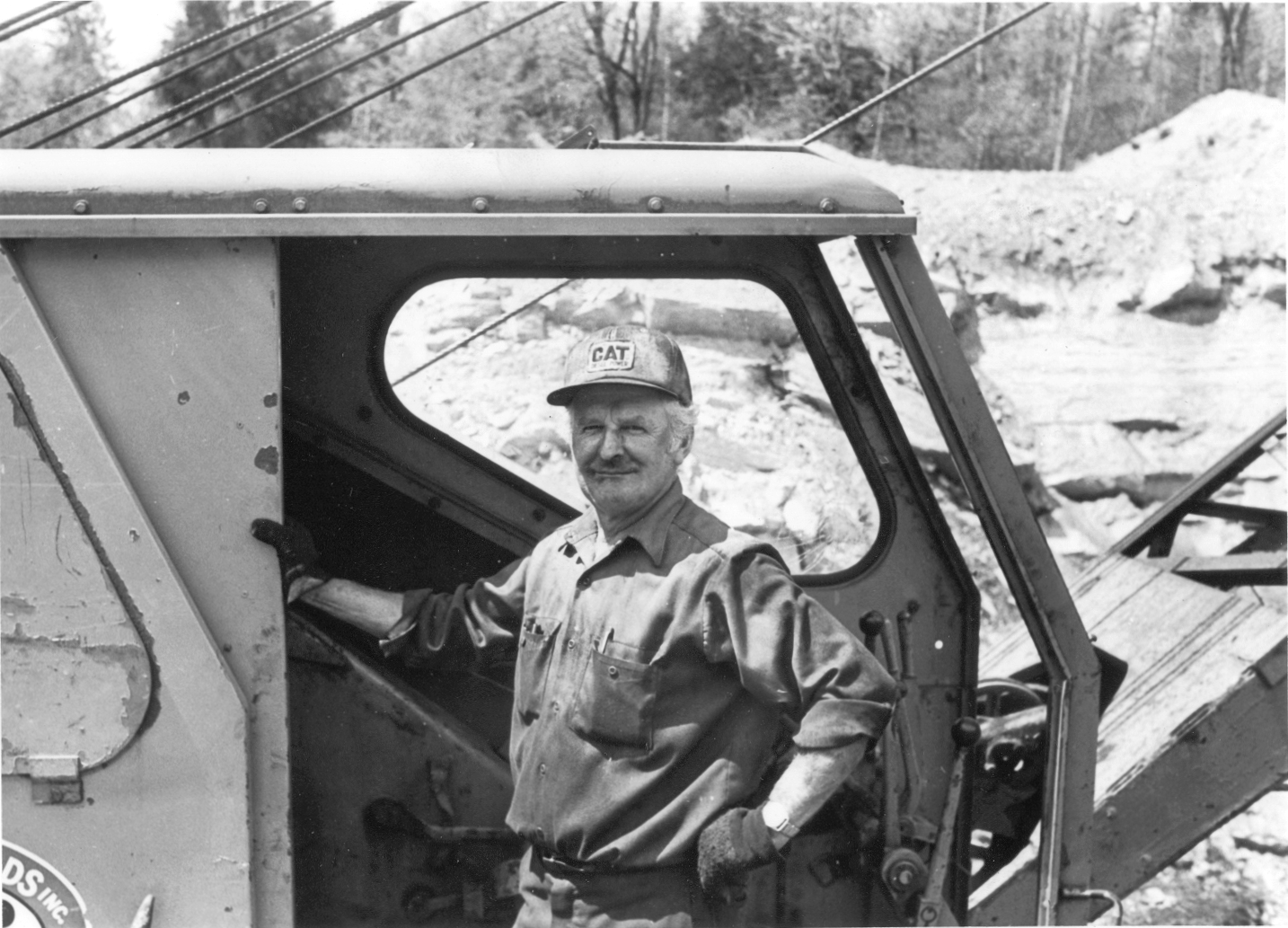
In this 1977 photo on Franklin Hill, east of Black Diamond, Jack Kombol stands beside the dragline he operated for Palmer Coking Coal (Palmer) at the McKay-Section 18 surface coal mine.  The Koehring 405 had an excavating shovel bucket to move overburden and extract coal.  The light-colored rock in the background was the sandstone bedrock laying above and below the McKay coal seam that tilted at about 45 degrees to the surface.  This photo comes courtesy of Lou Corsaletti, who authored several articles about the coal industry in southeast King County.

After closing the last underground coal mine in Washington, Palmer began surface mining this seam to supply Washington State with fuel to heat institutions like the Shelton Correction Center, and Monroe Reformatory.

Jack Kombol was born at his family’s rental home in the tiny and short-lived town of Hiawatha.  The homes were provided by Northwest Improvement Company (NWI) to house workers at their Hiawatha coal mine located midway between Kanaskat and Kangley.  The mine was designed to replace the Ravensdale Mine, whose Nov. 16, 1915 explosion claimed the lives of 31 miners.  Jack’s father, Tony Kombol, worked at the Ravensdale mine but was sent home early that dreadful Tuesday.  Like many unemployed coal miners, Tony Kombol left Ravensdale and found work in Arizona and Montana copper mines.  Jack’s mother, Lulu (Shircliff) Kombol, was a Ravensdale school teacher who similarly lost her job.

The growing Kombol family returned to Washington in early 1919, when Tony rejoined NWI at their new Hiawatha mine.  However, the mine was riddled with problems and dangers.  Two miners, Joseph Ripoli, Italian, and John Panotas, Greek, suffered fatal accidents during the mine’s brief five-year history that produced meager amounts of coal.  Tony Kombol, who at age 17 emigrated to the U.S. from Croatia in 1902, soon found work at the nearby Parkin Kangley Coal Company mine.  It was located less than a mile north of the Hiawatha home that the family of seven continued to rent from NWI.

On August 7, 1925, Tony Kombol was severely disabled when an errant dynamite explosion blinded him at the Parkin Kangley mine.  He spent 30 days in the hospital but couldn’t return to work due to a full disability for which he received a $40 monthly pension plus a $35 monthly stipend for five children, all under the age of 10.  Lulu Kombol returned to work as a school teacher in Selleck and Cumberland to support the family.

A year or so later his second son, and fourth child, Jack contracted polio at age six or seven forcing an absence from school that lasted nearly two years.  After recovering, one of Jack’s legs was shorter than the other.  He attended Selleck school through the 8th grade then went to Enumclaw High School.  Being two years older than fellow students and not particularly academic, he dropped out during his junior year.

Because of a polio-shortened leg, Jack was unfit for service during World War II and moved to Seattle where he drove garbage, tanker, and tow trucks.  After the war, he primarily worked in the woods where he drove log trucks and operated equipment for his brother’s logging company, Bernell Kombol & D.L. Holcomb, and at his cousin-in-law’s firm, Woodrow Gauthier of Gauthier Brothers Lumber and Logging.

Kombol found a new logging job in Northern California and relocated there in early 1950.  Pauline Morris, an Enumclaw girl whose father and uncles owned Palmer Coking Coal, soon followed.  The couple married in Crescent City later that year.  Jack joined Palmer in 1952 and worked for the company until his death in April 1979 at age 57.

Jack and Pauline’s son, Bill Kombol began writing “When Coal Was King” in May 2007.  The position evolved after his youngest son’s Cub Scout troop visited the Maple Valley newspaper, Voice of the Valley.  There, Bill learned that the publisher had recently lost a columnist and volunteered for the job.

And the rest, as they say, is History.

This story originally appeared in the July 17, 2023 issue, Voice of the Valley, which would have been Jack Kombol’s 103rd birthday.


Categories
Musings Uncategorized

International Bill Wheeler Appreciation Day

Not often enough does one realize how high Bill Wheeler once leaped.  He’s shown here in the Chuck Smith gym 55 years ago during a game his Enumclaw Hornets basketball team lost to Fife.

But Wheels as he later came to be known kept winning the hearts of those who knew him well.  Following graduation, Bill’s talents were bigger than his hometown’s needs and first landed at Big Bend C.C. where he was going to learn to fly, then to Ellensburg to further ground his education.  At Central Washington College he studied how to become a wild cat, and succeeded wildly.  There he gained the nickname Wheels in a story so fantastic that it can only be told over a cold beer as he brings a smile to your face.

A forever friendship was forged when Bill Wheeler (in plaid pants), Bill Kombol, and Keith Hanson took a week-long road trip to Reno, Disneyland, and Big Sur in Eugene Wheeler’s Lincoln Continental Mark IV.  This late November 1975 photo by Pauline Kombol at 1737 Franklin Street, Enumclaw, Washington.

After schooling, ranching, and the passage of time, Wheels returned to his home town to mold the life he sought to build.  There in the seat of every imaginable piece of heavy mobile equipment, Bill sculpted the earth, buried utilities, excavated customer’s dreams, and thrived.  He soon became the second letter of S & W Construction, learning much from his first letter partner, Sam Schaafsma.  But a first-rate man demands his own dominion, and it wasn’t long before Wheeler Construction was born.

Bill Wheeler compares Operating Engineer union cards with 99-year-old Cal Bashaw, left (Oct. 24, 2019). The Wheeler and Bashaw families both moved from Alaska to Enumclaw in 1965, after which Bill became good friends with Cal’s son, Wynn.

Requiring further refinement in the finer arts of life, Bill placed a ring on the finger of a fiery, red-haired, Scots-Irish lass of clever tongue and semi-sweet disposition.  Children were born and a fine home built.  In time the wheeling wild cat was tamed, but how long it took no one has yet stated with certainty.  What skills he lacked on the golf links he more than made up for at job sites moving enough dirt with backhoes, bulldozers, graders, and dumptrucks to build a dozen golf courses.  At the poker tables, he’s always a threat, but mostly to his own wallet.

Throughout it all, Bill Wheeler has remained as devoted to friends as he is to his adopted hometown of Enumclaw where he arrived in the 7th grade.  Legions number the good deeds and generous gifts of time, labor, equipment, and materials that Bill has donated to his community.  Of late he’s even found a new girl in his life and spends hours playing handsome prince to a charming Princess Lucy.

So in a Leap of Faith with hopes that others second this emotion, I hereby declare February 29th as International* Bill Wheeler Appreciation Day, to be celebrated once every four years by people just like you and me who appreciate the finest things in life.  As for the other 365 days . . .  may God bless Bill Eugene Wheeler.

* International due to his mother, Pat Wheeler’s Canadian heritage.

Bill Wheeler enjoying a cup of black coffee and blackberry cobbler at a Jan. 7, 2023 Pokerque with his longtime Enumclaw pals.
Categories
History

Tony and Lulu’s Story

Their stories began in 1885.  That January, a baby boy was born in Fuzine, Croatia.  His name was Anton Kombol, the same as his father. When baby Anton was born, Croatia was a provincial kingdom within the Austro-Hungarian Empire.  Fuzine is a village in the Primorje-Gorski-Kotar region about six miles from the coast, but 2,400 feet above sea level, and 30 miles from the largest regional city of Rijeka.

Little is known of Anton’s early life in Fuzine.  Though he was Croatian by birth, the Kombol family surname derived from French immigrants who first settled in the region during the Napoleonic era.  The earliest recorded birth of a Kombol in Croatia was Ivan born to Martin and Ana Kombol about 1810 in the village of Bribir, around 20 miles southeast of Fuzine and near the coast.  Ivan married Matejka Grenko, while his son, Anton married Franciska Mihaljevic, baby Anton’s mother.

A 1968 postcard photo of Fuzine, Croatia.

Through actions at the 1815 Congress of Vienna after the fall of Napoleon, this area of Croatia was absorbed into the Austrian Empire and later the combined empire jointly administered with Hungary. The primary local industries were woodworking and furniture-making.  As Anton grew towards adulthood that would be his likely future if the Austrian army didn’t call first.

Over 5,000 miles west, baby Lulu’s prospects seemed bright.  The Brown family was well respected and her mother, Jennie Brown at age 17, was noted as “one of our most attractive young ladies.”  Walla Walla, with a population of 3,500 was the largest city in Washington Territory.  Lulu’s father, William Shircliff had recently returned from expeditionary explorations in Alaska, then secured the respected paymaster position at the nearby Army fort.

The couple married on a Thursday evening in early June at the home of Jennie’s parents, Horace and Sarah Brown.  The wedding announcement in the Walla Walla Journal noted that “the groom is clerk to Major D. R. Larned, paymaster, U.S.A., and is one of the finest and most promising young men in existence.”  Mr. and Mrs. Shircliff began housekeeping two days later in a house at the corner of Birch and Seventh Streets.  Shocking for the time, just 10 weeks later a baby girl was born and christened Lulu Mildred Shircliff.

Jennie Brown and William Shircliff, well before their wedding day when she was nearly seven months pregnant.

William Shircliff left Walla Walla the following March, seven months after his daughter’s birth.  He traveled to San Francisco where he was stationed at the army garrison, with promises to soon send for his wife and baby girl – a pledge he never kept.  Jennie pleaded with her husband for money so she and Lulu could move south and join him.  Shircliff ignored her entreaties, so she filed divorce proceedings upon which he was ordered to pay child support.  There’s no record of whether Shircliff paid or not, but within two years he moved to Washington D.C.  As far as we know, Lulu never again saw her father.

Lulu Shircliff as a baby in Walla Walla, 1886.

Three years later Lulu’s mother, Jennie remarried and moved onto Ransom Holcomb’s farm on the Cowlitz River south of Toledo, Washington.  Lulu remained in Walla Walla with her grandmother until age 11, when she joined her new family and two baby brothers, Ransom and Wyman, 10 and 13 years her junior.  Far from the active world of the small town she’d known in Walla Walla, on the farm Lulu experienced an old-fashioned life in a remote but exciting place – a farm filled with cows, pigs, ducks, goats, and chickens.  The farm produced eggs, cream, cheese, milk, and hay, all of which were used to sustain the family and farmhands with excess sold to Portland merchants downstream.

Farm life was busy with Lulu assisting her mother in making hearty breakfasts for her stepfather, uncle, and hired men.  After breakfast, animals were fed and chores began.  Milk was skimmed and the thick cream churned to butter.  Crocks and milk pails were meticulously washed in hot soapy water and then placed on slotted shelves to dry.  The remaining hours were spent baking bread, making cheese, and doing typical chores like ironing, sewing, and cleaning.

The farm was self-sufficient except for staples such as green-bean coffee which they hand roasted.  Most foodstuffs were grown on the farm: potatoes, carrots, turnips, pumpkins, oats, and wheat.  The family’s orchards supplied fresh produce in season, with the majority canned to provide fruit for the rest of the year.  Bee hives pollinated spring blossoms and provided honey for the family. Evening hours were short and illuminated by oil lamps.  Early to bed was only occasionally delayed by card games, reading books, or singing as her mother played guitar.

During the school year, Lulu walked about a mile each way.  There in a one-room schoolhouse, 15 or so students of all ages were taught.  Later when attending Chehalis High School, Lulu moved away from the farm because the commuting distance was too far.  She boarded with different families the first year, then rented an apartment with another farm girl her junior and senior years.  The Chehalis Superintendent, Mr. Thompson encouraged her to pursue a teaching career and allowed Lulu to miss classes anytime a substitute was needed.

Lulu Shirclifff sporting a large white bow, 2nd row, 2nd from right with her 1904 graduating class.

After graduation, Lulu’s future brightened.  A vacancy in grade school landed her a series of full-time jobs, albeit with limited credentials.  In 1906, her stepfather traveled to Alaska where he suddenly died.  Ransom Holcomb was always interested in Lulu’s education and had left her money for that purpose.  The following September, Lulu enrolled at the Teacher’s College in Bellingham where she earned a teacher’s certificate.

Meanwhile, back in Croatia, Anton was anxious about life.  The following year he’d turn 18 and risked being drafted into the Austrian army.  Two older brothers, John and Matt had emigrated to Roslyn and found work in coal mines with good wages.  So Anton decided to leave his family and village behind to join his brothers in America.

Anton traveled to the port city of Rijeka embarking on a steamer to Le Havre, France.  He crossed the English Channel to Southampton where he boarded the St. Louis on a nine-day voyage across the Atlantic that landed him on New York’s Ellis Island.  The next day, this 17-year-old boy who spoke no English, boarded a train for a five-day trip across the country.  On Christmas Day 1902, Anton rode that train carrying a loaf of bread and a promise of what his future might hold.  Within a month, he turned 18 and was working in a coal mine.

Matt, John, and Anton Kombol in the early 1900s, likely in Rosyln.
Both Tony and Lulu move to Ravensdale

Their worlds grew closer in 1908 – a pivotal year for both.  After laboring six years in Roslyn’s coal mines Tony, as he came to be known moved to greener pastures in Ravensdale.  There he worked for the same company as in Roslyn, the Northwest Improvement Company (NWI).  It was owned by the Northern Pacific Railway whose locomotives burned millions of tons of black diamonds every year.  That year, Tony also submitted his declaration to become a U.S. citizen.

Deciding a teacher’s pay in Centralia was not sufficient to her tastes, Lulu chose a job in Ravensdale where the best wages were paid.  This was probably because it was an unruly mining town, lacking middle-class families and culture, so coal companies needed to pay top wages to attract the young women who increasingly filled the ranks.  There she boarded at reduced rates with families who valued the literacy a teacher brought into their homes.  Convenient rail access also provided Lulu with opportunities to attend top plays and musicals in Tacoma or Seattle, where she traveled on weekend excursions and stayed with friends.

Lulu Shircliff, with her class of Ravensdale school children, 1913.
Tony Kombol, upper right with the Northwest Improvement Company bunker crew, 1913.

How Tony and Lulu met is lost to time.  But it wouldn’t be difficult in a town of 725, according to 1913 census figures.  In June 1914, Tony purchased a plot of land just north of Kent-Kangley Road and built a home for his soon-to-be bride.  They exchanged wedding vows on August 4th.  The newlyweds were 29 years of age, gainfully employed, and seemingly settled into a good life.

Tony Kombol in front of the home he built, 1914. The home still stands at 27521 S.E. 271st St., Ravensdale, WA 98051.

A few days before their nuptials, Austria-Hungary declared war on Serbia.  Then France and Germany declared war against each other setting in motion the start of World War I.  Had Tony still lived in Croatia, he would have been drafted as Austria mobilized.  By the war’s end, 20 million lay dead with another 21 million wounded.  The 1919 Treaty of Versailles created a new country called Yugoslavia, meaning South Slavs, formed from Serbia, Croatia, Slovenia, Bosnia-Herzegovina, Macedonia, and Montenegro.

Fifteen months later, on November 16, 1915, their happy home was shattered by a mine explosion that claimed 31 miners’ lives.  The Ravendale tragedy was the third worst coal mine disaster in Washington state history. The mine was utterly destroyed by the deadly blast, and the company had little interest in reopening.  Tony might have been lost as well if a blown fuse hadn’t crippled the hoisting machinery that brought coal to the surface, sending 100 miners home that morning.

Ravensdale mine explosion that killed 37 miners, Nov. 16, 1915.

Miners left Ravensdale in droves.  With the abrupt termination of over 230 mining jobs, there was little value in the new home Tony had built for his bride.  By 1920, Ravensdale’s population fell 75% to 187 residents.  Most left town in search of new jobs.

To Arizona and Montana, then back to Washington

Tony left for Arizona the next month and Lulu followed a few months later, probably at the end of the school year, though enrollment had no doubt fallen precipitously.  In Ray Arizona, Tony found work in the copper mines.  The couple also saw the birth of their first child in June 1916, a baby boy they named Bernell.  A year later Montana beckoned with yet another copper mining job and yet another baby this time a girl named Dana born in March 1918.

Looking for new opportunities Tony left for Alaska but stopped in Washington to see William Reese, the Northwest Improvement mine superintendent with whom he was friendly.  NWI was the company Tony had worked for since coming to America.  It was opening a new mine to be called Hiawatha, located about five miles east of Ravensdale.  Tony agreed to join the effort.  Since NWI had not yet moved homes to Hiawatha to house their employees, Tony took up residency in Durham.  Lulu soon arrived and the following year so did their third child, Nola born in Aug. 1919.

As miners dug the tunnels and built the surface facilities to mine coal, NWI moved or built about 20 company houses in Hiawatha.  Tony and Lulu’s fourth and fifth children, Jack and Nadine were born at home in July 1921 and August 1923.  One of those Hiawatha dwellings became the family’s home for the next 50 years.

In a strange twist of fate, the Morris Brothers Coal Mining Company incorporated in Dec. 1921 and shortly thereafter purchased the entire town of Durham – the mines, bunkers, houses, and hotels.  All of the large and extended Morris family who had lived and mined coal in the Pierce County town of Wilkeson since 1894 moved to Durham.  With Durham less than a mile south of Hiawatha, it was inevitable that Morris and Kombol children would attend the same Selleck and Enumclaw schools and romp through the same neighborhoods.

A map of Durham with each Morris family home and the homes of miners identified.  Some of the miners followed the Morris family from Wilkeson.

The Kombol family glided along smoothly on Tony’s wages from mining coal while Lulu, who had quit teaching after the Ravensdale disaster tended to five small children.  But, 1925 threw the Kombol family a nasty curve ball.  An errant dynamite shot exploded in Tony’s face blinding him completely and speckling his skin with tiny bits of coal.  Though an operation partially restored his sight, he could no longer work in the coal mines but only perform chores around home.  Tony became Mr. Mom to five children under the age of 10, while Lulu went back to work as a school teacher.

Times were tough but the Kombols soldiered on

Their Hiawatha home was small and located on land owned by Northern Pacific Railroad under a 99-year lease.  The main floor measured just over 1,000 square feet with two bedrooms and a sleeping porch upstairs accessed through the back bedroom.  There was a basement underneath with a barn in a field out back.

The seven family members shared rooms as the children grew to adulthood.  They even welcomed relatives, like Rose Kombol who left Roundup, Montana, a small mining community where Tony’s brothers, John and Matt had relocated.  Rose moved west at age 16 and worked at the nearby Durham Hotel, managed by Jonas and Maggie Morris, whose only son, George was a year older than Bernell Kombol.  Rose later married Woodrow Gauthier, a logger and sawmill operator, whose partnership with his brother, Joe Gauthier employed Jack Kombol on numerous occasions during the 1940s and early 1950s.

Jack Kombol and Rose Kombol, planting a tree, 1939.

Times were tough as both the local coal mines and sawmills were subject to economic downturns when commodity prices fell.  The 1929 stock market crash precipitated a Great Depression that persisted through most of the 1930s.  Then in 1939, the Pacific States Lumber Company which owned the town of Selleck was unable to meet its financial obligations and saw all of its land, buildings, lumber, and railroad lines seized by the IRS for nonpayment of taxes.

The following year, former mill employees, Lloyd Qually Sr. and Gust Coukas bought the company out of bankruptcy for just $3,000, when no other bids were submitted.  Qually and Coukas dismantled the mill buildings and salvaged the equipment.  Later Lloyd Qually and his wife, Lucille, who taught school with Lulu, fixed up Selleck’s old company homes and rented them out.  One of those Selleck dwellings became Jack and Pauline’s first home soon after their son, Barry was born.

Four of the five Kombol children graduated from high school, except Jack who quit during his junior year.  In chronological order, Nola married Chester Fontana, Bernell married Helmie Sandberg, Dana married Frank Zapitul, Nadine married Joe Silversti, and Jack married Pauline Morris.

From which 11 grandchildren were born, all of whom were present when Tony and Lulu celebrated their 50th wedding anniversary in early August 1964.  Lulu, who went back to teaching after Tony’s mine accident, taught school for 44 years and didn’t retire until 1965, the year she turned 80.  Tony passed away on Sept. 21, 1967, the end of a 53-year marriage.  Collectively, the six Kombol couples logged 290 years of marriage.

Their 50th wedding anniversary. Seated: Dana, Tony, Lulu. Standing: Jack, Bernell. Kneeling: Nola, Nadine. Sunday, Aug. 2, 1964.

Less than a year after Tony’s death, Jack and Pauline Kombol with Barry, Bill, Jeanmarie, and Danica in tow, traveled to Europe for six weeks, including a six-day stop in Yugoslavia.  The Kombols visited Jack’s relatives in Rijeka, Fuzine, and Pula, Croatia.  A few weeks later, they traveled to see Pauline’s relatives in Chepstow, Abertillary, and Nant-y-moel, Wales.

Jack Kombol with his cousin, Stefica Roksandic in Pula, June 10, 1968.

Lulu survived Tony by nearly a decade.  She moved out of the family home in early 1974, living her remaining years with daughter, Nola whose husband Chester Fontana died in April 1971.  Barry and Cathy Kombol moved into that Hiawatha home in May 1975 with their recently born daughter, Meaghan.

To My Family

After moving to the Lake City home where Nola had lived since 1940, Lulu began writing her autobiography.  “To My Family” was published on Aug. 27, 1974, her 89th birthday.  Lulu passed away on January 19, 1977, at the age of 91.

Thirty-four years later in 2011, her grandson, Bill Kombol obtained the original transcript of the memoir from Nadine.  On passages written about her father, Lulu scribbled out everything she’d written after receiving an official government document that William Shircliff completed where he failed to list her as his child.

Bill’s extended version was nearly twice as long as the original.  It also included 61 detailed footnotes and 26 photos of Lulu.  A nearly identical version (without photos) of Lulu Kombol’s “To My Family – Extended Version” appears on the Washington state history site, HistoryLink.org.

The Kombol family assemble in Renton for Bill & Jennifer’s wedding reception. Front row kneeling, L-R: Angie Beck, Brendan Kombol, Nolan Kombol, Cara Kombol.  2nd row seated: Eric Brough holding Kyle Brough, Jeanene Brough, Pauline Kombol holding Miranda Lewis, Nadine Silvestri, Dan Silvestri, Corre Kombol, Joe Silvestri holding Lindsey Brough.  3rd row standing: Nola Fontana, Meaghan Kombol, Bernell Kombol, Helmie Kombol, Todd Kombol, Karrin Kombol, Bill Kombol, Jennifer Kombol, Darlene Fontana, Jeff Kombol, David Lewis, Danica Kombol in front of Gerry Beck, Cheryl Beck, July 28, 1990.

Tony & Lulu’s Story was adapted from the eulogy I read at Aunt Nadine’s funeral in October 2019. – Bill Kombol, Sept 21, 2023


Categories
Uncategorized

July 5, 1953

July 5, 1953 – Baby Billy’s Birth

Seventy years ago today, Pauline Kombol bore her second son.  Twelve months earlier, she buried her first daughter.  Paula Jean lived for but two days.  Paula’s father, Jack was sad.  Pauline was devastated.

Paula Jean’s gravestone is in the Enumclaw cemetery 50 feet from her parents.

Just over a year later, the Kombol family gathered at Lake Retreat for their annual Fourth of July picnic.  By late afternoon, Pauline’s father-in-law, Papa Tony Kombol had indigestion that he blamed on the baked beans. The next day after hearing Pauline had her baby, Tony, in his distinct Croatian accent said, “It must have been the beans.”

The boy was delivered on a Sunday at 5:04 pm at Seattle’s Doctor’s Hospital by Dr. Albert Lee with nurse, Anne Green in attendance.  A year and one day later, on July 6, 1954, Pauline welcomed his baby sister, Jeanmarie into the world.  For Billy and Jeanie Kombol, born on the 5th and 6th of July, Independence Day would always be the kickoff to their birthday celebrations.

As Pauline rested comfortably, her dad, John H. Morris stopped by to ask what she planned to name her son.  Pauline had spent so much of her pregnancy praying for a healthy baby, that she’d given little thought to a name, either boy or girl.  The boy’s grandfather, John H. Morris provided the answer – his first name would be William, in honor of his  brother, Bill Morris, and the middle name, John, after him.  In 1982, that baby boy, William John Kombol assumed the same position as head of the family company, that his grandfather held for the first 30 years, following Palmer Coking Coal’s founding in 1933.

As Pauline held her 7-pound, 12-ounce baby, she saw his eyes were blue and his hair was brown.  The ‘Kombol, Boy’ record completed by Nurse Green listed his length at 20.5 inches with a head circumference of 13.5 inches.  Billy, as he came to be known spent the first week of his life at Doctor’s Hospital, whose original façade and entrance at 9th and University is now a part of the Virginia Mason Medical Center on  First Hill.  The bill for the delivery, anesthesia, nursery, pharmacy, and lab work, plus a six-day hospital stay came to $193.40.

The hospital invoice shows details of Pauline and Billy’s six-day stay in the hospital.

Letters of congratulations poured in from Aunt Nancy & Uncle Bill Morris (his namesake); Lloyd & Lucile Qually; Palma Weflen, Yvonne & Keith Grennan; Rose & Woodrow Gauthier; Wilfred & Wilma St. Clair; Marian Dahl, and Aunt Ruth Forest.  Pauline’s mother, Marie mailed her a letter every day.  Pauline kept all of them.

That week’s visitors to the hospital included his Grandma Marie & Grandpa John Morris; Aunt Nancy Morris, Aunt Nola Fontana, Aunt Alice & Uncle Jack Morris; Palma Weflen, Lucile Qually, Grandma Lulu Kombol & Aunt Dana Zaputil; plus Billy Guerrini with his Daddy, Jack.  Bill Guerrini was a close childhood friend of Jack back in their Kangley days.  Guerrini often told the story that Jack’s son was named after him.

The baby record completed by the hospital nurse with Baby Billy’s footprints. The booklet had several pages.

On July 11, Pauline and baby Billy left the hospital and traveled several miles north to Aunt Nola’s home in Lake City.  That Saturday night, Jack picked Pauline and Billy up driving them to the family’s rental home in Selleck.  By Monday morning, Jack was back at work as a truck driver for Palmer Coking Coal.

Pauline poured all her love into the baby boy at that small Selleck home.  It was built in 1912 to house workers of the long-since-closed sawmill. There she nurtured and cuddled Billy to ward off a repeat tragedy and heal the loss of Paula Jean.  So, all the love she hadn’t buried with Paula was invested in Billy.

And that’s how William John Kombol grew up, surrounded by love and affection.  As that grown boy writes another chapter in his story of scenes from a charmed life.

Pauline with Billy in the living room of their Selleck home, his milk bottle on the lamp-stand, Sept. 1953.

Who’s who among those named:

Pauline Lucile Morris (1927-2011) – Pauline was born the 4th of four children to John H. Morris and Nina Marie Morris.  Both of her parents were children of Welsh coal miners named Morris who immigrated to America.  She grew up in Durham, the coal mining town where so many of her Morris uncles and aunts lived, as did dozens of miners and their families.  Pauline moved to Enumclaw at age six, graduated from EHS in 1945, and married Jack Kombol in late 1950.

Laverne Shercliffe “Jack” Kombol (1921-1979) – Jack was born the 4th of five children to Tony Kombol and Lulu Shircliff.  He was struck with polio at age six so didn’t attend school for two years.  Jack dropped out of high school at age 19 and moved to Seattle where he lived with his sister, Nola, and drove trucks for the garbage companies.  He bounced around at a number of jobs but mostly worked in the woods driving logging trucks and running equipment.  Jack joined Palmer Coking Coal Co. in June 1952, the same month Paula Jean died.  He died of pancreatic cancer at age 57.

Paula Jean Kombol (1952-1952) – Paula died two days after birth and is buried in the Enumclaw cemetery about 50 feet from her parent’s grave.

Tony Kombol (1884-1967) – Jack’s father, Tony emigrated from Croatia at age 17 and made his way to Roslyn where he joined two brothers as coal miners. Tony worked at the Ravensdale mine, avoiding the 1915 explosion that claimed 31 lives.  The family moved to Arizona and Montana where he worked the copper mines before returning to Washington.  A 1925 explosion nearly blinded him and he could no longer work.  For the next 42 years, he kept track of their small farm and worked around the home.

Lulu (Shircliff) Kombol (1885-1976) – Jack’s mother, Lulu was born in Walla Walla to Jennie Brown, age 17 who was seven months pregnant.  Jennie married William Shircliff, an Army paymaster clerk, who abandoned his wife and daughter after eight months of marriage.  Lulu’s mother remarried and she grew up on a Cowlitz River farm.  Lulu attended Bellingham Normal School attaining her teacher’s certificate and eventually moved to Ravensdale where teachers were paid more.  After bearing five children, she went back to teaching, primarily in Cumberland and Selleck schools after Tony’s mine accident  In total, Lulu taught for more than 50 years before retiring at age 80.

John Henry Morris (1894-1973) – Pauline’s father was born in Wilkeson into a large family of coal miners.  John’s mother and father emigrated from Wales shortly after their marriage.  His father and brothers all worked in the coal mines, eventually rising through the ranks and starting their own coal mining company, then a second named Morris Brothers. John with three brothers and one investor started Palmer Coking Coal Co. in August 1933, during the darkest days of the Great Depression.

Nina Marie (Morris) Morris (1890-1967) – Pauline’s mother was born in the coal mining town of Franklin.  Her father, Joshua was a coal miner who in 1880 was on the prospecting party that discovered coal seams in the Green River Gorge that led to the establishment of Black Diamond and Franklin.  Shortly after Marie’s birth, the family moved to Osceola where Joshua farmed in the summer and mined coal in the winter.  Marie and her two sisters, Lena and Ruth graduated from Buckley H.S. and all three become school teachers. She met John while teaching in Wilkeson where he was working in the coal mines.

Uncle Bill Morris (1897-1979) – William “Bill” Morris was the closest brother to John H. Morris, thus a great uncle to his namesake, Bill Kombol.  Bill Morris was a jack-of-all-trades around the coal mines, working primarily on the surface in the preparation plants.

Aunt Nancy (Boots) Morris (1899-1969) – Nancy and her husband Bill lost two children, each of whom died shortly after childbirth.  Great Aunt Nancy often babysat the Kombol children in their Four Corners home.

Lloyd & Lucile Qually – Lloyd was the head mechanic for Pacific States Lumber, the company that owned the town of Selleck.  He held that job until the mill closed in 1939.  Lucile was a school teacher with Lulu Kombol at the old Selleck School that burned down in 1929.  Eventually, they lived in the town’s biggest home, once occupied by Frank Selleck.  The Quallys were good friends of Jack and Pauline.

Palma Weflen – Census records show she was a 55-year-old widow and nurse living with a family in Seattle. Most likely she was a kind of a midwife to Pauline.

Yvonne (Cross) & Keith Grennan – Yvonne was one of Pauline’s best friends from high school.  Her husband Keith was a brother to Dolly (Grennan) Fugate another of Pauline’s good friends.

Rose (Kombol) Gauthier (1920-2001) was Jack’s first cousin who moved from Roundup Montana when she was 16 to live with the Kombol family in Kangley.  She went to work at the Durham Hotel, which was managed by Jonas and Maggie Morris, John H., and Bill Morris’ older brother.  Rose married Woodrow Gauthier (1913-2001) (pronounced goat-chee), a logger and later a sawmill owner.  Jack worked for Gauthier Brothers Lumber & Logging Co. on and off for 10 years.

Wilfred & Wilma St. Clair were next-door neighbors to the home of Tony & Lulu Kombol, and friends with Jack & Pauline.  Two of their sons, Bill and Dick St. Clair often played with the Kombol boys.

Marian Dahl (1912-2005) was Pauline’s cousin, though almost a generation older.

Ruth (Morris) Forest (1892-1968) was Pauline’s aunt and Nina Marie Morris’ sister, hence Bill’s great-aunt.  She was born on the Fourth of July.

Jack Morris (1918-2007) was Pauline’s brother and Alice (Hanson) Morris (1920-2016) was his wife, hence Bill’s uncle and aunt.

Dana (Kombol) Zaputil (1918-2012) was Jack’s oldest sister, married to Frank Zaputil (1914-1984), hence Bill’s aunt and uncle.

Nola (Kombol) Fontana (1919-2017) was Jack’s older sister, married to Chester Fontana (1916-1971), hence Bill’s aunt and uncle.  Chester’s Fontana relatives, who during Prohibition were involved in bootlegging gifted Chester & Nola their Lake City home in 1940.  When Jack moved to Seattle to drive garbage trucks during the war years, he stayed at Chester and Nola’s Lake City home paying for his room and board.  Twenty-five years later, when Bill took a bank job in Seattle he stayed with his Aunt Nola and paid her for room and board.  Nola lived in that home for 77 years before dying there in 2017.

Billy Guerrini, at age 97 is still alive and lives in the family home in Kangley.  Jack was best friends with his brother Martin “Fats” Guerrini, but after Fats died during WW-II, Jack and Billy became close friends.  When Jack drove to the hospital to see his new baby boy name Billy, Billy Guerrini came in with him.

Categories
Musings

Living London’s Life – 1978

While traveling through Europe that year I’d set a tight budget: $10 per day, excluding travel.  In London, this tiny allowance would be tested.  The first night I tramped about Kings Cross station looking for economical accommodations.  Most were at prices that fully consumed my budget goal.  I chose the cheapest of the lot and the next day scoured classifieds looking for something under $5 per day.  I avoided hostels,  to be free of Americans with Eurorail passes moving about in herds.  There were a hundred too many young Yanks, each backpacking through Europe with indeterminate plans to some day attend grad school when back home.  They simply didn’t interest me.  I wanted to live among locals.

A boarding house in northeast London at  Highbury & Islington at £2.50 a night caught my eye.  The exchange rate of $1.85 per pound was favorable, so the room came to a frugal $4.65 per night.  It also included a full English breakfast, so that would cut down on food costs.  I had a private room with a free-standing tub, sink, high ceilings, and water chamber down the hall.

I kept the 1978 map of the London Underground.

The building was a sprawling Victorian affair, a bit shabby and nearly a mile from the tube stop, which meant there were no tourists in sight.  In fact, the boarding house only accepted men, mostly tradesmen and laborers. Breakfast was served from 5:30 to 7:30 am in a drab, low-ceiling basement. We sat on benches at heavy wooden tables hunched over our hot breakfasts.  It was the same every day: runny baked beans, greasy bacon, stewed tomatoes, bread toasted on one side, butter, marmalade, cornflakes, tea, juice, and coffee, all served cafeteria style.  There was little conversation.  Men of all ages sat sullenly contemplating another day’s labor.  It was fine by me.  I rose early, ate the hearty fare, and was out the door for my day’s adventure.

Soon after arriving, I read about a free concert at Victoria Park in east London.  There were expected to be 80,000 fans to march from Trafalgar Square to Rock Against Racism, as the event was known.  After observing the masses at Trafalgar I’d hopped the tube to the park.  In early 1978, punk music was pretty new.  I considered England’s biggest act, the Sex Pistols to be dreadful.  But, the Clash were different – talented musicians with inventive lyrics, good melodies, and two front-men, Joe Strummer and Mick Jones who rocked with the best of them.

The Clash performing in Victoria Park before 80,000 on April 30, 1978.

I sidled my way up front near the stage.  When the Clash performed mobs of young men jumped up and down some with violent intent.  From its resemblance to a pogo stick, Pogo-ing soon became a verb.  I joined along, but the most rambunctious of the pack swung heads and fists so violently that I beat a quick retreat to safer spaces along the edge.   Also on the Rock Against Racism program that day were: the Tom Robinson Band (political rock); Steel Pulse (reggae) and X-ray Spex (punk), with only TRB being any good.

During most days, I’d visit museums, galleries, historical monuments, fashionable squares, parks, and vibrant districts.  Hyde Park, Speaker’s Corner was always a hoot, like the half-bearded wit who entertained the crowd for an hour.  Towards early evening I’d gravitate to areas with cheap restaurants to peruse menus, looking for the best prix fixe value for a multi-course meal.  Those deals were usually found in immigrant districts so I often dined in Indian, Pakistani, or Middle Eastern joints.

This witty, half-bearded guy entertained the crowd at Speaker’s Corner for nearly an hour.

I typically planned an evening’s entertainment and often joined the London Walks around famous neighborhoods.  These walks had names like Sherlock Holmes’s Baker Street or the Secret World of Jack the Ripper.  You’d meet the guide at a pub.  Then a dozen or so tourists followed a well-spoken Brit who guided us through the streets of London relating topical stories with anecdotal stops at key points.

At the end of the typical 90-minute tour, most of the crowd topped off their evening with a pint or two in the pub where we’d first met.  Some nights I’d catch a music performance, some freely presented in a club or church.  I saw a bit of theater, the one to remember being Agatha Christies’ “Mousetrap,” the world’s longest-running play  having been continuously performed since 1952.  I’d hope to have seen more theater, like my literary hero, Somerset Maugham did when he was a youth 80 years earlier, but ticket prices were far higher than those days when Maugham paid pennies for a show.

Afterward, I’d catch the tube back to Islington & Highbury station for the long walk home under lamp lights to my boarding house. Sometimes the station was filled with festive, red-garbed Arsenal soccer fans, as the football stadium was a 15-minute walk.  Sometimes one’s thoughts conjured dire images of walking home alone at night in a foreign city.  But fortunately, this area hadn’t much cause for concern as few people were out late, and the ones that were had work in the morning.  Still, I stayed alert as getting jumped was never far from my mind.

One night whilst on a London Walk, I met a young Brit about my age who told me Queen was playing at Empire Pool (now Wembley Arena).  The thought of spending a night at the opera with Freddy Mercury and Brian May was enticing so plans were made to meet at a certain time and place outside the arena.  The bloke never showed so I bought a ticket (£2.50) and found myself witnessing one of the greatest performing bands of all time.  Queen rocked most all their hits, including eight songs from “Night at the Opera” and some lesser-known personal favorites like “39” and “Love of My Life.”

I kept my Queen ticket stub. At then exchange rates, £2.50 came to about $4.65.

My favorite hobby was reading London newspapers. Newsstands were everywhere, and it was easy to find discarded copies at any rail or subway station.  I read them all: Daily Telegraph, Guardian, Evening Standard, Daily Mail, London Times (a tad too dry), and page 3 of the Sun (aficionados will understand).  There were also the weekly music rags like Melody Maker and New Music Express filled with stories about rock and pop groups of the day with a listing of nightly happenings at hundreds of music venues scattered through town.   Rare but welcome was the International Herald-Tribune, a joint-venture daily by the New York Times and Washington Post, bringing news of home, especially U.S. sports which weren’t often covered abroad.

Anne Biege in her Oxford dorm room, May 1978.

I made one brief sojourn from London to Oxford to see a hometown friend, Anne Biege who was studying there.  She showed me about the storied campus and we had a pint at the Eagle and Child, the pub made famous by C.S. Lewis, J.R.R. Tolkien, and fellow inklings.  Anne found me a bed in her friend Tim Gallagher’s room.  He was an English major with a fascination for Edmund Spenser’s “The Faerie Queene.”  In an ancient cathedral, I made a brass rubbing from an armored knight.  I still have it.

My rubbing of a knight in Oxford’s cathedral.

My two-month visa to the United Kingdom was set to expire in a few days.  I’d spent a month in Wales (including one week traveling with a rugby team up the Irish coast) and nearly a month in London.  Soon it was time to head back to Paris and join my sister, Danica for her birthday, then head for Spain.

Here’s the postcard I wrote home to the folks towards the end of my stay in London.

May 8, 1978

Dear Mom & Dad,

Well, I’m here in London and have been about a week and a half now.  It’s a great city though I now have a much different perspective of it than I had 10 years ago.  I’ve been trying to go out every night and have so far seen three plays, four movies, five rock groups (all in one day at a free open-air, Anti-Nazi concert in Victoria Park), one classical concert, and innumerable pubs.  I’m living in a nice ‘dump’ in the suburb of Highbury, northwest of the city.  It’s kind of a working-class boarding house for those single people on the lower end of the economic ladder.  Quite comfortable, yet unremarkable, though its cheapness compensates adequately.

I’ve been really active touring and such, having taken in many of the main and not-so-main sights of London.  Among the more notable with short descriptions:

  • House of Commons – where I heard the Rhodesia problem debated.
  • Old Bailey – where I saw a real live murder trial.
  • Hyde Park – where the better part of yesterday’s sunny Sunday was spent listening to all sorts of weirdos at Speaker’s Corner.
  • Tower Hill, a Chelsea pub walk, a Dickens’ Oliver Twist walk, most of the major art museums, the London Stock Exchange, and several assorted churches.

I wrote to Anne Biege and will call her Wednesday in hopes of going to see her in Oxford.  Tonight I plan to go to the Marquee Club for a rock concert in the same club the Rolling Stones frequently played in the early Sixties.

Oh, by the way, this postcard represents my favorite picture from today’s visit to the gallery listed below (Edouard Manet, The Bar at the Folies-Bergere, 1881 – Courtauld Institute Galleries, University of London). I’ve been doing that with each visit to a gallery lately.  I still haven’t written to Barry.  Ahhh . . . tell him I lost his address. I’ve written Jean a couple of times though I just got a letter from Dana the other day.  Also, got Scott Hamilton and his English sheepdog, Gretchen off at Heathrow Airport okay.

As they say here, “All the best.”  – Bill

My post card to Mom & Dad – I’m still amazed at my tiny cursive script, even more that it was kept legible.  Above portrait by Edouard Manet – The Bar at the Folies-Bergere, 1881 – Courtauld Institute Galleries, University of London.
Categories
Musings

I wrote this letter to Mom & Dad

Forty-five years ago, I wrote this letter to Mom & Dad.  I was in Paris near the end of my first of five months in Europe.  My sister Danica (then known as Dana) was studying at the Sorbonne for a year so my parents decided to visit her during an extended vacation.

I quit my job at Seattle Trust & Savings Bank and decided to start fresh and discover my future.  I’d explore Europe – alone, for months, with little direction and no particular plan or focus, and somehow at the end of it all at age 24, find myself.

I came to Paris a few days before my parents arrived.  On Feb. 6, 1978, we began a 25-day auto tour of Lyon, Nice, Monte Carlo, Pula, Zagreb, and Vienna, highlighted by visits with several sets of Croatian relatives.

Mom and Dad left for home on March 3rd and several days later I penned this Aerogramme letter.

One of several letters to Mom and Dad written on light-weight, air-mail, self-sealing envelopes.

March 6, 1978

Dear Mom & Dad –

I don’t quite know what to say.  I hope you weren’t disappointed that I didn’t express my gratitude as much as I could, but you’ll understand that the ‘thank-yous’ would have been so numerous as to make one thank-you seem inconsequential.  So, I guess what I want to say is thank you a thousand times for everything.  I hope I was acceptable as a traveling companion as I sure enjoyed your company and now miss it.

Jack & Pauline’s passport photo for their 1978 trip through Europe.

You’ll never guess what we did Saturday.  Oh, this was ten times better than the sewer system.  Dana and I visited the Catacombs of Paris.  I wish I could send you a postcard (I sent one to Clinton) so you could get the visual impact of seeing these millions of human bones stacked like kindling in tunnels several hundred feet below the streets of Paris.  They were placed there when several Paris cemeteries were torn up to make room for the city’s expansion in the late 18th and early 19th centuries.  It’s a bit morbid at first but fascinating nonetheless.  Got some good pictures (ha ha).

Bill at the Paris Catacombs, March 4, 1978
Danica in the Paris Catacombs, March 4, 1978.

Yesterday, Sunday, Dana and I visited the Rodin museum.  Rodin was the famous sculptor who did the “Thinker” – the piece with the man sitting, chin on his head and elbow on his knee in a very thoughtful moment.  The gardens were beautiful as was the weather yesterday and today.  The skies are now a bright blue and the sun shines hard.  The temperature though has dipped and it’s rather cold outside.

Today, I visited the Paris stock exchange which was extremely interesting, particularly after having seen the commodity exchange in Chicago.  I almost wish I’d seen the Paris exchange first, as it is so calm compared to the unruly Chicago market.  There’s still lots of shouting and such but nothing compared to the screaming in the commodity pits.  Here in Paris, I was able to actually walk on the floor of the exchange, though I did get a couple of stares (no doubt due to my casual attire in the midst of a sea of suits).  But the amazing thing was that I was walking on the floor of France’s equivalent of the N.Y.S.E.

Their exchange system is quite different from the American counterparts, as prices seemed to be established more by consensus than by the bid-ask system in the U.S.  This probably explains the calmer stance as that all-important need to scream your order and acceptance of the other bidder’s order doesn’t really need to exist here.  An interesting sidelight was at one point during the bond market when all the men broke into a song they sang humorously for half a minute.

Writing as small and legibly as possible, you could tell a good story on an Aerogramme (plus there was 1/3 of a panel on the back).

I moved into this hostel for Protestant students.  It’s a dormitory situation, but I get a bed, breakfast, and hot showers all included for 20 francs a night (about $4).  Almost half the people here are French, a quarter English, and the rest Americans. 

In fact, before I finished the previous sentence I was engaged in an extended conversation with John Leeson, an Irishman who now lives in Oxford and is teaching French here in Paris.  And, this letter might begin to sound a bit disjointed as I’m sharing my bottle of Yugoslavian wine with John and Jeff Alford, an American from Newport Beach, California.  We’re listening to Radio Luxembourg (Europe’s Top 40 station).

I met Dana’s good (best) friend Carrie, the one whose parents were here over Christmas.  She’s red-headed and quite nice, the exact opposite of Jana.  Dana even admits that Jana is a bit too much.  Much of the time her stories are B.S. and it can even get to Dana at times.

I ate dinner at Dana’s one night and can understand the source of many of her culinary complaints.  The food is horrible.  I had spinach – not the fresh green vegetable I’m used to, but a dull, sickly green blob of something that if you didn’t know it was food, you wouldn’t touch it with a ten-foot pole.  The best I can say was that it was barely edible.

Well, say hello to Barry and Cathy for me (and tell Cathy thank you for the Valentine’s card).  Also, tell her I’m sorry I didn’t send her one but I actually forgot when I was making a list of everyone I sent one to.  Also, if you happen to see Wheels, tell him that his cassette deck is in my room.

Thank you for everything.

Love, Bill

Post Script: I wrote several more letters to Mom and Dad on that trip.  Mom kept a keepsake box for each of her four children where after her death I found that letter and many other treasures.

Jack and Bill Kombol, Feb. 8, 1978. I know the date because my efficient Mother kept a detailed travelogue of our journey.

During those four weeks we spent together, I grew closer to my Dad than perhaps I’d ever been.  He worked hard all his life and in later years found numerous ways to give back to the community.  He helped the old oddballs to whom he rented tiny apartments on the second-floor above Steve’s Shoe Store at the corner of Griffin and Cole in downtown Enumclaw.  He was elected to the school board and as such handed me my diploma when I graduated from high school.

Jack Kombol hands me my diploma, June 2, 1971.

Jack Kombol passed away April 11, 1979, not even a year after coming home from our trip to Europe.  He died on a Wednesday, I wrote a poem on Thursday, and read it at his funeral on Saturday.  I was 25-years-old, channeling feelings from the 14th year of my life when two grandparents, Dad’s father and Mom’s mother died on the same day:

Tears We Have

The last day we expected was the morning that we feared
the nights we cried so long ago have come to rest right here.

We gazed in one another’s eyes
We prayed that we might cope
We stared through nature’s loneliness
and filled our days with hope.

Every day brings forth each night from which dawns each new day
longings fill the times between with thoughts from yesterday.

We’ll never let our smiles down
We’ll never lose our faith
We’ll never touch the world beyond
or see tomorrow’s face.

The news it comes so suddenly, the sadness travels far
raindrops fall from blossomed eyes as we touched who we are.

We realized the sorrow
We understood the pain
We felt the empty feelings
yet prayed no prayers in vain.

And so we’ll cry these tears of pain from sorrow we must store
the tears we have are tears we’ve cried a thousand times before.

There wasn’t much that Dad liked more than operating the heavy equipment he did until shortly before his death.  Here’s Jack Kombol with a drag-line shovel at the McKay coal seam,on Franklin Hill east of Black Diamond, circa 1977.


Categories
History Uncategorized

Poetry by Pauline

A photo album Pauline assembled during high school years yielded two of her poems.  Her first was brash and bawdy  while the second reflective and self-assured.   “Boyfriends” likely dates to her junior year (1944) judging by who’s mentioned in the poem and her album photos that year.

The second, “This world that we’re livin’ in” dates to after graduation – but it’s hard to say exactly when.  I’ve included the type-written poems plus select photos to illustrate her high school friendships.

This is my poetic tribute to the best Mom I ever had, Pauline Lucile (Morris) Kombol (1927–2011).  Happy Mother’s Day from your historian son, Bill Kombol – May 8, 2022.

Judging by the number of photos in her high school album, Shirley Stergion (right) was probably Pauline’s best friend among many.  In front of Enumclaw High School located at 2222 Porter Street.

Boyfriends

We girls and our boyfriends,
We have quite a time.
But for the ones we like best,
We wouldn’t give a dime.
I chase after everyone I know I can’t get,
But what do you care, it’s no skin off your tit.

Well, JoAnn likes muscles, Erna like chins,
But some like boys with plenty of sins.
And I’ve got one, you all know who,
It’s Howie I’m speaking about to you.
Valera likes to have about six on the string,
And her heart tells her it’s just a fling.
Now Beve likes Renton, and you know why,
Just mention Tony’s name, and listen to her sigh.

But this thing called love, has broken many hearts,
Yet it has only caused others to let a big fart.
What would you do, if there weren’t any boys?
Well, we wouldn’t be so sad and there’d be many more joys.
But as times goes on and variety is the spice,
You’ll probably be at the church getting showered with rice.

I can picture it now, Erna and her hubby,
She’ll love his chin even if he isn’t chubby.
And here comes JoAnnie showing her muscle,
With her butt held in by a big wire bustle.
And look! There’s Lois, the big old fat,
She hasn’t left the church, ‘cause that’s just where she sat.
She’s an old maid and will never get married,
She couldn’t get Howie, so now she’ll be buried.
Next comes Beve, with her big toothy smile,
There’s pompadour Tony at the end of the aisle.

And there stands Valera, all wide eyed and mad,
She couldn’t get married and am I glad.
She and Miss Calahan are figuring out a way,
That they can marry two guys and be happy that day.
But it isn’t possible and she should know,
And I’m afraid if she ever tried it, to jail she’d go.

It’s ten years later and what do you think,
Here comes a bunch of wopes and of garlic they stink.
If you saw their chins and looked at their nose,
You’d know right away they’re Erna Merlino’s.
Here’s a little boar with his hair piled high,
One look at him and you’d know who he was and why.
I said to him, “Where’s your daddy, Tony?”
He said, “Oh, home eating crackers and baloney.”
But now we will pass, through Renton right now,
And there’s a dame, sittin’ milkin’ a cow.

We look at her face and guess who it is,
It’s our own JoAnn milking a cow named Liz.
I asked her what had happened to all her husband’s money,
She gave me a dirty look and said, “Don’t be funny.”

As I started home, I stopped at the lake,
I wanted to see Howie, so I pulled on the brake.
I went to the door and rang the bell,
I heard Howie yell, “I’m out here in the well.”
In the well I thought, now’s my chance,
To corner him into the wedding dance.

I finally married him after this long time,
And after 80 long years
I’m a bride at 89!!!!!

Appearing in the poem:
Erna – Erna Jean Williams
Beve – likely Beverly Boland, but possibly Beve Rocca
JoAnn – JoAnn (Ewell) Clearwater
Howie – Howard Johanson
Valera – Valera Pedersen
Lois – Lois (Buck) Hamilton
Miss Calahan –De Lona Calahan, Tiger Tales Yearbook staff advisor
Tony – presumably Tony Merlino of Renton

Written circa 1944, during her junior year at Enumclaw High School

The final draft of Pauline’s “Boyfriends.” The first draft had typos and was missing the final stanza.
The boy she finally marries (in the poem) at the age of 89 – Howard ‘Howie’ Johanson (photo from Tiger Tales 1945, Enumclaw High School yearbook).
Valera Pedersen, Beve Boland, Pauline Morris, Erna William, and Shirley Stergion, May 1944 on the front lawn of EHS.  Interestingly, Shirley’s name did not appear in the poem, but then again she and Jimmy Puttman were a couple during high school and then married shortly thereafter. 
“Seniors” Spring 1945: Shirley Stergion, Yvonne Cross, Faye Timm, and Pauline Morris on a bicycle ride through the surrounding countryside.
Erna Williams at Enumclaw’s Avalon Theater, May 1944. Both Pauline and Erna worked at the Avalon, then located at the N.E. corner of Cole St. & Myrtle Ave.

This world that we’re livin’ in

This world that we’re livin’ in
Is awful nice and sweet–
You get a thorn with every rose
But ain’t the roses sweet.

I’ve shut the door on yesterday,
Its sorrows and mistakes:
I’ve looked within its gloomy walls
Past failures and mistakes.

And now I throw the key away
To seek another room,
And furnish it with hope and smiles
And every spring–time bloom.

You have to live with yourself, you know,
All your whole life through.
Wherever you stay, or wherever you go,
You will always companion you.

So–it’s just as well to make of yourself
The person you’d like to be,
And spend each day in the pleasantest way,
With the finest of company.

The typed original of Pauline’s “This world that were livin’ in.”
  • By Pauline Lucile Morris

    Pauline Morris, Valera Pedersen, Bev Boland, Shirley Stergion, at Enumclaw High School, May 1944, on the front lawn of EHS.
“Sub-debs” June 1945 – Top: Nancy Bruhn, Yvonne Cross, Faye Timm, Shirley Stergion, Pauline, Morris.  Lower: Jane Smitterlof, Dolly Grennan, Martha Hanthorn , Marice Heiberg.  Photo on the front lawn of EHS looking east across Porter Street to the stile-standing 18-unit apartment built in 1926, in which Pauline lived sometime after high school.

Post Script:   Morris – Stergion  – Puttman – Kombol

Pauline Morris and Shirley Stergion, May 1944 – their children, Lynne Puttman and Bill Kombol, 1968.

Our moms were BFF before there was such a thing.  We’ve been 5-year reunion friends since graduation.  Their names were Shirley Stergion and Ponnie Morris until they married Jim Puttman and Jack Kombol.

Her name is Lynne always misspelled Lynn and I was called Billy the name she still calls me.  They were Tigers from the Class of ’45.  We were Hornets from the Class of ’71.  Their 1944 picture was taken on the front lawn Enumclaw High School on Porter Street.  Our 1968 Ka-Teh-Kan yearbook photo was taken inside the gym of the same building – by then Enumclaw Junior High.

They have both passed to the world beyond ours: Shirley in 2019 and Pauline in 2011. We reached the 9th grade Hall of Fame with our funniest laughs.  Lynne became a stand-up comedienne helping people laugh.  Bill studied Economics which is no laughing matter.

But wherever our lives have rambled, we share the bond our mothers shared – Enumclaw.  Some say it translates as a ‘place of evil spirits’ while others claim it’s a ‘thundering noise.’

Whatsoever Enumclaw may be – where so ever Enumclaw may reside – long may her spirit dwell.