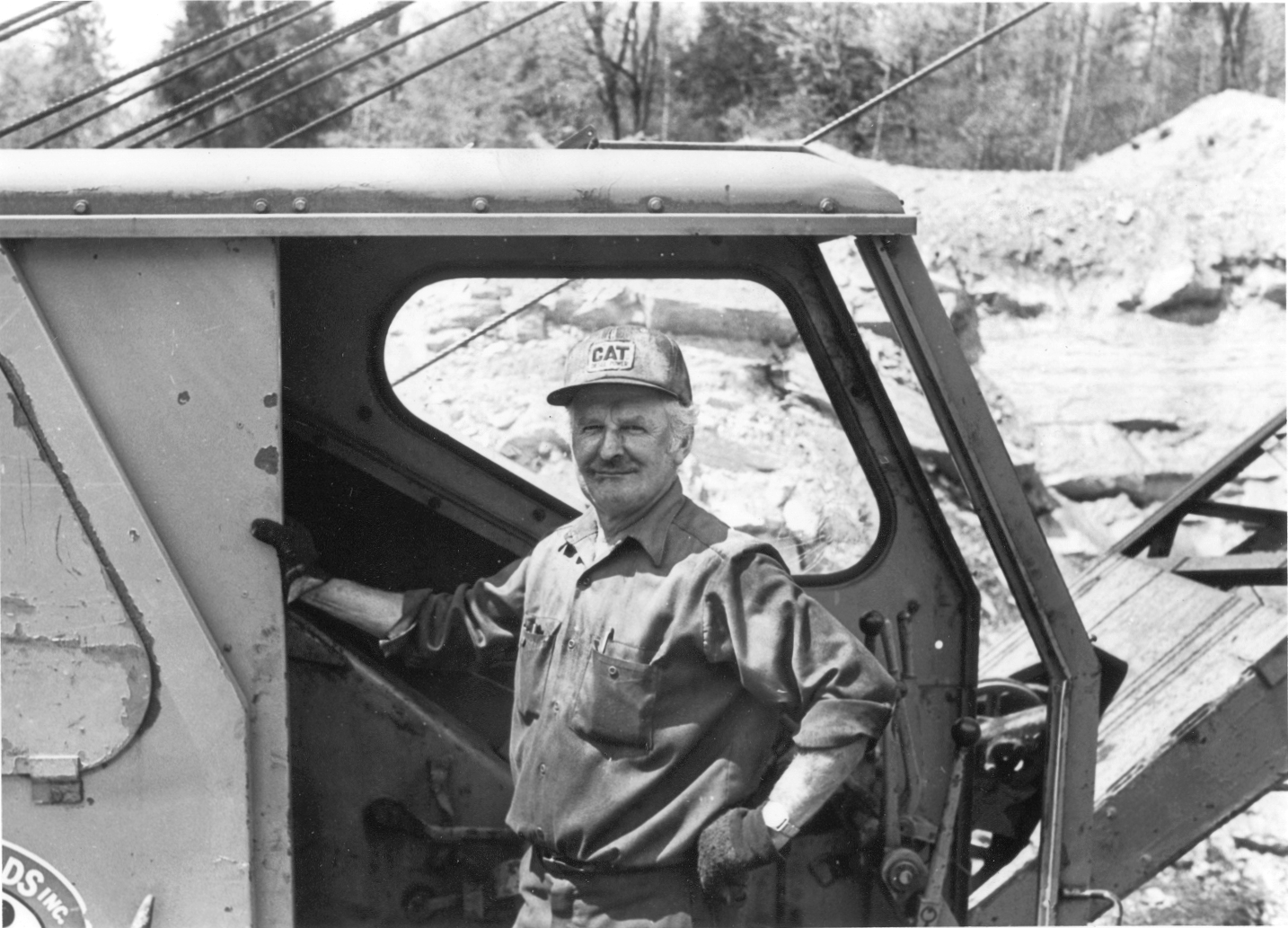
Frank Manowski and the Slag Pile in Black Diamond
The year was 1960. A small boy was in first grade at Kibler Elementary. His teacher, Mrs. Lewis, distributed 12-by-18-inch sheets of light brown construction paper to her 35 students. She instructed them to draw a crayon picture of something they liked. Billy sketched a coal car climbing a steep incline, his dad, Jack Kombol operating a track loader, while a dump truck loaded with coal passed by. Little did that small boy know he would one day labor at that wash plant, working side by side with the man who built that mountain.

Numerous old coal slag piles sit in and around Black Diamond, Ravensdale, and Franklin. Most are small, now swallowed by trees and wild blackberries. To many, they look like just another natural hill. The largest, however, contains over a million cubic yards of refuse and rises 140 feet above the surrounding landscape. It sits west of State Route 169, just behind Palmer Coking Coal’s mine office. This is the story of that mountain and the man most instrumental in building it—Frank Manowski.

During the era of underground mining, impurities such as shale, rock, and slack were inevitably hauled to the surface. Back then, old men and young boys toiled at picking tables, separating waste from clean coal by hand. Later, mechanical wash plants took over, cleaning the coal through a specific-gravity process using large tanks of pulsating water.
In both cases, the resulting refuse, called slag, had to go somewhere. Dumping the material downhill into a gully or low spot was always the first option, but even that method eventually required rail tracks once the ravines filled up. A mine located on flat ground needed a different solution for its waste dilemma. The most straightforward method was to build a stockpile utilizing the very same equipment found underground—coal cars on rail tracks.

Morgan Slope / Mine 11 – America’s deepest underground coal mine
In 1896, a new mine opened in Black Diamond. Named Morgan Slope in honor of the Black Diamond Coal Mining Company’s superintendent, Morgan Morgans, it was destined to become the largest and most successful operation in western Washington.
The Pacific Coast Coal Company purchased the mine and its accompanying company town in 1904. After 1913, Morgan Slope was renamed Mine 11, tracking the section of land where it sat. It eventually earned fame as the deepest underground coal mine in the United States. Before closing in 1927, Morgan Slope / Mine 11 produced nearly 7 million tons of coal over 31 years of operation, averaging an impressive 225,000 tons per year.

Morgan Slope tapped into the McKay seam, one of the state’s finest coal grades. This same rich vein was extracted in Ravensdale, Lawson, and Franklin. Geologists described the McKay coal as “pitch black with a vitreous luster, which compared very favorably with the better grades of bituminous coal obtained in the Eastern States.” Yet, like every coal seam, the McKay was laced with inferior coal plus bone mixed with clays and shale, particularly within the stubborn layer known as parting rock.
Workers separated mine-run coal into market-bound product, while the combined waste of coal, clays, and shale were destined for slag piles. Ignited by spontaneous combustion from the McKay seam’s high BTU content, the Morgan Slope slag pile smoldered for decades at temperatures approaching 2,000°F. The intense heat from burning heap fused the shale, sandstone, clay, and silt together, while iron pyrites turned the burned slag to shades of red. The pile functioned like a giant kiln, which some likened it to ‘nature’s brick.
The October 11, 1923, issue of the Pacific Coast Coal Co. Bulletin described the Mine 11 rock dump at Black Diamond as a growing mountain whose constant nocturnal fires resembled a “biblical Pillar of Fire”
“Thirteen years ago the present rock dump of Mine 11, at Black Diamond, was begun. Though the mine had been in operation for many years prior to 1910, it was then that the present dump was started when the old dump caught fire. This dump is today an imposing pile of rock and waste material brought out of the mine, and it is constantly growing.
Like a small mountain, it rises out of the wide expanse of the valley and is visible for a considerable distance. At night, the numerous fires which blaze constantly from its base to its summit makes it loom up much after the manner of the biblical Pillar of Fire.”

After the available fuel within the stockpile was spent, the towering heap of rocky material cooled, leaving behind a colored rock that locals naturally called “red cinders.” What was once discarded as useless waste found an unexpected second life as a surfacing material. The original Black Diamond–Ravensdale Road was paved with this very material, affectionately dubbed the “Red Top” road.
Finely crushed cinder was also laid down for high school running tracks; it proved to be an ideal surface, though generations of athletes remembered how a sudden spill left knees and elbows raw and bloodied. This striking red rock also found its way into countless Pacific Northwest landscape designs. To this very day, cinders from that historic stockpile are still being sold. Judging by sales figures spanning the past 70 years, the imposing landmark described in the 1923 Bulletin likely contained well over one million cubic yards of material.
The McNally-Norton Wash Plant
Though Mine 11 closed in 1927, the surrounding rail yard and preparation plant survived to support a new era of coal processing. In the following years, raw coal from nearby mines was brought to the Black Diamond facility, washed of impurities, and shipped to market. In 1945, Pacific Coast Coal Company modernized operations by installing a McNally-Norton jig-style wash plant, and a new mountain of waste rock began to grow.
However, because this new wash plant cleaned coal with more efficiency—and because quality standards had relaxed over time—less valuable material ended up as slag. By maximizing coal recovery, the McNally-Norton plant left less easily combustible fuel in the new dump. As a result, the current slag heap never ignited like its predecessor; instead, it smoldered quietly through slow oxidation.
The slag pile grew upward using the coal mining industry’s time-tested method. Dozens of times each day, a steel cable pulled a loaded slag car up a steep grade to the apex of the hill, where waste material was discharged from side-dump doors. Over the decades, this relentless cycle expanded the slag pile to an estimated 1.2 million cubic yards.

Throughout its growth, one man shaped this manufactured mountain than any other: Frank Manowski. He was closely tied to the coal-washing operations at the Mine 11 plant, becoming an almost permanent fixture of the facility. As underground coal mining entered its twilight years in the early 1970s, Frank’s rugged, weathered presence made him a favorite subject for newspaper photographers, eager to capture underground coal mining’s final chapter in the Pacific Northwest.

Frank Manowski
Frank Manowski was born on March 18, 1913, to Cornell and Anna Manowski, Polish immigrants who emigrated to Black Diamond in 1900. Frank was the youngest of 11 children, five daughters and six sons. Demonstrating how deeply coal ran in the family, four Manowski boys, Max, Les, George, and Frank, followed their father’s footsteps into coal mining, and two sisters married coal miners. Frank grew up in Black Diamond, graduating from high school in 1932, then earned an athletic scholarship to play baseball at St. Martin’s College.

When his college days drew to an early close, Frank took his first job at a local sawmill. From 1934 to 1936, he toiled underground alongside his father for the West Coast Fuel Company at their Cedar Mountain coal mine. Frank soon gravitated towards surface work in preparation plants, first with Pacific Coast Coal, then Strain Coal Company, and finally Palmer Coking Coal Company. Over the next 42 years, Manowski labored tirelessly at preparation plants, spending the vast majority of his historic career at the Mine 11 yard in Black Diamond.
Yet Frank never lost his passion for sports. He continued playing baseball for 22 years, well into adulthood, and played 11 seasons as a soccer player. He mostly suited up for Black Diamond’s company-sponsored teams. In mining communities such as Ravensdale, Carbonado, Wilkeson, and Black Diamond, baseball was a large part of local entertainment. Weekends were made for sports, and baseball was the biggest draw.
At the old Black Diamond grandstands, near the present-day school field on Highway 169, Frank’s mother, Anna, held court in a special seat where unsuspecting fans were warned against sitting. After the final out, both teams, along with umpires and friends, routinely descended upon the Manowski home for an evening of shared food, camaraderie, and merriment.
In 1939, Frank married Helen Strom of Enumclaw. Two years later, they welcomed a son whom they named Frank. Though he shared his father’s name, young Frank was technically not a junior. In Black Diamond, the family lived on Lawson Street next to the Presbyterian Church. They relocated to Enumclaw in 1959 to a home on Wells Street, near the hospital. For 23 years, Helen worked as a claims secretary for the Mutual of Enumclaw.
The younger Frank Manowski carved his own lasting legacy in Enumclaw as the long-serving recreational coordinator for King County Parks. Based out of the historic Fieldhouse adjacent to Pete’s Pool, Frank championed youth sports for 33 years, from 1965 to 1997.
How a Wash Plant Works
At the Mine 11 preparation plant, the older Frank toiled day in and day out. Each day, dump trucks delivered raw coal to the plant for processing. Coal was first dumped in a hopper, where it passed over a vibrating screen. Material less than four inches fell through onto a conveyor belt. Larger chunks landed on the picking table. There, a laborer separated the large pieces of coal, which were sent to a crusher and joined the screened coal heading to the wash plant.
Jigging is an ancient mineral-processing method that uses specific gravity and water as a medium to separate materials by weight. The McNally-Norton washer was a Baum-style jig process in which pistons powered by compressed air produced the necessary pulsating motion. As the raw coal moved through the washer tub, air-driven pistons pushed plates up and down and agitated the mix of coal, slag, and water. Coal, being lighter than rock or shale, rose in the turbid river of water and was carried through a chute for further sorting.

A bucket conveyor lifted the clean coal to the top of the bunkers where it was screened into separate bins of stoker, egg nut, and lump coal. The bins held hundreds of tons of coal ready for shipment by truck or train. Stoker coal made up the largest percentage of production and was used in large quantities by Washington state institutions such as schools and prisons. Homeowners typically used the slightly larger egg nut coal and lump coal for home heating.
Inside the McNally-Norton washer box, heavier impurities such as rock, sandstone, shale, and bony coal, collectively called slag, fell to the bottom, where a bucket conveyor carried them out of the wash box and into a hopper. Periodically, Manowski walked behind the plant and lifted a chute door, loading the waste slag into a 5-ton coal car. He then activated a hoist drum, which pulled a thick steel cable threaded through a bull wheel at the top of the pile, towing the coal car up the hill to its peak. There, two steel rails tripped the side doors, causing the slag to fall away.

A water pipeline parallel to the rail track hydraulically flushed the slag downhill. Introducing water also inhibited combustion of any carbon-rich material. After one section of the growing hill became too clogged with waste material, miners laid new ties and rails, extending the stockpile even higher. That’s how the stockpile eventually grew to a mammoth 1.2 million cubic yards. A nearby photo shows Archie Eltz, Charlie Falk, and Frank Merritt atop the waste dump working on the water pipeline that helped sluice waste down the stockpile.

Every mechanical plant is subject to breakdown, especially a processing mill that sorts coal from rock. Frank Manowski was practical and handy. He knew every belt and bolt in the plant, and had likely replaced every piece during his 33 years, coddling the machinery along. More than once, Frank noted that he’d repaired and reconfigured the wash plant more times than he cared to remember.

The End of an Era
When Manowski turned 65 in 1978, it was his turn to retire. Bill McLoughry, another lifelong Black Diamond coal miner, stepped into the operator’s position until handing off the reins in 1981. Chris Kroha of Lake 12 next filled the vacancy, running the plant until the John Henry surface coal mine launched operations in 1986. At that point, Black Diamond local Doug Sikes took control. Doug earned his place in local history as the facility’s very last operator, keeping the historic gears turning until the washing plant finally fell silent in November 1990.
That year the McNally-Norton wash plant was decommissioned after 45 years of continuous operation. Once the surrounding bunkers, bins, corrugated sheet metal, and conveying equipment were dismantled and hauled away, only the large iron hull of the old wash tub remained.
In April 1991, five months after the Mine 11 wash plant fell silent, Frank Manowski passed away at the age of 78. His life neatly mirrored the machinery he so faithfully maintained. His wife, Helen, survived him by 22 years, passing away in Enumclaw in November 2013 at the age of 94. Their son, Frank, carries on the family name at his home in Bonney Lake.
Larry Abele captured many of the striking historic photos that accompany this essay in January 1973. Several of his images appeared in a feature story about coal mining in the Sunday, January 14, 1973, supplement, “Now,” distributed by the Renton Record-Chronicle, Kent News-Journal, and Auburn Globe newspapers.
By Bill Kombol