Categories
Musings

First Tastes of Mortality

“Whatever became of the moment when one first knew about death? There must have been one, a moment, in childhood when it first occurred to you that you don’t go on forever.” – Tom Stopppard, Rosencrantz and Guildenstern are Dead

More than fifty years ago, two grandparents died on the same day.  It was the last day of summer, and the first time anyone close to me had died.

A dragon lives forever but not so little boys
Painted wings and giant rings make way for other toys.
One grey night it happened, Jackie Paper came no more
And Puff that mighty dragon, he ceased his fearless roar.
                                     – Leonard Lipton / Peter Yarrow

Released in Jan. 1963, Peter, Paul & Mary’s “Puff the Magic Dragon” soon topped the charts.

I remember my first thoughts about dying.  It was the spring of 1963 and I was nine years old.  Grandma and Grandpa Morris lived in a large, white, country home west of Enumclaw on McHugh Street.  The radio played in the background.

The number one song was “Puff the Magic Dragon” by Peter, Paul & Mary.  It’s a children’s song wrapped in fabled lyrics released during the height of the folk era.  I’d heard it before, but never fully absorbed this line: “A dragon lives forever, but not so little boys.”  My tenth birthday was in a month or so.

Grandma (Nina Marie Morris) was in the early stages of dementia, which even a boy could recognize.  She was easily confused.  One day, Billy Hawthorne (Grandma’s part-time caregiver’s son) and I played a cruel trick on her by hiding in the closet.  We watched as she search for us in vain.  After frantic calls we reappeared, only to see a vacant look of despair on her bewildered face.  Mom explained she had hardening of the arteries, causing blood to flow slowly to her brain, meaning she couldn’t think as clearly as before.  She was ill and wouldn’t get better.  I felt guilty about our trick.

Grandpa and Grandma – Jack and Marie Morris, a night on the town in San Francisco, 1959.

The song ended but a feeling lingered – I wouldn’t be a little boy much longer.  Just like Jackie Paper, my imaginary dragons and toy soldiers would soon be gone.  My wistful feelings of melancholy floated in the wind like the down of a dandelion.

One evening that summer, I lay in bed.  It was a Friday or Saturday night.  Next to my bed was a cheap AM radio.  Late at night, I spun the dial picking up a distant station in Salt Lake City and listened to the final innings of a baseball game.

It ended and the nightly news was read – “At 12:01 a.m., a convicted murderer on death row will be executed by firing squad.  Growing tired I turned off the radio and imagined a blindfolded prisoner led to a brick courtyard.  The moment passed but the memory remained – a boy, the radio, a distant broadcast, the bleakness of death.

Bad posture, Billy at Grandma & Grandpa Morris home, Spring 1967.

During the 14th year of my life, the grim reaper finally appeared.  It was 1967.  Music defined my world and I delighted in its sounds.  Newspapers called it the “summer of love.”  For me it was a summer of friends, family, fun . . . and Sgt. Pepper.  Each morning brought new sounds and adventures.  The sun shone day after rainless day, for so long it set a record – 67 days without rain.  The bluest skies you’d ever seen were in Seattle.

That September, I entered the final year of junior high as a 9th grader.  Three weeks later that cozy world was disquieted by the death of two grandparents: Grandma Morris and Papa Kombol.  On the same day, my father lost his father, and mother lost her mom.  In a way, this double death was a tonic for our parents.  They told us kids of feeling like orphans, leaning on each other – weathering funerals and wakes, one after the other.  September 21st was the last day of summer . . . and fittingly, the autumn of my youth.

Papa Tony Kombol and Grandma Nina Marie Morris died on the same day.

Both grandparents were elderly: 82 and 77, yet important fixtures in my life.  Papa (Tony Kombol) babysat me when I was four and five.  Mom dropped me off at their home near Elk Coal where I’d follow Papa doing chores, fixing lunch, then put me down for a nap.  Legally blind from an August 7, 1925 coal mining accident, he stayed home while Grandma Lulu taught school in nearby Selleck.  Needing to be near Enumclaw’s medical facilities, Papa came to our home the last few weeks of his life.

Grandma Morris was the first person I remember reading to me.  We flipped through “Two Little Miners” so many times I could picture each page.  I boarded an airplane for the first time in late June 1962, a Boeing 707, when she and Grandpa took me to San Francisco.  We braved chilly Candlestick Park and watched my first major league baseball game.  The Giants won the pennant that season.

When in San Francisco Grandpa always stayed at the Maurice, a businessman’s Hotel near Union Square where that day we had our shoes shined, July 1962.

We dined in the Starlight Room of the Sir Francis Drake Hotel, celebrating  great-aunt Ruth’s 75th birthday . . . and my 9th.  I still have the menu dated July 3, 1962.  Two weeks earlier, Tony Bennett released the song, “I Left My Heart in San Francisco.”

Great Aunt Ruth’s birthday was July 4th and mine July 5th, so Grandpa Morris took us to the restaurant at Sir Francis Drake Hotel.  It was a fancy place with the date  printed at the top of the menu.  The waiter gave it to me as a souvenir.

In later years Grandma Morris was confined to the Bethesda Manor nursing home not far from our Enumclaw home, falling deeper into the darkness of dementia.  Mom visited her daily, sometimes twice.  She hired our neighbor, Wilma Boerlage to provide extra care.  I’d go on occasion, but in time sGrandma no longer recognized me.

Jack & Pauline Kombol, late 1967.

Over the coming weeks, I began to imagine life without parents.  It was the year Mom stopped tucking me in and saying nighttime prayers together.  Alone in bed, save for a pink teddy bear won at the Puyallup Fair, I thought of the future.  One day Mom and Dad will surely die, just like Grandma and Papa.

A profound sense of sorrow enveloped me.  Visualizing their deaths, I cried myself to sleep each night.  I tried to figure a way out – what if they never died?  Maybe I’d die first and be spared the heartache?  Whatever scenario I concocted, the end was always the same – falling asleep to tears.  The end of their lives and my childhood hung in the balance.  But I knew not how, nor when.

Unbeknownst to me, the thoughts of that 14-year-old boy were long ago articulated by Stoic philosophers.  A Stoic prepares for the future by focusing on the worst possible outcome, a Latin principle called premeditation of adversity.  Seneca advised his followers to rehearse ruinous scenarios “in your mind – exile, torture, war, shipwreck,” thereby robbing the future of its awful bite. The anticipation of hardship softens its eventual blow.

Each morning, Mom woke me as I skipped downstairs to find a hearty breakfast on the kitchen table.  Jean and I walked to the Junior High, a three-story, brick building four blocks away.  There I roamed the halls, diagrammed sentences, and played with friends after school.

Male tear ducts shrink as boys become men.  It becomes more difficult for men to cry.  Evolutionary psychologists can no doubt tell you why.  My tears were gone in time.

Ninth grade led to new friendships and adventures.  I turned out for basketball and made the greatest team ever.  I raised tropical fish in an aquarium.  At semester’s end, I earned my first perfect report card, all A’s.  As a special treat, Dad took me to the Four Seasons in downtown Enumclaw for Chinese food.  I felt pride in the glow of my father’s love.

Twelve years later, I wrote a poem and read it at his funeral.  The lines recalled the mournful feelings of that teenage boy:

The last day we expected was the morning that we feared feared
the nights we cried so long ago have come to rest right here.
And so we’ll cry these tears of pain from sorrow we must store
the tears we have are tears we’ve cried a thousand times before.

Father and son, Jack Kombol and Bill, Lyon, France, Feb 1978, a year before he died.

In February 1968, Barry and I picked copper strands from piles of rocks and sticks at PCC’s Mine #11 wash plant in Black Diamond.  The wire came from blasting caps used when dynamite dislodged coal at the Rogers #3 mine.  Seven years later I’d work in that mine, learning just how those wires were used.

Over several weekends we collected nearly a pickup load of coiled yellow wire, then burned off the plastic coating.  Dad sold the copper for 40 cents a pound at the recycling yard.  It was souvenir money for us four kids to use during our family’s forthcoming trip to Europe later that spring.  It was six weeks long, so we missed the last few weeks of school.  In Ireland, England, Wales, and the continent we saw historic sights, tasted new foods, and explored a world far removed from our own.

We also visited the embodiment of death – Dachau, the Jewish concentration camp near Munich.  The visitor’s center displayed black and white photos of emaciated bodies, illustrating all manners of depravity.

Mom kept a journal of our trip so I know the day we visited Dachau – May 31, 1968.

The guide told us of Jewish children with tattooed numbers on bony arms – herded from rail cars, not knowing their fate. We walked through the barracks, gas chambers, and crematoriums where thousands died at the hands of their Nazi henchmen. We witnessed the tools of death on an unimaginable scale.  I’ve never forgotten that visit or the sign on the entrance gate: Arbeit macht frei. “Work sets you free.” Mom read its translation from Arthur Frommer’s Europe on $5 a Day,

The sign on the gate as you enter Dachau – “Arbeit Macht Frei,” – Work sets you free.

Three weeks after our family returned home, I turned 15.  Four days later a boy I’d grown up with died.  John Sherwood attended our Presbyterian church.  His parents, Earl and Isabelle Sherwood were our youth group leaders and taught us Sunday school.  John was a troubled lad who’d just flunked 10th grade.

On a warm summer evening in early July, John went to a party and guzzled 190-proof Everclear from a bottle.  Mr. Sherwood found his son slumped over the front seat of their car just after midnight.  The Enumclaw police never figured out who provided the bottle, though some teens in town surely knew.

He was the first contemporary I’d known who died.  John was 16.  The coroner’s jury attributed his death to “consuming excessive amounts of liquor furnished by a person or persons unknown.”  The Enumclaw Courier-Herald ran articles linking his death to narcotic and alcohol abuse among local youth in 1968.  Glue sniffing was a particular concern that year.

The following spring our Cascadian yearbook printed his photo in remembrance, followed by a short poem:

John Sherwood’s page in our high school yearbook.

He is not dead, this friend not dead,
But in the path we mortals tread
Got some few, trifling steps ahead
And nearer to the end;
So that you too, once past the bend,
Shall meet again, as face to face, this friend
You fancy dead.
Robert Louis Stevenson 

When you’re young, five years is practically forever.  “Puff the Magic Dragon” was a distant memory.  Heading to high school in September new adventures emerged.  I started a job as the Saturday boy at Palmer’s mine office in Black Diamond.  I joined the chess team and found a new sport’s calling.  By summer, I’d have a driver’s license plus two more jobs to fill my days.  Papa and Grandma were fading memories.

Sporting a Nehru jacket on my first day of high school as a sophomore, Sept. 1968.

As boyhood drew to a close, a young man began to emerge.  My horizons broadened.  Ahead of me lay many deaths . . . aunts, uncles, cousins, classmates, and yes parents, first Dad in 1979, and Mom in 2011.

Those first tastes of mortality would always be with me, but  childhood fears were fading.  A new set of adolescent anxieties gripped me.  I was growing up and my world was growing larger.

Categories
Musings

On Turning 68

Fifty years ago I turned 18, a few weeks after graduating from high school.  My head was filled with dreams of heading off to college.  My bank account was bolstered by countless graduation cards filled with $5, $10, and $20 bills.  I was filled with certainty — in the knowledge that so many relatives and friends believed in me. The feeling was one of confidence.

Those first post-graduate weeks were spent lounging in Lincoln City in the company of Grandpa Morris and cousin, Dave Falk.  Returning home, I began my second season as an ice cream vendor for another cousin, Dan Silvestri selling popsicles from a three-wheel Cushman scooter.  That summer job netted me $1,032, plus all the Sidewalk Sundays I cared to eat. 

The graduate (left) and his 68-year-old self, standing beside the same home at 1737 Franklin Street, this time holding the high school diploma awarded 50 years earlier.

One thought however, did not cross my mind.  I spent no time reflecting on what life might be upon reaching the age of my grandparents, great aunts and uncles, many of whom had sent cards and offered words of encouragement.  It isn’t in a boy’s nature to think about growing old.  It’s certainly of an older man’s to ponder what has long since passed.

My dad, Jack Kombol never finished high school, but insisted I go to college.  My grandfather provided funds for my first year.  After that I was on my own and worked summer jobs to pay my way.  If I’ve learned one thing in the ensuing 50 years, its thankfulness––the knowledge that I stand today on the shoulders of those who came before.  We exist because our parents brought us into existence.  And they too, through generations stretching back to the beginning of humanity.

I’ve grown to recognize how blessed I’ve been by those who blazed the trail to where I now dwell.  And to recognize the debt we each owe to those who helped us along, taught us a song, or how to belong.  To better cultivate that sense of obligation, we owe it to those coming after to pave for them a better path forward, in gratitude for that trail blazed for us.  And through it all to rely on the grace of God whose plan unfolds every day, whether be helped or hindered by each daily action we undertake.

Perhaps my great-great grandmother, Nancy Matilda (Hembree) Snow who came across the plains on the 1943 Oregon Trail wagon train said it best:

“Our being in this world is not accidental.  We all have a mission to do some special work, and it is work that will honor Him and bless those around us.  If we do not find that work and do it, our life is a failure; the true end of living is not realized.   We may not learn in a moment; but step-by-step, day-by-day; as we go on things will be made clearer.  Those who do the smallest things well because they are God’s plan, are to be honored far above those who do great things for the world’s praise.”

Nancy Matilda Hembree (1837-1922)
Categories
Musings

A Tribute to My Mother: Pauline Lucile Kombol

“Our being in this world is not accidental.  We all have a mission to do some special work, and it is work that will honor Him and bless those around us.  If we do not find that work and do it, our life is a failure; the true end of living is not realized.   We may not learn in a moment; but step-by-step, day by day, as we go on things will be made clearer.  Those who do the smallest things well because they are God’s plan, are to be honored far above those who do great things for the world’s praise.”  – Nancy Matilda Hembree (1837-1922)

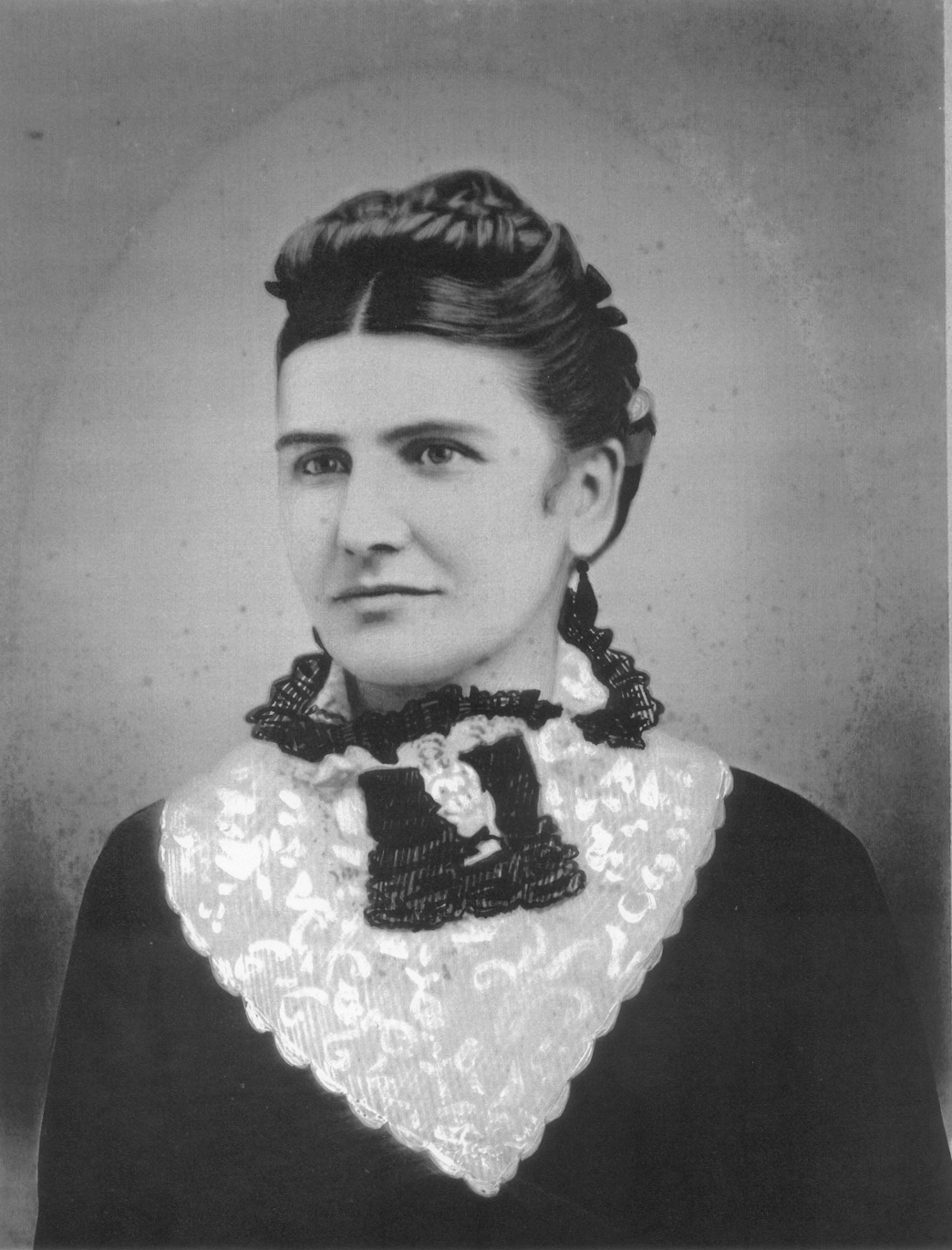
Nancy Matilda (Hembree) Snow (1837-1922)

Thus spoke Pauline’s great-grandmother, Nancy Matilda (Hembree) Snow decades before my Mother was conceived.  Pauline Lucile Morris was born to John Henry and Nina Marie, both had the last name Morris.  She was as Welsh as one could be.  Her father was a coal miner and her mother a school teacher.  Both her grandfathers and great-grandfathers worked in the coal industry.  Her great-grandmother, Nancy was a pioneer of the 1843 Oregon Trail. 

Pauline grew up in the coal mining town of Durham surrounded by an extended family of aunts, uncles, and cousins most of whom worked in or around the mines.  Her family moved to Enumclaw when she was six, first to a hop farm in Osceola and later a home above Newaukum Creek.  At school she made life-long friends many of whom are here today.  She edited the school newspaper and annual, graduating from Enumclaw in 1945, just as World War II ended.  Her obituary claims she briefly attended the University of Washington.  The truth . . . for about 15 minutes

Pauline Morris, left with Shirley Stergion in front of Enumclaw High School, circa 1944.

After a short stint in Seattle, she landed back home working at the Palmer Coking Coal mine office at Four Corners.  There she pumped gas and helped with bookkeeping.  In 1950, she and Jack Kombol eloped to California and married.  Eventually the couple made their way back to Selleck, where Barry, Jeannie and I first lived, and then to Elk Coal where Dana was born, just a quarter mile from the Durham of Mom’s childhood.

Mom had six life-changing experiences: Barry, Billy, Jeannie and Dana; but two others I’d like to tell you about.  Her second baby, a daughter Paula Jean died two days after birth.  Mom used to say that after the loss of that baby, she loved the rest of us so very much, so that she would never lose another child.  One day years later, Jeannie and I rambunctiously raced around the living room, and Mother’s prized china cup collection crashed to the floor shattering every piece.  Despite her initial sadness, Mom decided then and there that she would never value any possession more than the people in her life.

Pauline holding her second son, who 58 years later read this eulogy at her funeral, Sept. 1953.

Our family moved to Enumclaw in 1958.  There Pauline joined civic life as a den mother, Camp Fire leader, election-day poll worker, raising money for the March of Dimes, helping elderly aunts, and later caring for her own mother.  There she ran the home – baking cookies, canning homemade jam, making pies – always from scratch and never with a recipe or measured ingredients.  Menus were traditional and set: Friday – fish or tuna noodle casserole; Saturday – hamburgers; Sunday – fried chicken or pot roast; Monday – meat loaf, and so on.  We never had soda pop or potato chips, but did enjoy Kool-aid and homemade frozen popsicles.  Each summer we took vacations with the Cerne’s to Grayland and Hoods Canal – I later learned that we stayed at the same Beacon Point cabins where her family vacationed when she was young.

One of the big events of our lives was the family trip to Europe in 1968.  Mom researched and found our Welsh and Croatian relatives and planned our journey through ten countries in six weeks.  Using her dog-eared copy of Europe on $10 a Day, Mom found cheap pensions and small family-run hotels to fit her tight budget.  Jack drove us across Europe in a small station-wagon jammed with six people and 13 suitcases.  We played Hearts in the backseat and listened to Radio Luxemburg with Danica stuffed back amongst the luggage.

The Kombol family portrait, 1967.

In later years we spent our summers at Lake Sawyer where Dad built a cabin.  During one particularly inebriated summer party, Mom earned the nickname ‘Carrie Nation’ when she raced around the cabin pouring out booze and opening the tap of the keg refrigerator watching cold beer spill to the ground. 

In early 1979 Jack was diagnosed with cancer and passed away within 3 weeks.  A night before he died, he called me to his bedside and said, “I want you to take care of your mother.”  Since the girls were away and Barry was married with a growing family, the primary duty of caring for Mom fell to me.  So, I frequented her home where she cooked me delicious dinners.  And, made sure I brought my laundry so she could wash it.  And, she hemmed my pants and sewed buttons on my shirts; and, always sent me home with casseroles, lentil soup, and blackberry pies.  It seemed the more I tried taking care of Mom, the more she took care of me.  And who could ever forget the summer Keith Timm Jr. moved in with Mom and me.  Then there were two of us . . . “to take care” of Mom.

Pauline and her three siblings, Evan Morris, Betty Falk, and Jack Morris, June 18, 1977.

During the early years after Dad’s death, she kept herself busy on the Enumclaw School Board and as a Director of Cascade Security Bank.  But like a caterpillar, she spun her cocoon waiting to find the wings of the butterfly she became.  And that she did.  I can’t claim credit for pushing her out of the nest – I was too busy “taking care of her.”  But off she flew – first to Seattle where she bought a condo and found friends through extension classes and her beloved movie group.  More grandchildren were born and off she went to care for them.  She enjoyed traveling and over the years took trips to Russia, China, Hungary, Italy and elsewhere.  She loved her time in Lincoln City, and eventually spent her winters, first in Palm Springs and later Scottsdale. 

Coal Miners’ Daughters: with Loretta Lynn at Sesame Street studios, circa 1983.

Around the turn of the century, a wonderful gentleman entered into Mom’s life.  His name was Cal Bashaw.  He was a widower born the same year as my Dad.  Mom and Cal had known each other from their days as bank directors.  Well, I have to admit that Cal and I have radically different styles.  When he started to “take care of” Mom; he did things like always helping her with her coat; opening doors; helping with her chair, fixing things around the house, running errands, taking her out to dinner, and always being there to care for her needs.  It seemed the more we were around Cal, the more my own lovely wife began pointing out all of Cal’s far-too-many good traits.  I started hearing things like, “Why can’t you be more like Cal?”  Basically, Cal’s caring manner made my previous efforts to “take care of” Mom look fairly absurd.

Cal Bashaw, Pauline, and grandson Henry Kombol, Christmas 2004.

But truly, Mom and Cal had a wonderful ten years together.  And if only more people were like Cal, and like Mom, the world would be a far better place. 

So, I come to the end, but also the beginning: the beginning of our lives without Pauline, without her sunshine.

Still, her light still shines – a small, bright star to guide me – to guide me through the darkness and back to life.  So until that day when my light joins hers, I will rest easily, knowing that Pauline led a good life; a life worth living; a life which blessed those around her; a life of small things done well – done not for the world’s praise; but done through an honored existence, dedicated to her friends and to her family, and lived according to God’s plan.

Pauline Morris, graduation photo – Enumclaw Class of 1945.

And, if she were here today  . . . I’ll let you complete the thought.