Categories
Uncategorized

Radical Tom Wolfe

“Radical Wolfe” was the last film I expected to watch on a transcontinental flight back east last year.  Tom Wolfe died nearly six years ago, and airline movie selections rarely feature thoughtful documentaries about revolutionary literary figures.  Passengers want comfort-food entertainment to better digest crummy airline food.  Movie thrillers, rom-coms, and music videos offer what both parties seek – for airlines: quiet and pacified sardines; and for 300 passengers crammed in a tube: stimulating entertainment.

Six miles high on our flight to New York City, with earplugs in and eyes glued to the screen, I muscled through the staccato nature of wifi interruptus, a common airplane movie ailment of frozen screens and mid-scene glitches.  Still, I thoroughly enjoyed “Radical Wolfe,” a documentary that grew from Michael Lewis’ 2015 Vanity Fair article.  Lewis is a writer whose flame was lit by Tom Wolfe’s torch.

Tom Wolfe was a quiet southern gentleman, who with a younger sister grew up in a home of educated parents.  His father, Tom Sr. was editor of The Southern Planter, an influential agricultural magazine, and his mother, Helen was a landscaped designer.  Tom turned down Princeton University to attend Washington & Lee, where he majored in English and became sports editor of the college newspaper.  He played baseball advancing to a semi-professional team and earned a try-out with the New York Giants.  He was cut after three days.

Wolfe abandoned sports and next enrolled in Yale’s American Studies doctoral program.  After several years of research, Wolfe submitted his doctoral thesis exploring Communist influences on American writers during the 1930s, a subject he knowingly chose to provoke his mentors.  The thesis was savagely rejected, but after rewrites and toning down his florid style, it was accepted and a freshly-minted Dr. Tom entered the real world.

A series of lowly jobs in newspapers over five years eventually landed Wolfe a job at the Herald Tribune, a perennial second-place, we-try-harder competitor to the New York Times. Wolfe developed a special affection for his adopted Big Apple calling it, “pandemonium with a big grin on it.”  There he joined Clay Felker and a team of fresh writers like Jimmy Breslin who embarked on a common quest to make journalism livelier.  In their Sunday supplement, New York, the team produced the “hottest Sunday read in town.”  In America’s biggest metropolis, Wolfe discovered that cities are complex entities and far more than what any one person experiences.  Yet, there’s no way to fully grasp individuals without first understanding how people create their lives and construct their fabrications.  .

It was also in New York during the mid-1960s when Wolfe adopted the clothing style that set him apart from Wall Street bankers to Greenwich Village hippies.  He began wearing white suits that were traditionally worn only during the sultry days of summer.  But Tom Wolfe wore his custom-made, cream-colored suits year-round becoming the snowy-dressed dandy of the Big Apple.  White suits provided the protective armor that Wolfe hid behind when researching his stories.

Tom Wolfe, on the back cover of “From Bauhaus to Our House.”

New Journalism

Wolfe’s New Journalism was a set of writing techniques to lift nonfiction storytelling to an entertaining experience.  He was the maestro among fellow journalistic practitioners like Hunter Thompson, Gay Talese, George Plimpton, Joan Didion, and Rex Reed.  Wolfe explained the story-telling process of New Journalism during a 1987 Rolling Stone interview with Brant Mewborn.  “The first is scene-by-scene construction.  In other words, telling the entire story through a sequence of scenes rather than the simple historical narration.  Second is the use of real dialogue—the more the merrier.  The third, which is the least understood of the techniques, is the use of status details.  That is, noting articles of clothing, manners, the way people treat children, the way they treat servants, etc.  The fourth is the using point of view, which is depicting scenes through a particular pair of eyes.”

I can’t recall when Tom Wolfe first came into my life.  Like many in the late sixties, I heard the phrase “Electric Kool-Aid Acid Test” bandied about but knew nothing of Ken Kesey’s antics or his psychedelically-inspired Merry Pranksters. Nor was I aware of Wolfe’s send-up of the cocktail party where wealthy socialites joined a get-together with Black Panthers.  I came upon Wolfe while leafing through the pages of Rolling Stone where he wrote the first chapters about how test pilots became astronauts.   The magazine’s publisher, Jann Wenner urged him to start the story, that six years later became “The Right Stuff.

One of Wolfe’s most controversial works, “Radical Chic” was written in 1970 after he attended a party Leonard Bernstein hosted to introduce New York society to the Black Panthers.  Wolfe’s entree to the party came when he noticed an invitation on David Halberstam’s desk.  He promptly called the RSVP number and announced, “This is Tom Wolfe, and I accept.”  He arrived at the Bernstein’s posh Park Avenue apartment and immediately sought out the party’s hosts, Leonard and Felicia Bernstein, to present himself.

He made no secret of the fact he was collecting notes for a story.  He carried a green steno spiral notebook upon which in bold block letters he’d written, Panther Night at Leonard Bernstein’s.  It was only after he told readers of New York Magazine what he had seen and heard that critics attacked its accuracy. When one of the guests claimed he recorded the affair on a hidden tape recorder, Wolfe was overjoyed.  He hadn’t recorded the event but knew his note-taking must have been precise and accurate if fellow guests falsely believed he did.  The story raised his profile.  But I didn’t read it till a dozen years later.

Tom Wolfe seated in his Manhattan apartment.

The Purple Decades

I didn’t fully fall in love with Wolfe and his kaleidoscopic writing style until release of “The Purple Decades,” his greatest hits collection of early works in the Sixties right up until the time of its 1982 release.  That sampling inspired me to read more Tom Wolfe, so I paced through his earlier books.

Two years later Rolling Stone began publishing chapters for his first novel, “The Bonfire of the Vanities.” Wolfe had frequently bemoaned the decline of American fiction so decided to show the literary world how to capture the vibrancy of New York, the world’s most dynamic city.  In a letter to Wenner, Wolfe proposed submitting serial installments much like how Charles Dickens published many of his novels – in popular magazines. It would be modeled on William Thackeray’s “Vanity Fair.”  From July 1984 to August 1985, each biweekly issue of Rolling Stone arrived in my mailbox with a new chapter that I immediately inhaled.  Wolfe found the pressure of deadlines provided the motivation he hoped for.  He was right, and this reader was hooked.

Back in the Sixties, Wolfe began noticing subcultures of ordinary people who were rarely mentioned in mainstream culture.  His role as a white-suited sociologist allowed Wolfe to blend into these tight social groups, like the custom car crowd from which he produced “The Kandy-Kolored Tangerine-Flake Streamline Baby” or the San Diego surfers from which he wrote “The Pump House Gang.”  “What struck me,” he noted, “was how so many people have found such novel ways of extending their ego way out on the best terms available, namely their own.”  Each subculture devised its own hierarchical status structure. For custom car owners it might be the most inventive creation, or for surfers who best epitomized beach culture.

When asked why he wrote, Tom Wolfe usually answered he enjoyed exploring how people sought status in their lives. “I think every living moment of a human being’s life, unless the person is starving or in immediate danger of death, is controlled by a concern for status.”  He developed this theory after studying Max Weber, a German sociologist who wrote the essay, “Class, Status, and Party.”  Wolfe refined Weber’s insights into what he termed the ‘Statusphere.’ He explained people were not competing for prestige with all of society.  Instead, they pursued rank and status within a narrow sphere of their own making, typically friends, co-workers, fellow hobbyists, or other social frameworks where close companionship is found. Most people regard their personal Statusphere as better than all others.

The Human Comedy has never been richer.

The collective insights from status-seeking surveillance fueled his first novel, “The Bonfire of Vanities,” a blast of oxygenated air that captured the social milieu of Manhattan in the 1980s. Wolfe’s characters were composites discovered during years of careful observation and months of research into their lusts and livelihoods.  The novel was phenomenally successful generating $15 million in gross sales, the equivalent of $40 million today.  And what a book it was, Wolfe chuckled, “to produce a movie so bad that it lost nearly $100 million dollars.”  As Tom Wolfe wryly observed about his own bestseller, “The human comedy has never been richer.”

After “Bonfire of the Vanities” elevated Tom Wolfe to the top of the country’s authors, his 1998 follow-up novel, “A Man in Full” landed him on the cover of Time Magazine.  He was now the most famous writer in America.  His publisher was so confident of the book’s sales that more than a million copies were printed before anyone had read a single word.  The story was set in Georgia with a cast of characters, both black and white from all castes of Atlanta’s social and economic classes.  It was a huge success but drew critical reviews from staid authors pushed aside by Wolfe’s popularity.

Particularly aggrieved were John Updike, John Irving, and Norman Mailer who entered the fracas attacking the novel as “entertainment, not literature.”  Still, Wolfe had the last laugh, amusingly skewering his assailants in a spirited and mocking counter-punch titled, “My Three Stooges.”  The novelist John Gregory Dunne summed up the kerfuffle best, “Wolfe had the capacity to drive otherwise sane and sensible people clear around the bend.”

Wolfe was regularly accused of everything from ignorance to arrogance.  One critic termed Wolfe “the most dangerous writer in America and the one person you don’t invite to your party.”  When asked why some critics despised him, Wolfe responded that he simply pulled away the status-seeking veil for all to see.  He continued, “Intellectuals aren’t used to being written about. When they aren’t taken seriously and become part of the human comedy, they have a tendency to squeal like weenies over an open fire.”  Gay Talese, a fellow New Journalism writer explained some of the contempt directed Wolfe’s way, “Here was a writer who stuck his neck out, criticizing fiction writers and their work.  Then he goes ahead and writes a best-selling novel. He knows he will get killed critically because everyone in the literary establishment will have it in for him.”

About politics, Wolfe said he belonged to the party of opposition and found enemies on both sides of the partisan divide.  But Wolfe didn’t care and quipped, “You’re nobody till somebody hates you.”  He shrugged off flak explaining, “It usually means that I’ve been unorthodox in some way.  I haven’t gone along with the reigning intellectual line.”   When accused of being cynical, racist, and elitist, Wolfe struck back.  “That’s nonsense. I throw the challenge to them: if you think (my writing) is false, go out and do what I did.  Get beyond the cocoon of your apartment and take a look.”

The author-admirer’s bookshelf of Tom Wolfe.

Wolfe has regularly been called America’s leading satirist but always rejected the title.  He emphasized his point was not to satirize, but to detail how people think and act, as he discovered through detailed reporting.  Others found his work transformative. Larry Dietz, a friend and editor observed, “What Tom did with words is what French Impressionists did with color.”

He also cared deeply about freedom of expression.  Some voices in the documentary film suggest that Tom Wolfe might not be published today because he regularly pissed off too many people.  Today’s culture is filled with armies of the righteous, anxious to be offended and wear their moral indignation like a Technicolor dream coat of wounded pride.  But Marshall McLuhan, who Wolfe chronicled in a 1965 essay, issued the best rejoinder, “Moral indignation is the technique used to endow the idiot with dignity.”

In 1996, Tom Wolfe suffered a heart attack that required quintuple bypass surgery.  He was humbled to discover that he too was made of clay. He survived the incident and wrote another five books and numerous magazine articles before dying in May 2018 from an infection.  Thomas Kennerly Wolfe Jr. is buried at Hollywood Cemetery in his hometown of Richmond, Virginia.

He was Tom Wolfe! 

Grandiose, courageous, skilled, and humorous, Wolfe was filled with vim, vigor, vinegar, and vitality.  In death, his work may be neglected, but Wolfe is so good he will no doubt be rediscovered again and again by future generations. He inspired me to read critically and write lavishly.  Though I haven’t one percent of Tom’s skills, like Wolfe, I arise each day thanking God for having been born in the greatest country and the greatest time in the history of the world.

After you finally realize the collective WE are fertile grounds in the Human Comedy, that he so meticulously detailed, take a moment to recite a prayerful thank you for Tom Wolfe and his 88 years of life.  He was unique and unprecedented, a jewel and a gem, a writer like no other, who makes us laugh, and I miss him dearly.  So this essay is my heartfelt “thank you” to a man who first entertained and eventually inspired me to go out into this great big kettle of comic stew and find interesting things to write about.   For there’s no writer more interesting than Tom Wolfe.

Postscript: Two degrees of separation

A decade before his death, my glamorous sister Danica was invited to a tony dinner party at the home of Tom and Meredith Brokaw in their Upper East Side Manhattan apartment.  She walked into a gathering of perhaps 15 guests and spotted Tom dressed in his signature white suit.  “Oh my gosh,” she thought, “My brother should be here.”  Danica knew of my love for Wolfe and could only hope she might speak with him.  It got much better than that.  As the guests were seated at three round dinner tables, she found herself between Tom Wolfe and Diane von Furstenberg, the Belgian fashion designer best known for developing the wrap dress.  The evening proceeded with Danica’s attention raptly fixed on Tom’s every utterance.

At the party’s end, she rushed home and called me to deliver her star sighting and recite everything he’d said.  I didn’t have the presence of mind to write it down and neither did she.  During their conversation, she related my admiration for his work and bragged that I’d read every one of his books.  She boldly asked if he would be so kind as to autograph a copy if it were mailed. He said of course, and Danica secured his address to execute the favor.

I was thrilled with the offer and began thinking about which book to send.  While contemplating my good luck, I became acutely aware of what I was really doing.  What would Tom Wolfe’s finely scripted autograph on the facing page of a book even mean?  Would I casually, while entertaining friends pull it from the bookshelf, open the cover, and reap the astonished envy all present? And by doing so imbue myself with some superior status for possessing such an item?  That I owned a book that upon my death might fetch an extra $10 from a collector, assuming my heirs even looked inside the cover?  Wouldn’t I be reveling in the personal vanity that my literary hero had so expertly exposed in his essays and novels?

The decision came easily, I wouldn’t do it.  Why?  I was embarrassed to exhibit such a personal vanity by trading on the celebrity of an author who warned me against that very trait.  Instead, I quietly sat down and read the first chapter of Ecclesiastes, “Vanity of vanities, all is vanity . . . there is nothing new under the sun.”

Categories
History

Tony and Lulu’s Story

Their stories began in 1885.  That January, a baby boy was born in Fuzine, Croatia.  His name was Anton Kombol, the same as his father. When baby Anton was born, Croatia was a provincial kingdom within the Austro-Hungarian Empire.  Fuzine is a village in the Primorje-Gorski-Kotar region about six miles from the coast, but 2,400 feet above sea level, and 30 miles from the largest regional city of Rijeka.

Little is known of Anton’s early life in Fuzine.  Though he was Croatian by birth, the Kombol family surname derived from French immigrants who first settled in the region during the Napoleonic era.  The earliest recorded birth of a Kombol in Croatia was Ivan born to Martin and Ana Kombol about 1810 in the village of Bribir, around 20 miles southeast of Fuzine and near the coast.  Ivan married Matejka Grenko, while his son, Anton married Franciska Mihaljevic, baby Anton’s mother.

A 1968 postcard photo of Fuzine, Croatia.

Through actions at the 1815 Congress of Vienna after the fall of Napoleon, this area of Croatia was absorbed into the Austrian Empire and later the combined empire jointly administered with Hungary. The primary local industries were woodworking and furniture-making.  As Anton grew towards adulthood that would be his likely future if the Austrian army didn’t call first.

Over 5,000 miles west, baby Lulu’s prospects seemed bright.  The Brown family was well respected and her mother, Jennie Brown at age 17, was noted as “one of our most attractive young ladies.”  Walla Walla, with a population of 3,500 was the largest city in Washington Territory.  Lulu’s father, William Shircliff had recently returned from expeditionary explorations in Alaska, then secured the respected paymaster position at the nearby Army fort.

The couple married on a Thursday evening in early June at the home of Jennie’s parents, Horace and Sarah Brown.  The wedding announcement in the Walla Walla Journal noted that “the groom is clerk to Major D. R. Larned, paymaster, U.S.A., and is one of the finest and most promising young men in existence.”  Mr. and Mrs. Shircliff began housekeeping two days later in a house at the corner of Birch and Seventh Streets.  Shocking for the time, just 10 weeks later a baby girl was born and christened Lulu Mildred Shircliff.

Jennie Brown and William Shircliff, well before their wedding day when she was nearly seven months pregnant.

William Shircliff left Walla Walla the following March, seven months after his daughter’s birth.  He traveled to San Francisco where he was stationed at the army garrison, with promises to soon send for his wife and baby girl – a pledge he never kept.  Jennie pleaded with her husband for money so she and Lulu could move south and join him.  Shircliff ignored her entreaties, so she filed divorce proceedings upon which he was ordered to pay child support.  There’s no record of whether Shircliff paid or not, but within two years he moved to Washington D.C.  As far as we know, Lulu never again saw her father.

Lulu Shircliff as a baby in Walla Walla, 1886.

Three years later Lulu’s mother, Jennie remarried and moved onto Ransom Holcomb’s farm on the Cowlitz River south of Toledo, Washington.  Lulu remained in Walla Walla with her grandmother until age 11, when she joined her new family and two baby brothers, Ransom and Wyman, 10 and 13 years her junior.  Far from the active world of the small town she’d known in Walla Walla, on the farm Lulu experienced an old-fashioned life in a remote but exciting place – a farm filled with cows, pigs, ducks, goats, and chickens.  The farm produced eggs, cream, cheese, milk, and hay, all of which were used to sustain the family and farmhands with excess sold to Portland merchants downstream.

Farm life was busy with Lulu assisting her mother in making hearty breakfasts for her stepfather, uncle, and hired men.  After breakfast, animals were fed and chores began.  Milk was skimmed and the thick cream churned to butter.  Crocks and milk pails were meticulously washed in hot soapy water and then placed on slotted shelves to dry.  The remaining hours were spent baking bread, making cheese, and doing typical chores like ironing, sewing, and cleaning.

The farm was self-sufficient except for staples such as green-bean coffee which they hand roasted.  Most foodstuffs were grown on the farm: potatoes, carrots, turnips, pumpkins, oats, and wheat.  The family’s orchards supplied fresh produce in season, with the majority canned to provide fruit for the rest of the year.  Bee hives pollinated spring blossoms and provided honey for the family. Evening hours were short and illuminated by oil lamps.  Early to bed was only occasionally delayed by card games, reading books, or singing as her mother played guitar.

During the school year, Lulu walked about a mile each way.  There in a one-room schoolhouse, 15 or so students of all ages were taught.  Later when attending Chehalis High School, Lulu moved away from the farm because the commuting distance was too far.  She boarded with different families the first year, then rented an apartment with another farm girl her junior and senior years.  The Chehalis Superintendent, Mr. Thompson encouraged her to pursue a teaching career and allowed Lulu to miss classes anytime a substitute was needed.

Lulu Shirclifff sporting a large white bow, 2nd row, 2nd from right with her 1904 graduating class.

After graduation, Lulu’s future brightened.  A vacancy in grade school landed her a series of full-time jobs, albeit with limited credentials.  In 1906, her stepfather traveled to Alaska where he suddenly died.  Ransom Holcomb was always interested in Lulu’s education and had left her money for that purpose.  The following September, Lulu enrolled at the Teacher’s College in Bellingham where she earned a teacher’s certificate.

Meanwhile, back in Croatia, Anton was anxious about life.  The following year he’d turn 18 and risked being drafted into the Austrian army.  Two older brothers, John and Matt had emigrated to Roslyn and found work in coal mines with good wages.  So Anton decided to leave his family and village behind to join his brothers in America.

Anton traveled to the port city of Rijeka embarking on a steamer to Le Havre, France.  He crossed the English Channel to Southampton where he boarded the St. Louis on a nine-day voyage across the Atlantic that landed him on New York’s Ellis Island.  The next day, this 17-year-old boy who spoke no English, boarded a train for a five-day trip across the country.  On Christmas Day 1902, Anton rode that train carrying a loaf of bread and a promise of what his future might hold.  Within a month, he turned 18 and was working in a coal mine.

Matt, John, and Anton Kombol in the early 1900s, likely in Rosyln.
Both Tony and Lulu move to Ravensdale

Their worlds grew closer in 1908 – a pivotal year for both.  After laboring six years in Roslyn’s coal mines Tony, as he came to be known moved to greener pastures in Ravensdale.  There he worked for the same company as in Roslyn, the Northwest Improvement Company (NWI).  It was owned by the Northern Pacific Railway whose locomotives burned millions of tons of black diamonds every year.  That year, Tony also submitted his declaration to become a U.S. citizen.

Deciding a teacher’s pay in Centralia was not sufficient to her tastes, Lulu chose a job in Ravensdale where the best wages were paid.  This was probably because it was an unruly mining town, lacking middle-class families and culture, so coal companies needed to pay top wages to attract the young women who increasingly filled the ranks.  There she boarded at reduced rates with families who valued the literacy a teacher brought into their homes.  Convenient rail access also provided Lulu with opportunities to attend top plays and musicals in Tacoma or Seattle, where she traveled on weekend excursions and stayed with friends.

Lulu Shircliff, with her class of Ravensdale school children, 1913.
Tony Kombol, upper right with the Northwest Improvement Company bunker crew, 1913.

How Tony and Lulu met is lost to time.  But it wouldn’t be difficult in a town of 725, according to 1913 census figures.  In June 1914, Tony purchased a plot of land just north of Kent-Kangley Road and built a home for his soon-to-be bride.  They exchanged wedding vows on August 4th.  The newlyweds were 29 years of age, gainfully employed, and seemingly settled into a good life.

Tony Kombol in front of the home he built, 1914. The home still stands at 27521 S.E. 271st St., Ravensdale, WA 98051.

A few days before their nuptials, Austria-Hungary declared war on Serbia.  Then France and Germany declared war against each other setting in motion the start of World War I.  Had Tony still lived in Croatia, he would have been drafted as Austria mobilized.  By the war’s end, 20 million lay dead with another 21 million wounded.  The 1919 Treaty of Versailles created a new country called Yugoslavia, meaning South Slavs, formed from Serbia, Croatia, Slovenia, Bosnia-Herzegovina, Macedonia, and Montenegro.

Fifteen months later, on November 16, 1915, their happy home was shattered by a mine explosion that claimed 31 miners’ lives.  The Ravendale tragedy was the third worst coal mine disaster in Washington state history. The mine was utterly destroyed by the deadly blast, and the company had little interest in reopening.  Tony might have been lost as well if a blown fuse hadn’t crippled the hoisting machinery that brought coal to the surface, sending 100 miners home that morning.

Ravensdale mine explosion that killed 37 miners, Nov. 16, 1915.

Miners left Ravensdale in droves.  With the abrupt termination of over 230 mining jobs, there was little value in the new home Tony had built for his bride.  By 1920, Ravensdale’s population fell 75% to 187 residents.  Most left town in search of new jobs.

To Arizona and Montana, then back to Washington

Tony left for Arizona the next month and Lulu followed a few months later, probably at the end of the school year, though enrollment had no doubt fallen precipitously.  In Ray Arizona, Tony found work in the copper mines.  The couple also saw the birth of their first child in June 1916, a baby boy they named Bernell.  A year later Montana beckoned with yet another copper mining job and yet another baby this time a girl named Dana born in March 1918.

Looking for new opportunities Tony left for Alaska but stopped in Washington to see William Reese, the Northwest Improvement mine superintendent with whom he was friendly.  NWI was the company Tony had worked for since coming to America.  It was opening a new mine to be called Hiawatha, located about five miles east of Ravensdale.  Tony agreed to join the effort.  Since NWI had not yet moved homes to Hiawatha to house their employees, Tony took up residency in Durham.  Lulu soon arrived and the following year so did their third child, Nola born in Aug. 1919.

As miners dug the tunnels and built the surface facilities to mine coal, NWI moved or built about 20 company houses in Hiawatha.  Tony and Lulu’s fourth and fifth children, Jack and Nadine were born at home in July 1921 and August 1923.  One of those Hiawatha dwellings became the family’s home for the next 50 years.

In a strange twist of fate, the Morris Brothers Coal Mining Company incorporated in Dec. 1921 and shortly thereafter purchased the entire town of Durham – the mines, bunkers, houses, and hotels.  All of the large and extended Morris family who had lived and mined coal in the Pierce County town of Wilkeson since 1894 moved to Durham.  With Durham less than a mile south of Hiawatha, it was inevitable that Morris and Kombol children would attend the same Selleck and Enumclaw schools and romp through the same neighborhoods.

A map of Durham with each Morris family home and the homes of miners identified.  Some of the miners followed the Morris family from Wilkeson.

The Kombol family glided along smoothly on Tony’s wages from mining coal while Lulu, who had quit teaching after the Ravensdale disaster tended to five small children.  But, 1925 threw the Kombol family a nasty curve ball.  An errant dynamite shot exploded in Tony’s face blinding him completely and speckling his skin with tiny bits of coal.  Though an operation partially restored his sight, he could no longer work in the coal mines but only perform chores around home.  Tony became Mr. Mom to five children under the age of 10, while Lulu went back to work as a school teacher.

Times were tough but the Kombols soldiered on

Their Hiawatha home was small and located on land owned by Northern Pacific Railroad under a 99-year lease.  The main floor measured just over 1,000 square feet with two bedrooms and a sleeping porch upstairs accessed through the back bedroom.  There was a basement underneath with a barn in a field out back.

The seven family members shared rooms as the children grew to adulthood.  They even welcomed relatives, like Rose Kombol who left Roundup, Montana, a small mining community where Tony’s brothers, John and Matt had relocated.  Rose moved west at age 16 and worked at the nearby Durham Hotel, managed by Jonas and Maggie Morris, whose only son, George was a year older than Bernell Kombol.  Rose later married Woodrow Gauthier, a logger and sawmill operator, whose partnership with his brother, Joe Gauthier employed Jack Kombol on numerous occasions during the 1940s and early 1950s.

Jack Kombol and Rose Kombol, planting a tree, 1939.

Times were tough as both the local coal mines and sawmills were subject to economic downturns when commodity prices fell.  The 1929 stock market crash precipitated a Great Depression that persisted through most of the 1930s.  Then in 1939, the Pacific States Lumber Company which owned the town of Selleck was unable to meet its financial obligations and saw all of its land, buildings, lumber, and railroad lines seized by the IRS for nonpayment of taxes.

The following year, former mill employees, Lloyd Qually Sr. and Gust Coukas bought the company out of bankruptcy for just $3,000, when no other bids were submitted.  Qually and Coukas dismantled the mill buildings and salvaged the equipment.  Later Lloyd Qually and his wife, Lucille, who taught school with Lulu, fixed up Selleck’s old company homes and rented them out.  One of those Selleck dwellings became Jack and Pauline’s first home soon after their son, Barry was born.

Four of the five Kombol children graduated from high school, except Jack who quit during his junior year.  In chronological order, Nola married Chester Fontana, Bernell married Helmie Sandberg, Dana married Frank Zapitul, Nadine married Joe Silversti, and Jack married Pauline Morris.

From which 11 grandchildren were born, all of whom were present when Tony and Lulu celebrated their 50th wedding anniversary in early August 1964.  Lulu, who went back to teaching after Tony’s mine accident, taught school for 44 years and didn’t retire until 1965, the year she turned 80.  Tony passed away on Sept. 21, 1967, the end of a 53-year marriage.  Collectively, the six Kombol couples logged 290 years of marriage.

Their 50th wedding anniversary. Seated: Dana, Tony, Lulu. Standing: Jack, Bernell. Kneeling: Nola, Nadine. Sunday, Aug. 2, 1964.

Less than a year after Tony’s death, Jack and Pauline Kombol with Barry, Bill, Jeanmarie, and Danica in tow, traveled to Europe for six weeks, including a six-day stop in Yugoslavia.  The Kombols visited Jack’s relatives in Rijeka, Fuzine, and Pula, Croatia.  A few weeks later, they traveled to see Pauline’s relatives in Chepstow, Abertillary, and Nant-y-moel, Wales.

Jack Kombol with his cousin, Stefica Roksandic in Pula, June 10, 1968.

Lulu survived Tony by nearly a decade.  She moved out of the family home in early 1974, living her remaining years with daughter, Nola whose husband Chester Fontana died in April 1971.  Barry and Cathy Kombol moved into that Hiawatha home in May 1975 with their recently born daughter, Meaghan.

To My Family

After moving to the Lake City home where Nola had lived since 1940, Lulu began writing her autobiography.  “To My Family” was published on Aug. 27, 1974, her 89th birthday.  Lulu passed away on January 19, 1977, at the age of 91.

Thirty-four years later in 2011, her grandson, Bill Kombol obtained the original transcript of the memoir from Nadine.  On passages written about her father, Lulu scribbled out everything she’d written after receiving an official government document that William Shircliff completed where he failed to list her as his child.

Bill’s extended version was nearly twice as long as the original.  It also included 61 detailed footnotes and 26 photos of Lulu.  A nearly identical version (without photos) of Lulu Kombol’s “To My Family – Extended Version” appears on the Washington state history site, HistoryLink.org.

The Kombol family assemble in Renton for Bill & Jennifer’s wedding reception. Front row kneeling, L-R: Angie Beck, Brendan Kombol, Nolan Kombol, Cara Kombol.  2nd row seated: Eric Brough holding Kyle Brough, Jeanene Brough, Pauline Kombol holding Miranda Lewis, Nadine Silvestri, Dan Silvestri, Corre Kombol, Joe Silvestri holding Lindsey Brough.  3rd row standing: Nola Fontana, Meaghan Kombol, Bernell Kombol, Helmie Kombol, Todd Kombol, Karrin Kombol, Bill Kombol, Jennifer Kombol, Darlene Fontana, Jeff Kombol, David Lewis, Danica Kombol in front of Gerry Beck, Cheryl Beck, July 28, 1990.

Tony & Lulu’s Story was adapted from the eulogy I read at Aunt Nadine’s funeral in October 2019. – Bill Kombol, Sept 21, 2023


Categories
Musings

I wrote this letter to Mom & Dad

Forty-five years ago, I wrote this letter to Mom & Dad.  I was in Paris near the end of my first of five months in Europe.  My sister Danica (then known as Dana) was studying at the Sorbonne for a year so my parents decided to visit her during an extended vacation.

I quit my job at Seattle Trust & Savings Bank and decided to start fresh and discover my future.  I’d explore Europe – alone, for months, with little direction and no particular plan or focus, and somehow at the end of it all at age 24, find myself.

I came to Paris a few days before my parents arrived.  On Feb. 6, 1978, we began a 25-day auto tour of Lyon, Nice, Monte Carlo, Pula, Zagreb, and Vienna, highlighted by visits with several sets of Croatian relatives.

Mom and Dad left for home on March 3rd and several days later I penned this Aerogramme letter.

One of several letters to Mom and Dad written on light-weight, air-mail, self-sealing envelopes.

March 6, 1978

Dear Mom & Dad –

I don’t quite know what to say.  I hope you weren’t disappointed that I didn’t express my gratitude as much as I could, but you’ll understand that the ‘thank-yous’ would have been so numerous as to make one thank-you seem inconsequential.  So, I guess what I want to say is thank you a thousand times for everything.  I hope I was acceptable as a traveling companion as I sure enjoyed your company and now miss it.

Jack & Pauline’s passport photo for their 1978 trip through Europe.

You’ll never guess what we did Saturday.  Oh, this was ten times better than the sewer system.  Dana and I visited the Catacombs of Paris.  I wish I could send you a postcard (I sent one to Clinton) so you could get the visual impact of seeing these millions of human bones stacked like kindling in tunnels several hundred feet below the streets of Paris.  They were placed there when several Paris cemeteries were torn up to make room for the city’s expansion in the late 18th and early 19th centuries.  It’s a bit morbid at first but fascinating nonetheless.  Got some good pictures (ha ha).

Bill at the Paris Catacombs, March 4, 1978
Danica in the Paris Catacombs, March 4, 1978.

Yesterday, Sunday, Dana and I visited the Rodin museum.  Rodin was the famous sculptor who did the “Thinker” – the piece with the man sitting, chin on his head and elbow on his knee in a very thoughtful moment.  The gardens were beautiful as was the weather yesterday and today.  The skies are now a bright blue and the sun shines hard.  The temperature though has dipped and it’s rather cold outside.

Today, I visited the Paris stock exchange which was extremely interesting, particularly after having seen the commodity exchange in Chicago.  I almost wish I’d seen the Paris exchange first, as it is so calm compared to the unruly Chicago market.  There’s still lots of shouting and such but nothing compared to the screaming in the commodity pits.  Here in Paris, I was able to actually walk on the floor of the exchange, though I did get a couple of stares (no doubt due to my casual attire in the midst of a sea of suits).  But the amazing thing was that I was walking on the floor of France’s equivalent of the N.Y.S.E.

Their exchange system is quite different from the American counterparts, as prices seemed to be established more by consensus than by the bid-ask system in the U.S.  This probably explains the calmer stance as that all-important need to scream your order and acceptance of the other bidder’s order doesn’t really need to exist here.  An interesting sidelight was at one point during the bond market when all the men broke into a song they sang humorously for half a minute.

Writing as small and legibly as possible, you could tell a good story on an Aerogramme (plus there was 1/3 of a panel on the back).

I moved into this hostel for Protestant students.  It’s a dormitory situation, but I get a bed, breakfast, and hot showers all included for 20 francs a night (about $4).  Almost half the people here are French, a quarter English, and the rest Americans.  In fact, before I finished the previous sentence I was engaged in an extended conversation with John Leeson, an Irishman who now lives in Oxford and is teaching French here in Paris.  And, this letter might begin to sound a bit disjointed as I’m sharing my bottle of Yugoslavian wine with John and Jeff Alford, an American from Newport Beach, California.  We’re listening to Radio Luxembourg (Europe’s Top 40 station).

I met Dana’s good (best) friend Carrie, the one whose parents were here over Christmas.  She’s red-headed and quite nice, the exact opposite of Jana.  Dana even admits that Jana is a bit too much.  Much of the time her stories are B.S. and it can even get to Dana at times.

I ate dinner at Dana’s one night and can understand the source of many of her culinary complaints.  The food is horrible.  I had spinach – not the fresh green vegetable I’m used to, but a dull, sickly green blob of something that if you didn’t know it was food, you wouldn’t touch it with a ten-foot pole.  The best I can say was that it was barely edible.

Well, say hello to Barry and Cathy for me (and tell Cathy thank you for the Valentine’s card).  Also, tell her I’m sorry I didn’t send her one but I actually forgot when I was making a list of everyone I sent one to.  Also, if you happen to see Wheels, tell him that his cassette deck is in my room.

Thank you for everything.

Love, Bill

Post Script: I wrote several more letters to Mom and Dad on that trip.  Mom kept a keepsake box for each of her four children where after her death I found that letter and many other treasures.

Jack and Bill Kombol, Feb. 8, 1978. I know the date because my efficient Mother kept a detailed travelogue of our journey.

During those four weeks we spent together, I grew closer to my Dad than perhaps I’d ever been.  He worked hard all his life and in later years found numerous ways to give back to the community.  He helped the old oddballs to whom he rented tiny apartments on the second-floor above Steve’s Shoe Store at the corner of Griffin and Cole in downtown Enumclaw.  He was elected to the school board and as such handed me my diploma when I graduated from high school.

Jack Kombol hands me my diploma, June 2, 1971.

Jack Kombol passed away April 11, 1979, not even a year after coming home from our trip to Europe.  He died on a Wednesday, I wrote a poem on Thursday, and read it at his funeral on Saturday.  I was 25-years-old, channeling feelings from the 14th year of my life when two grandparents, Dad’s father and Mom’s mother died on the same day:

Tears We Have

The last day we expected was the morning that we feared
the nights we cried so long ago have come to rest right here.

We gazed in one another’s eyes
We prayed that we might cope
We stared through nature’s loneliness
and filled our days with hope.

Every day brings forth each night from which dawns each new day
longings fill the times between with thoughts from yesterday.

We’ll never let our smiles down
We’ll never lose our faith
We’ll never touch the world beyond
or see tomorrow’s face.

The news it comes so suddenly, the sadness travels far
raindrops fall from blossomed eyes as we touched who we are.

We realized the sorrow
We understood the pain
We felt the empty feelings
yet prayed no prayers in vain.

And so we’ll cry these tears of pain from sorrow we must store
the tears we have are tears we’ve cried a thousand times before.

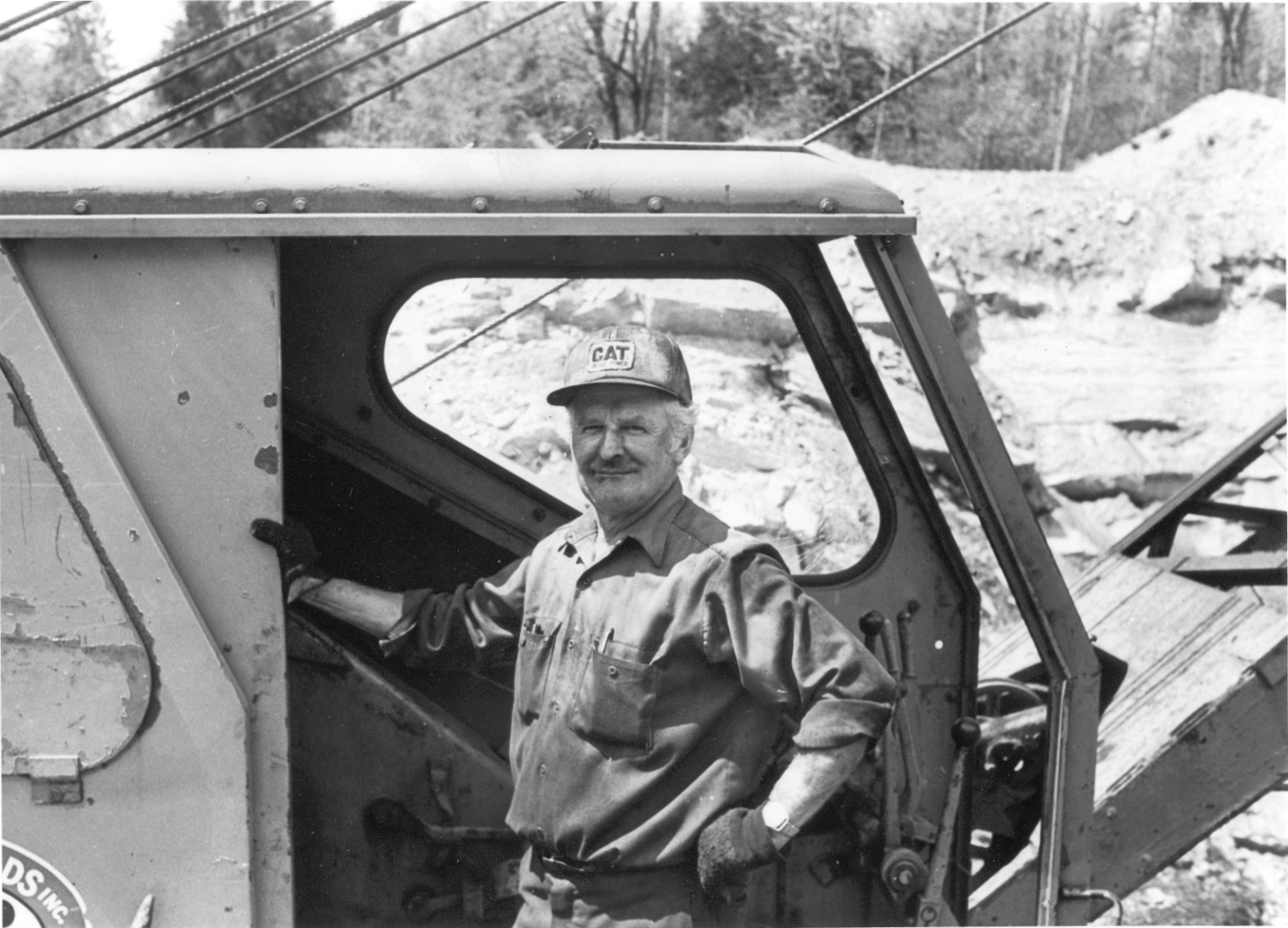
There wasn’t much that Dad liked more than operating the heavy equipment he did until shortly before his death.  Here’s Jack Kombol with a drag-line shovel at the McKay coal seam,on Franklin Hill east of Black Diamond, circa 1977.


Categories
Musings Uncategorized

Back in the Summer of ‘69

I didn’t get my first real six-string.  And Enumclaw’s five-and-dime was the last place this teenager wanted to be.  The allure of candy cigarettes and cheap toys had long since passed.  They may have been the best days of Bryan Adams’ life, but for me the Summer of ’69 was a middling byway on a slow road to adulthood.

Summer started off with a bang!  Literally! A Fourth of July bag of fireworks exploded on the front hood of my parent’s Ford LTD after an errant firecracker found its way in.  The following Monday, the Ltd with tarnished hood traveled three blocks to Enumclaw City Hall for my driver’s test.  Scoring 100 on the written and 96 in the car, I went home two days after my 16th birthday with a license to drive.

Woodstock Music Festival logo.

The summer of ’69 sounds so moving in retrospect – astronauts on the moon, hippies at Woodstock, Charles Manson in L.A, Kennedy on Chappaquiddick.  That wasn’t my summer.  Mine was frankly boring.  I didn’t have a full-time job.  Well, I actually had two part-time jobs: Office boy at Palmer Coking Coal manning the telephone and scale earning the princely sum of $5 for my five-hour shift. The second gig, as high school sports reporter for the Courier-Herald, I inherited from my brother, Barry.

I worked on July 5th, my 16th birthday earning $5, the cash receipt signed by my dad, Jack Kombol. It would mark the last time I ever worked on my birthday.

In the slow months of July and August, that second job meant little more than tracking down the two Franks of Enumclaw’s summer sports: Manowski and Osborn, for league scores and standings. That took all of a couple hours before Monday’s deadline.   During the rest of the week, tedium oozed.

I do remember going to the drive-in movies once at the recently opened Big ‘E” in Enumclaw and another time at Auburn’s Valley 6.  We rode in Wayne’s car.  I didn’t really see many buddies as most had jobs or played summer baseball, a sport I’d left two years prior. A very special thing did happen – one night Dad and I walked to the Roxy to see the film: “The Prime of Miss Jean Brodie.” It was likely the only time I went to a movie, just Dad and me.

That summer our family’s traditional vacation of one week in Grayland, and a second at Beacon Point on Hoods Canal ended.  The old-fashion cottage resort at Beacon Point shuttered and our joint vacations with the Cerne family were no more.  Those trips were the highlight of every summer since I could remember.  Barry graduated in June and headed to Alaska seeking his fortune. He returned soon enough finding out, that even in Alaska jobs don’t grow on trees.

Jeanmarie shipped out to Wilsall, Montana with her good friend, Cindy Johnson to help at her aunt’s cattle ranch.  Jeanmarie’s stay was cut short when Cindy’s grandpa died suddenly.  So the four remaining Kombols packed up and drove to Yellowstone retrieving Jean, coupled with a short tour of the park.  It seemed anticlimactic compared to our summer vacations of yesteryear.  The times they-were-a-changing.

Bill, Jack, Jeanmarie, Dana at Yellowstone, July 1969.  Mom as always was taking the picture.

I clearly remember the Apollo 11 moon landing on July 24th.  I remember not watching it.  It was an overcast day.  I bandied about the neighborhood, over at Jim Olson’s home, then here and there.  In the living room, Dad and Henry D. Gillespie, our Australian foreign exchange student sat transfixed on the sofa absorbed for hours.

Popping in that evening, I glanced at the TV then headed back outside.  I wasn’t slightly interested and had no appreciation for the magnitude of that moment – to me it seemed little more than a grainy television experience that went on for hours.  It turned out that Neil Armstrong’s one small step was viewed by more than 500 million across the globe.  In retrospect, my lack of interest was one giant failure to leap.

Henry D. Gillespie was a foreign exchange student from Australia who lived with our family for a year, from Dec. 1968 through Nov. 1969. This photo was featured in the 1969 Enumclaw High School yearbook.

Nationally, the Manson cult murders were a minor headline in the Seattle P.I., the newspaper I studiously read each morning.  Kennedy’s Chappaquiddick high-jinx was a much bigger story, which I earnestly followed.  I’d become a news junkie, with alternating subscriptions to Time magazine and U.S. News & World Report.  But, my perusal of the news was cursory – Woodstock in mid-August?  It didn’t register for me.  It wasn’t until the following year when Steve McCarty and I saw the movie that I even grasped what a music festival was.

What did register was a peevish, late-night, television personality named Bob Corcoran.  He hosted a channel 13 talk show.  Corcoran was the prototype for a mad-as-hell-and-not-going-to-take-it-anymore character, later seen in “Network.”  Half his audience was bored teenagers listening to drunken adults who called in to converse with Bob.  When teens placed a call – you could always tell – they’d make rude remarks, before the inevitable kill button and dial tone.  Between callers, Corcoran offered screeds on controversial issues, then ceaselessly promoted Tacoma’s B & I Circus store.

Bob Corcoran, our late-night TV fascination in the Summer of ’69.

That summer, our family friends, the Hamiltons were staying with us, having just moved back from London.  Their oldest son, Scott was a year older and we took over Barry’s bedroom in his absence.  There Scott and I watched Corcoran, howling at the inanities Bob spewed forth each night.  We giggled mindlessly at the mere mention of his name.  His show was so bad it made perfect sarcastic sense to our teenage-addled brains.  We even tried calling his show once but hung up after waiting on hold too long.

Corcoran later parlayed his quirky television stardom into politics by running for Congress in 1972.  His shtick was rabble-rousing, stick-it-in-their-face, populist rant, but in the primary, he was soundly defeated by Julia Butler Hansen.  How I ended up with the Elect Bob Corcoran to Congress ruler, I’ve long since forgotten.*

Corcoran used his television notoriety to promote a run for Congress, but failed miserably.

Night after night we tuned into Bob and played chess.  I’d taken up the sport during my just-ended sophomore year after reading an article in the Hornet student newspaper announcing formation of a new chess club.  My game improved quickly, landing me one of the top five boards.

The student newspaper, Hornet announcement in the Sept. 28, 1968 issue that changed my high school trajectory.

Scott Hamilton was a decent chess player who desperately wanted to win.  Late each night, we played game after game, again and again – 49 straight losses before Scott finally won.  But playing chess was just a way to pass time. Our real goal was to laugh at Bob Corcoran.

Scott Hamilton in 1967, one-year earlier when our family visited theirs in West Byfleet, a suburb of London

Amazingly, those memories are the most poignant of my summer of ’69.  The summer I turned 16, during one of the most dynamic times of the Sixties, when all the world’s charms lay before me – staying up late to watch a goofball TV talk show host and playing chess were my highlights.

All the same, everything turned out fine.  Returning to high school as a junior, my driver’s license landed me behind the steering wheel of the family’s second car, a 1965 Renault.  Our winning chess team became an important cog in my developing personality.  That semester I took an Economics class from Wes Hanson that ultimately directed my life (B.A., Econ, U.W., 1975).  Second semester I joined the Hornet staff and learned how to write.

Mr. Hanson at the lectern, a typical pose for the teacher whose Econ class led to my college major.

Another favorite, English lit was taught jointly by Miss Thompson and Mrs. Galvin.  Novels like “Catcher in the Rye” and “A Separate Peace” jolted a new sense of existential feelings through my all-to-logical heart.  “1984” and “Lord of the Flies” called into question what that heart was made of.  We read “Romeo & Juliet” out loud in class.  Franco Zeffirelli’s movie version had recently captured the nation’s attention, so our whole class attended a special showing one night at the Roxy.

Life accelerated.  The following summer, I worked 12-hour days selling popsicles, fudgesicles, and ice cream sandwiches.  High school life gave way to feelings of liberation and control.

Looking back on things, that summer of ‘69 was a quirky way station on the road through life – no longer a boy, but not yet a man.

* One day a few weeks before writing this essay, I ruffled through my desk drawer and grabbed for a straight edge.  Out came a Bob Corcoran for Congress ruler.  I have little idea how it landed there.  It came decades past from a Corcoran campaign booth brimming with swag at the Puyallup Fair.  Only serendipity can explain how that ruler appeared while writing this essay.