Categories
Uncategorized

Tony Kombol’s Fateful Day

Growing up in the extended Kombol clan meant at least four family gatherings each year – Easter, Father’s Day, Fourth of July, and Christmas Eve.  Occasionally, there was a wedding, an anniversary, or a Sunday assemblage added to the mix.  Grandma (Lulu) and Papa (Tony) had five children.  For me, that meant four sets of aunts and uncles, a total of eleven grandchildren, seven of them cousins.  Only Frank and Dana Zaputil were childless, but they always brought their good friend, Art, and the de facto twelfth grandchild, Pierre, a full-size French poodle, fully accepted into the family.  Pierre was probably the favorite.

Tony & Lulu’s 50th Anniversary party, Aug. 2, 196. L-R: Nadine, Tony, Nola, Lulu, Dana, Jack, Bernell.

Like most family parties, talk often turned to events of the second generation’s youth.  My parents, aunts, and uncles all grew up in the 1920s and 1930s in Kangley, Black Diamond, or Enumclaw.  Anytime one of the Kombols told a story, there was sure to be a dispute about the facts or the event.  There were often two or three different versions of what happened, to whom, and how.  There was even uncertainty regarding the date of my father, Laverne Shercliffe Kombol’s birth in 1921.  He was born at home in the small coal mining town of Hiawatha.   Some said July 17, others July 18, while July 21 was offered as the birthdate, according to his grandmother, Jennie.

And as to when Jack contracted polio and missed several years of school, no one could agree. Though it was some time after Tony’s fateful day.  As to that tragic event, no one remembered the month or year, but all agreed it happened in a Kangley mine.  But which one?

Maybe this is why I started researching and writing history, especially about the coal industry.  It’s no doubt helped having two grandfathers who were coal miners and two grandmothers who were school teachers.

Papa Kombol spoke in a thick Croatian accent.  Back then, the term Yugoslavian was still in use, or Austrian, as Austria ruled both.  His face and hands were speckled with purple freckles owing to a coal mining accident in the 1920s.  He wore thick, I mean thick, glasses and typically read his Croatian periodicals, mailed from the old country, held close to his face.  He had a hearty laugh, and when we were young, he always invited us to sit on his lap.

Anton Kombol was born January 6, 1885, in Fuzine, Croatia, to Anton Kombol (1849-1911) and Franciska Mihaljevic (1857-?).  Croatia had been a part of the Austrian Empire since the 1815 Congress of Vienna.  The first Kombols emigrated from France during the Napoleonic era, and successive generations of Kombol men married Croatian women.  The local industries were woodworking and furniture-making, which attracted the original French immigrants.  According to Leo Gregorich, Anton grew up in a place called Vrata, which means “gate” in Croatia.  It’s within walking distance of Fuzine.

As Anton approached adulthood, woodworking was in his future, if the Austrian army didn’t call first.   At age 17, Anton obtained an Austrian passport, issued on November 12, 1902.  He made the 20-mile journey to Fiume, then part of Italy (now known as Rijeka, Croatia), and sailed December 8 on a ship bound for Southampton, England, by way of Le Havre, France.  Anton arrived in New York on December 22, was processed through Ellis Island, then boarded a train on December 23, arriving in Roslyn, Washington, five days later.  It was nine days before his 18th birthday.

Two older brothers, John (Ivan) and Matt Kombol, both living in Roslyn, welcomed him.   Within days, he began work at the Northwestern Improvement Company’s coal mines that supplied fuel to power the locomotives of its corporate parent, Northern Pacific Railway.  Anton soon changed his name to the Americanized moniker, Tony.  For the next six years, Tony Kombol worked underground and saved his money.  He later moved to Cle Elum.

L-R: Matt Kombol, John Kombol, Anton Kombol, early 1900s, Roslyn.

In May 4, 1908, Anton Kombol filed his Declaration of Intention to become an American citizen.  He described himself as 5 feet, 6 inches, weighing 165 pounds, with brown hair, grey eyes, and a mustache.  That September, a 23-year-old woman named Lulu Shircliffe accepted a teaching position in Ravensdale as her pay in Centralia “was not sufficient to our tastes.”  She and a friend “landed in the hinterlands in Ravensdale, where the pay was tops, a coal mining town not far from Seattle.”

Sometime over the next two years, Tony Kombol moved to Ravensdale, whose mines were also operated by the Northwestern Improvement Co (NWI).  Tony found room and board with William and Hanna Joseph, while Lulu lived at the home of Stephen and Lottie Weston, and their son, William.  Stephen Weston was the hoisting engineer at the Ravensdale mine.

Tony Kombol, second from top with Croatian friends, likely near Ravensdale, circa early 1910s.

On November 11, 1911, Tony Kombol filed his Petition for Naturalization.  Matt Starkovich, a fellow Croatian and Deputy Sheriff for King County, and Frank Ludwig, a Ravensdale liquor dealer signed as witnesses stating, Tony “is a person of good moral character, attached to the principles of the Constitution of the United States, and is in every way qualified to be admitted as a citizen of the United States.”  Tony declared his Oath of Allegiance on June 27, 1912, and received his Certificate of Naturalization on July 16, 1912.  After ten years in the U.S., Tony became a citizen.

Lulu frequently returned to Chehalis to visit and stay with friends.  It isn’t clear how or when they met, but at the time Ravensdale’s population was just over 700, so it would be natural for two eligible adults to know each other.  In her job as a schoolteacher, Lulu was well-known and highly respected.  And in a town with 230 coal miners, many of them single, she would have been one of the best catches around.

Lulu Shircliffe with her class of Ravensdale students, 1913. She would marry Tony Kombol the following year and retire from teaching . . . until circumstances dictated a return.

On June 18, 1914, John and Marguerite Carnero agreed to sell a 7,250 square foot lot to Tony Kombol for $160, due on or before December 31, 1914.  Tony went to work building a house.  Tony and Lulu were married in Seattle on August 4, 1914, and enjoyed a ten-day honeymoon before returning to their new Ravensdale home.  As was the custom for young schoolteachers of the day, Lulu quit her job and went to work making their house a home.

Tony Kombol stands in front of the home he had built for his fiancée, Lulu Shircliffe, 1914.

On Tuesday, November 16, 1915, a blown fuse knocked out the hoisting machinery at Ravensdale No. 1.  One hundred miners were sent home until the problem was fixed.  Tony Kombol was one of them.  Hours later, 31 men were killed by an explosion that destroyed the mine.  It was the third-worst coal mining disaster in Washington state history.  Many of the deceased miners were buried in the Ravensdale Cemetery, while others were sent back to the homes of their youth. The tragedy hit Ravensdale hard, and the townsfolk suffered.  Merchants closed shops and miners left town seeking greener pastures.  It isn’t clear what Tony and Lulu did with their home; they probably sold it cheaply.  It survived and still stands at 27521 S.E. 271st Street in Ravensdale. The Kombols’ next two years would be hectic.

Shortly after the Nov. 16, 1915, explosion that claimed the lives of 31 coal miners and ended mining in Ravensdale for the next several years.

At the time of the tragedy, Lulu was three months pregnant with their first child.  In late December 1915, Tony traveled to Ray, Arizona, with a fellow miner, Charley Canonica, where they found work in a copper mine.  Several Ravensdale miners and their families followed.  Lulu shipped their belongings a couple of months later.  Bernell Kombol was born there on June 3, 1916.

After leaving Arizona, Tony found work in an Aberdeen, Washington, sawmill, while Lulu moved to Billings and joined her mother.  That’s where their second child, Dana, was born.  After rejoining the family in Montana, where he spent time working at the copper mine, Tony set off for Alaska, where business was booming.  He was determined to make a small fortune or return.  On his way north, Tony stopped off at Ravensdale to see William Reese, the Superintendent of the Northwestern Improvement Co.’s mines.  A new mine, called Hiawatha, located halfway between Durham and Kangley, opened in 1917.  Experienced coal miners were needed.  Tony accepted the offer, and Lulu returned to Washington and found lodging in Durham, where their third child, Nola, was born.

Tony Kombol and his first son, Bernell, circa 1918.

As Tony labored building the new Hiawatha mine, NWI built cottages west of Kangley-Kanaskat Road to house their workforce.  Some homes were transported by rail from Ravensdale, which hadn’t yet recovered from the disaster.  Superintendent Reese was fond of the Kombol family and offered them one of the choicest homes, next door to him.  Jack Kombol was born in that Hiawatha home, which still stands at 27723 Kanaskat-Kangley Road S.E.

The company needed that house back, so their fifth and final child, Nadine, was born in new quarters.  Sometime later, William Reese made it possible for the Kombol family to return to the nicer home and secured a 100-year lease for them.  They lived in that home until Tony died. Lulu remained several more years before moving in with Nola for her final season of life.  There, she wrote a striking autobiography, a testament to her writing skills and a treasure for her family.

In the forests above Tony & Lulu’s longtime home on the Kanaskat-Kangley Road, their grandson, Bill Kombol, explores the artifacts and surface structures around the old Hiawatha mine, Nov. 28, 2023

NWI’s Hiawatha mine proved to be a colossal failure.  The coal seam was subject to faulting, so production was frequently interrupted.  Plus, higher wages being paid at the nearby Durham mine caused Hiawatha’s miners to hold out for wages of $15 – $20 per day, compared to the $8 daily rate paid at NWI’s mine in Roslyn.  The Hiawatha mine temporarily shut down on November 1, 1920, then opened and closed on and off until its permanent closure in 1924.

For the measly amount of coal produced, Hiawatha had one of the worst records in the state, as measured by deaths per ton mined.  Joseph Ripoli, an Italian, age 43, was instantly killed by a gas explosion on the evening of July 7, 1918.  Ripoli left a widow and four children.  Then on May 12, 1923, a Greek miner named John Panotos, age 42 and single, perished in the mine after a slab of coal fell from the chute, striking his head, and causing instant death.

While we don’t have Tony Kombol’s work records, he probably kept working through closures owing to his close relationship with Superintendent Reese.   Even an inactive mine needs someone to run pumps to prevent flooding and start fans for ventilation.  William R. Reese was appointed State Coal Mine Inspector in 1923 and left NWI.  So did Tony Kombol.

In 1922, George Parkin and associates reopened the Kangley mine. A year earlier, they started mining in nearby Elk Coal.  The new Kangley portal was on the Alta seam, but no shipments were made that first year.  It isn’t known when Tony started work at the Parkin Kangley Coal Company.  It was located less than a mile from his home.  At the time, automobiles were a luxury, so most laborers lived within walking distance of work.

Life trundled along for the Kombols.  Lulu stayed busy raising five children, all under the age of ten, while Tony labored underground.  After more than a year of development work, the Parkin Kangley mine began shipping coal, just over 20,000 tons, in 1924.  They employed 32 underground miners, while another four processed and sorted coal in the top works.  The following year, production tripled to 64,000 tons, with 56 underground miners and twelve on the surface.  The addition of so many new miners, many of whom spoke different languages, coupled with a push for higher yields, may have weakened safety protocols.  We will never know.

The morning of Sunday, August 7, 1925, began like any other.  Most mines operated seven days a week, so Sunday work wasn’t unexpected.  It was a pleasant day with an expected high of 77°. Rain hadn’t fallen in over a month.  I still haven’t found the accident report that documents exactly what happened and how.  I did, however, by chance review an old envelope in Lulu’s collection of memorabilia, where I discovered the accident date, the coal company name, and the Washington Department of Labor & Industries (L&I) claim number 329482.

The Labor & Industries letter I discovered in an old envelope from Lulu’s collection of memorabilia.

But my attempts to find further evidence and information have thus far been stymied by arcane Department rules, communicated to me in a terse email dated June 20, 2024:

RE:      Anton Kombol
Records Request ID 154566

We have received your request for workers’ compensation claim records.  However, Washington State law prohibits us from releasing confidential claim records to anyone who is without express written authorization from the injured worker or the employer of injury.  At this time, the Department has to deny the request.

With Anton Kombol dead and the Parkin Kangley Coal Company closed over 98 years ago, I’m not exactly sure from whom I must seek written authorization.  Right now, L & I have blocked me from seeing the file until I figure out an angle, or a kindly bureaucrat bends the rules.  The search continues.

The only detailed description of the accident came during a September 2008 interview I conducted with Leo Gregorich, a close family friend and fellow Croatian.  At the time, Leo was 96 years old, but sharp as a knife with a keen storytelling ability.  My interview was fortuitous, as Leo Doran Gregorich Jr. died the following May.

Here’s how Leo described Tony’s Kombol debilitating accident:

“Tony told me about the accident.  He was in the hospital for 30 days, but he was always confident that he would get his eyesight back.  The accident happened when he was working in a coal mine.  He was working in a ‘room’ of a ‘room and pillar’ mine.  They were mining a ‘room’ in a pitched coal seam, in the crosscut.  They were using dynamite.  Tony has set some dynamite shots by lighting the fuses.  The lit fuse burned at a set time per inch and would ignite a cap that caused the sticks of dynamite to explode.

When Tony set his shots, there were miners working in the next room, and they were shooting their dynamite shots at the same time.  Tony set three shots to go off.  He thought he heard his three shots go off and then returned to his working area (room) and was met by his last shot, which exploded near his face.  Apparently, one of the three shots that he’d heard explode came from the miners in the next room.”

The explosion blinded Tony and permeated his face and hand with tiny specks of coal that in time became purple-colored blots.  After several years, Dr. J. Thomas Dowling, an associate in the Virginia Mason Clinic, performed an operation that restored Tony’s eyesight so he could read and perform chores around the house.  He was 40 years old.  His second act lasted 41 years.  As a side note, the clinic’s founder, James Tate Mason, was formerly Black Diamond’s company doctor.  As King County Coroner, Mason also led the investigation into the 1915 Ravensdale explosion.  Mason’s daughter was named Virginia, and that’s how the organization was named.

Ten months after the accident, Anton Kombol’s L & I claim was approved, and he was awarded a $40 monthly pension.  The three older children, Bernell, Dana, and Nola, were each awarded $5 per month.  Jack, at age 5, was given $7.50, and Nadine, age 3, received $12.50 per month, totaling $75 per month for the family of seven. The Kombols also received an immediate payment of $3,955 for Tony’s lost vision and partial hearing loss.

The Dept of Labor & Industries accident report and calculation of benefits under Claim No. 329482, for Anton Kombol, his wife, Lulu, and their five children, Bernell, Dana, Nola, Laverne (Jack), and Nadine.

The Kombol family’s troubles were not yet over.  Two years after the accident, likely in 1927, when polio saw its worst outbreak since 1916, their second son, Jack, contracted the devastating disease.  It landed him in bed for more than a year and kept him from attending school.  At home, Tony cared for him, as Lulu taught during the school year.

Then, their second daughter, Nola, became a very nervous, tense, and active child.  So much so that she developed fevers, which would last a week, and was bedridden.  Lulu took her to a child specialist who advised, “Keep her away from other children as she wears herself out keeping up with them or excelling them.”  A decision was made to send Nola to live with William Reese and his wife in the Mount Baker area of Seattle.  Nola lived with the childless Reeses until about 1930, when Mr. Reese, still the State Coal Mine Inspector, died.

The first year after the accident, Lulu was hired as a teacher in Cumberland through the influence of a friend.  It had been twelve years since teaching in Ravensdale.  Lulu started teaching 3rd and 4th grade on September 3, 1926.  She was paid $100 per month, or $1,200 for the school term.  Lulu Kombol continued teaching full-time for another 40 years until 1965, the year she turned 80. She remained a substitute teacher several years thereafter.

In 1937, Mrs. Lulu Kombol was teaching grades 1 & 2 in Selleck.

Tony never again found gainful employment. He played an early version of a house husband, taking care of the animals and performing household chores.  From my second to fifth birthdays, our family lived in Elk Coal, one-half mile from Grandma and Papa.  Sometimes I’d be dropped off with Papa for babysitting.  I remember following him during chores, napping in their bedroom, and Papa making me tomato soup for lunch.

Tony lived to the ripe old age of 82, spending the final weeks of his life with Jack and Pauline and their four children, to be closer to medical services in Enumclaw.  Lulu survived him by ten years, passing away in January 1977, at age 91.  They are buried together at the Enumclaw Cemetery near three of their children.

So, on this, the one hundredth anniversary of that fateful day, we salute brave Anton Kombol with a solemn adieu, farewell Papa, adieu.

Tony Kombol at a family party, circa 1965.


Categories
Uncategorized

March Fourth With Uncle Joe

I was blessed with eight fine aunts and uncles. There were no divorces among them.  Collectively the eight couples logged 430 years of marriage.  I was particularly fond of uncles, as a boy often is.  They bore names that belong to the Greatest Generation: Jack, Frank, Charlie, Bernell, Chester, Joe, George, and Evan.  Each influenced my life for the better.  My last surviving uncle, Joe Silvestri died at age 99 three months shy of his 100th birthday.

Like all of them, Joe had a firm handshake that greeted nephews upon arrival at any holiday event or family gathering.  Each had a different banter but Joe’s was unique – inquiring but posed by a man with something to say.  A diehard Roosevelt Democrat, Joe was usually the first to bring up politics, but just as quick to suggest a game of penny-ante poker.  “Just a little fun,” he’d say.  As the youngest nephew, what a thrill it was to play poker with older cousins and uncles on Christmas Eve.

Christmas Eve poker in the Silvestri basement. Clockwise from left: Barry Kombol, Bill Kombol, Gerry Beck, Lanny Silvestri, Uncle Joe, Dan Silvestri 1977.

In conversation, Uncle Joe often went one step beyond – usually to the supernatural, perhaps faith healing, copper bracelets, or fire walking.  He marveled at their possibilities and curative powers but when pressed added a disclaimer that much is still unknown. He talked politics with a passion, but politely and with a willingness to listen to differing points of view.  Joe was also that uncle with an 8-millimeter motion picture camera – complete with 500-watt lights blinding nephews and nieces who hurtled about the living room concealing our eyes from the glare.

In high school, Joe’s oldest son, Dan offered me a summer job selling popsicles from a 3-wheeled Cushman scooter.  The business was operated from the basement of Uncle Joe and Aunt Nadine’s home on Kent’s East Hill.  Each evening we counted our coins and bills.  Joe often stood watch over the assemblage.  Our tills were expected to match the confectionaries sold. Still, most drivers were short, through neglect or more often petty pilferage.  Mine always balanced perfectly.  For decades Joe bragged that ‘nephew-Bill’ as he called me, was their best Popsicle salesman and never short on his till.  Uncle Joe was a mentor who made me feel proud.

L-R: Joe, Nadine, Cheryl, Dan, and Lanny at Cheryl’s wedding to Gerry Beck, Sept. 14, 1974.

Joe worked much of his life as a highway engineer for the Washington Dept. of Transportation.  He began work on the I-90 project over Snoqualmie Pass in the 1950s.  My Dad and his brothers-in-law needled him about the construction job that never ended.  Uncle Joe graciously accepted their ribbing, offering a spirited defense with a knowing laugh.

One by one, my father and uncles passed away until only Joe remained.   He alone was left to care for the three Kombol sisters, his wife, Nadine, plus sisters-in-law, Dana and Nola, becoming their chauffeur and escort at family functions, marriages, and funerals.  When two more aunts passed on, only Joe and Nadine remained from that generation.  They celebrated their 75th wedding anniversary on a delightful Sunday afternoon joined by family and friends.

Joe’s work ethic befit the greatest generation he exemplified.  He served his family in life and death.  When Aunt Dana Zaputil died in 2012, family members were invited to choose items of remembrance from her home. We strolled through her Fauntleroy home telling stories, recalling good times, and singling out keepsakes. It was a hot summer day with temperatures stretching into the 90s and most kept to the air-conditioned indoors.

Someone asked, “Where’s Uncle Joe?”  Up on the rooftop, my 92-year-old uncle stood pressure-washing accumulated moss and debris to prepare his late sister-in-law’s home for sale.  It took the urging of two nephews and a son to convince him to come down the ladder and off the roof.  He did so only with a promise that one of us would finish the job.

Two years before his death, Joe, age 97, and Nadine showed up at Palmer Coking Coal to purchase a mixed load of sand and gravel.  I walked out to say hello as the loader dumped sand and 7/8” washed gravel into the bed of his small Ford pickup.  After the usual greetings and small talk, I inquired what he was doing with the mix, because it’s a specialty product.  Well, Joe explained, he planned to pour a slab that afternoon so would be hand shoveling the sand, gravel, and powdered cement into his concrete mixer back home.  I about fell over.

After knowing Joe for all of my sixty-plus years, he still managed to surprise me.  At their 75th wedding anniversary, Joe pulled out a harmonica and played a suite of songs to the large gathering of admiring relatives and well-wishers.  I had no idea he even played harmonica!

And just a week before his 99th birthday, Joe drove to my office with a worn suitcase of old photos and keepsake belonging to his stepdad.  Since I write a history column for the local newspaper, Joe gave me the opportunity to scan the contents in the event there was a story to tell. Indeed there was and I wrote it.

Joe & Nadine at their 75th wedding anniversary, Aug. 2018.

The Silvestri family’s proud Italian heritage.

Knowing the end was approaching, Joe hand-wrote his family’s history in a spiral-bound notebook.  His father, Carlo Silvestri grew up in the Emilia-Romagna province of Italy just 12 miles across the Secchia River from the home of his future bride, Clotilde Cavecchi.  They didn’t know each other.  Carlo found work in France eventually joining that country’s attempt to build the Panama Canal.  After the French effort failed, Carlo ventured to Washington where he became acquainted with Annibale Cavecchi whose sister, Clotilde worked as a housemaid in Marseille.

Carlo joined Annibale who was laboring on a farm in the Wabash-Krain area of Enumclaw. But he exchanged letters and photos with his sister, Clotilde, in the days before online dating sites. An arrangement was settled by which Clotilde moved to America and married the farmhand her brother had recommended.  Three decades later, Clotilde acquired that 40-acre farm where her brother and late husband had first found employment. Some of the land is still owned by Silvestri family members.

After the early years, Carlo and Clotilde moved to Black Diamond where Carlo worked as a self-employed lumberman hand splitting 2” x 8” wooden planks called lagging that were used in the coal mines.  He also raised cows, both dairy and beef, selling his meat in the Italian areas of Renton. Clotilde bore a succession of children, Nello, Ricco, Philomena, Fredericco, and Tomosco whose American names became Nick, Rick, Pink, Fred, and Tom.  They named their sixth child Giuseppe, Italian for Joseph.  Following baptism and confirmation, Uncle Joe added Anthony as his middle name.

During Prohibition Carlo joined a bootlegging ring, attending their still located east of Ravensdale. Clotilde’s first cousin, Tullio Cavecchi, and partner Sisto Luccolini sold the Italian brandy called grappa in Seattle.  But Carlo alone was nabbed in a raid and sentenced to a six-month term on a work farm.   Joe’s folks always referred to that farm as the ‘stockade.’  Still, Carlo earned enough money to buy a cow that he named Stocada, an Italian play on words.  Joe milked that cow for years.  Sadly, his father, Carlo died a few years later when Joe was only nine.

In time his widowed wife, Clotilde moved with her remaining children to Kangley where she married Frank Valerio, himself a widower. Joe was equally proud of his stepfather whose dusty suitcase came into Joe’s possession upon his death.  He spoke proudly of Valerio’s life as an Italian immigrant to Ravensdale, then Kangley where he worked as a coal miner.  Kangley is where Joe first met the children of Tony and Lulu Kombol, whose youngest daughter, Nadine he would one day marry.

Joe and Nadine in Kangley, 1942. Behind them is the Kangley Tavern, later operated for decades by Truman Nelson.

Joe delighted in his Italian heritage visiting the old country several times.  For decades he was a fixture in the Black Diamond chapter of the Sons of Italy.  Late in life, Joe paid tribute to the Italian dairy farmers who were active in the Enumclaw area and highlighted their work ethic.  Those family names were Ballestrasse, Capponi, Condotta, Fantello, Giglioni, Malatesta, Marietta, Primton, and Rocca.

A few years back wanting to learn more about his ancestry, Joe took one of the popular DNA tests.  It turns out my proud Italian Uncle Joe was actually 50% French.  Though he groused about the results, Joe chuckled ironically at his genetic heritage.

Joseph Antony Silvestri was born March 4, 1920, in Black Diamond.  Like many of his generation, he joined the Army during World War II. While Joe was stationed in South Carolina,his fiancé Nadine Kombol drove with her mother, Lulu across the country, where Joe and Nadine were joined in marriage on August 21, 1943.

L-R: Lanny, Joe, Dan, Nadine, and Cheryl Silvestri, 1953.

Together they raised three children: Danny, Lanny, and Cheryl.  His oldest son, Dan preceded his parents in death on the last day of June 2018.  Nadine passed away peacefully at their family home on Sept. 25, 2019.  Joe joined her just over two months later on Dec. 12th.  They are buried together in the Enumclaw cemetery right next to my parents, Jack and Pauline Kombol.

All my aunts and uncles are gone and so is most of the generation who guided me growing up.  Joe and Nadine were my last.  I miss them each dearly . . . especially Uncle Joe.

Nadine (Kombol) and Joe Silvestri in Wilmington, South Carolina on their wedding day, Aug. 21, 1943.


Categories
Uncategorized

My Buddy Keith

I can’t remember when I first met Keith Timm Jr.  It was likely as a kid at one of the Coal Miners’ picnics typically held at Lake Retreat. They were the highlight of our summers.  Free pop and ice cream, foot races for money, penny hunts, swimming, the Russian horse, baseball games, and watching coal miners and truck drivers drink too much.

And then there’s the vague memory of Keith, waiting for the bus at Enumclaw Jr. High (he was five years older than me) barking, “Hey! Aren’t you a Kombol?”

But we really got to know each other in the early 1980s when I took over as Manager of Palmer and hired Keith.  He began on the picking table, the usual starting job at a coal mine.  At the same time, cousin, Bob Morris was racing boats down the Cedar River, so Keith and I became his crew.  Hanging out together we soon became fast friends.  Maybe it was just driving around together in a pickup truck.  Anyone who rode around with Keith became his friend.

Keith Timm Jr., Rob Krause, Bob Morris, and Bill Kombol, the River Hawk team and boat crew during Cedar River boat races, circa 1980.

A few years later Keith told me he needed a place to stay.  He’d been living with his Mom and stepfather at their Black Diamond home.  Day after day, Keith complained about how much he detested his step-father, Ray. I don’t know the exact circumstances – some say Ray hit Keith’s Mom, Lorraine.  Whatever the cause, Keith proceeded to beat the crap out of Ray.  When the Black Diamond Police arrived they dispensed justice the “old-fashioned” way.  They told Keith to get out of town for a while.

Back then Lake Sawyer wasn’t part of town, so Keith asked if he could move in with Mom and me.  Soon Keith had a new home, but more importantly, someone to wash his clothes and fix his meals.  Several weeks into his stay, Mom asked me, “How do you think things are going?”  I said, “Pretty good, Keith seems fine.”  She replied, “There’s only one thing I can’t figure out – why is my toothbrush always wet?”  “So is mine!” I added.  Mom promptly bought new toothbrushes for all and wrote Keith’s name on his.

Keith Timm, Jr. and Governor Booth Gardner at the Black Diamond Museum, Nov. 1, 1985.

Keith was very proud of his sobriety.  He was an avid A.A. man and could tell you to the day how long he’d been sober.  I was still drinking back. One Friday night we went to a hockey game.  I got pretty drunk and Keith had to drive me home then put me to bed.  For the rest ofmy life, he never let me forget that night.  In time I realized Keith’s wisdom, so joined him in temperance. For me, it’s been 32 years, 21 days.  It was the second-best decision I’ve ever made and if it wasn’t for Keith I may not have made my best.

St. Patrick’s Day, 1985Gary Grant, our King County Councilman was running for re-election and held a fundraiser at the Lake Sawyer Community Club.  I asked Keith to be my date.  He was reluctant until I told him there’d be free food and pretty girls.

So we tooled over in my pickup and sure enough a pretty girl checked us in. We sat down and ate some food.  But, I couldn’t take my eyes off the girl at the welcome table.  She looked fairly young.  Being the suave guy I was, I wouldn’t dream of walking up and asking her age.  So, I had Keith do it for me.

Keith plops out of his seat, lumbers over to her table, and bluntly asks, “How old are you?” With answer in hand, Keith shuffles back and tells me.  Well, one political fundraiser led to another, and that to a Fourth of July party, a Volleyball game, and a burning boat.  Four years later I asked this pretty girl named Jennifer to marry me.  It was the best decision I ever made.  And, still happy she didn’t take a fancy to Keith.

Jennifer Grant and Keith Timm Jr. at Cedar River Boat Race day, June 1986.

In 1983, I was best man at Keith’s wedding to Kimberly Vaughan, a small affair in her parents’ home in Burien.  The marriage didn’t survive, but Keith was unfazed and confessed, “It sure was fun while it lasted.”  At times he drove me crazy.  But, like a boomerang, Keith always bounced back usually with a smirk on his face.  I’d ask, “What are you grinning about?”  He’d snicker as his smile grew wider.

Keith smiling broadly in the Palmer Coking Coal mine office after a full day on the picking table, Dec. 1984.  It was a dirty job, but Keith was never afraid of getting dirty.

Keith was famous for borrowing $2 for this or $5 for that, and usually paid you back . . . that is, if you reminded him time and again.  For those of you who haven’t been repaid, we’ve filled this glass bowl with dollar bills.  If Keith still owes you any money, now is your last chance to settle that debt.

There are so many more fond memories of Keith – like the time we toured the art galleries of Pioneer Square accompanied by a certified art snob – Keith in his stained overalls and plaid shirt surrounded by urbane Seattleites in snappy blazers and fashionable frocks.  Or the time I asked him to join me for dinner and a Mariner game at Safeco Field.  “Where do you want to eat?” I asked.  Without missing a beat, Keith replied, “The Metropolitan Grill” (the most expensive steak house in Seattle).  “I’m not taking you to the Metropolitan Grill,” I snarled, “I don’t even take my wife there.” We went to the ball game and out to dinner, but not to the Metropolitan Grill.

Keith kept the ticket stub to our Mariner game. I found it when cleaning out his trailer.

Or how about Keith at Alcoholics Anonymous?  He’d normally attended meetings in Grange halls or church basements, but in time grew more adventuresome.  Like when he started attending nude A.A. meetings held at a Jacuzzi in Bellevue of all places.  Now, that’s a picture to wrap your brain about. “Hello, my name is Keith and I’m an alcoholic” . . . buck-naked in a hot tub.

But, some of my best memories of Keith are just driving around playing old-time music and joining him as we crooned to the stereo. We did it one last time – a few days before he sank into the coma.  Two songs we heard that day are those I chose for his video tribute.

Keith holding my nephew, Carter Grant at our Lake Sawyer home, 2010.  Keith and Carter shared the same birthday, August 6.

We hadn’t seen Keith for a few days which was unusual because he always came by the mine office for something. Shelley Arnold, my secretary of nearly three decades suggested I check up on him.  I drove up to his camp trailer and saw his pickup, so knew he was home.  I banged on the door and yelled his name, then made my way through his collection of everything and found him lying on the bed.

Keith was breathing faintly.  I shook him, but he was unresponsive, so called 911.  The operator took our location and talked me through performing CPR and continued for 10-12 minutes before medics arrived. It wasn’t easy hauling him out of those tight quarters. I followed the aid car to Valley General and checked him into the hospital.

Keith Timm Jr. in coma at Valley General hospital in Renton, May 19, 2017.  Great efforts were made by the hospital staff to save his life.

The doctors and nurses hooked him up to a dozen tubes and devices, but Keith’s days were numbered in single digits.  I knew he wouldn’t mind me taking his picture, and if he recovered would enjoy seeing all the efforts undertaken to save his life.  Oh, what a laugh we would have had over this photo.  And an even bigger laugh when I reported about all the pretty nurses who fawned over him night and day.  Keith’s grin would be sparkling like the morning sun.  Then he was gone.

Keith Byron Timm Jr. was one-of-a-kind and I miss him dearly.  He was my buddy and I was his boss.  We were best friends.

Click on this link for a video of photos set to the songs Keith and I listened to on our last drive-around:  https://www.youtube.com/watch?v=pVPbCXxV0yE

A celebration of his life was held Friday, June 16, 2017 at the Black Diamond Community Center, where I delivered the above eulogy. His obituary and two photos appear below. – Bill Kombol

Obituary:

Keith Byron Timm Jr., a lifetime resident of Black Diamond, died on May 27, 2017, at Valley General Hospital. He was 68.

Keith graduated from Enumclaw High School in 1966.

He was born on Aug. 6, 1948, to Keith Timm and Lorraine Gibson. He grew up in Black Diamond and graduated in 1966 from Enumclaw High School. At the height of the Vietnam War, he enlisted in the U.S. Army and entered boot camp before receiving a medical discharge. He worked in the paint shops at Pacific Car and Foundry for a number of years, before joining Palmer Coking Coal Co. and later Pacific Coast Coal. He was married in 1983 to Kimberly Vaughan for a short time. He was a former member of the Black Diamond Fire Department and a Thursday regular at the Black Diamond Historical Museum. He loved antique trucks and was particularly proud of his 35-plus years of sobriety.

He is survived by his sister, Donna Elaine (Timm) Snow.

Remembrances can be made to the Black Diamond Historical Society, P.O. Box 232, Black Diamond, Wash. 98010.

Keith faithfully attended the Black Diamond Museum each Thursday, where Museum’s official photographer, Bob Dobson snapped this picture one time.  Whenever Keith saw him around town, he’d yell, “Hey Bob, take my picture.”


Categories
Musings

I wrote this letter to Mom & Dad

Forty-five years ago, I wrote this letter to Mom & Dad.  I was in Paris near the end of my first of five months in Europe.  My sister Danica (then known as Dana) was studying at the Sorbonne for a year so my parents decided to visit her during an extended vacation.

I quit my job at Seattle Trust & Savings Bank and decided to start fresh and discover my future.  I’d explore Europe – alone, for months, with little direction and no particular plan or focus, and somehow at the end of it all at age 24, find myself.

I came to Paris a few days before my parents arrived.  On Feb. 6, 1978, we began a 25-day auto tour of Lyon, Nice, Monte Carlo, Pula, Zagreb, and Vienna, highlighted by visits with several sets of Croatian relatives.

Mom and Dad left for home on March 3rd and several days later I penned this Aerogramme letter.

One of several letters to Mom and Dad written on light-weight, air-mail, self-sealing envelopes.

March 6, 1978

Dear Mom & Dad –

I don’t quite know what to say.  I hope you weren’t disappointed that I didn’t express my gratitude as much as I could, but you’ll understand that the ‘thank-yous’ would have been so numerous as to make one thank-you seem inconsequential.  So, I guess what I want to say is thank you a thousand times for everything.  I hope I was acceptable as a traveling companion as I sure enjoyed your company and now miss it.

Jack & Pauline’s passport photo for their 1978 trip through Europe.

You’ll never guess what we did Saturday.  Oh, this was ten times better than the sewer system.  Dana and I visited the Catacombs of Paris.  I wish I could send you a postcard (I sent one to Clinton) so you could get the visual impact of seeing these millions of human bones stacked like kindling in tunnels several hundred feet below the streets of Paris.  They were placed there when several Paris cemeteries were torn up to make room for the city’s expansion in the late 18th and early 19th centuries.  It’s a bit morbid at first but fascinating nonetheless.  Got some good pictures (ha ha).

Bill at the Paris Catacombs, March 4, 1978
Danica in the Paris Catacombs, March 4, 1978.

Yesterday, Sunday, Dana and I visited the Rodin museum.  Rodin was the famous sculptor who did the “Thinker” – the piece with the man sitting, chin on his head and elbow on his knee in a very thoughtful moment.  The gardens were beautiful as was the weather yesterday and today.  The skies are now a bright blue and the sun shines hard.  The temperature though has dipped and it’s rather cold outside.

Today, I visited the Paris stock exchange which was extremely interesting, particularly after having seen the commodity exchange in Chicago.  I almost wish I’d seen the Paris exchange first, as it is so calm compared to the unruly Chicago market.  There’s still lots of shouting and such but nothing compared to the screaming in the commodity pits.  Here in Paris, I was able to actually walk on the floor of the exchange, though I did get a couple of stares (no doubt due to my casual attire in the midst of a sea of suits).  But the amazing thing was that I was walking on the floor of France’s equivalent of the N.Y.S.E.

Their exchange system is quite different from the American counterparts, as prices seemed to be established more by consensus than by the bid-ask system in the U.S.  This probably explains the calmer stance as that all-important need to scream your order and acceptance of the other bidder’s order doesn’t really need to exist here.  An interesting sidelight was at one point during the bond market when all the men broke into a song they sang humorously for half a minute.

Writing as small and legibly as possible, you could tell a good story on an Aerogramme (plus there was 1/3 of a panel on the back).

I moved into this hostel for Protestant students.  It’s a dormitory situation, but I get a bed, breakfast, and hot showers all included for 20 francs a night (about $4).  Almost half the people here are French, a quarter English, and the rest Americans.  In fact, before I finished the previous sentence I was engaged in an extended conversation with John Leeson, an Irishman who now lives in Oxford and is teaching French here in Paris.  And, this letter might begin to sound a bit disjointed as I’m sharing my bottle of Yugoslavian wine with John and Jeff Alford, an American from Newport Beach, California.  We’re listening to Radio Luxembourg (Europe’s Top 40 station).

I met Dana’s good (best) friend Carrie, the one whose parents were here over Christmas.  She’s red-headed and quite nice, the exact opposite of Jana.  Dana even admits that Jana is a bit too much.  Much of the time her stories are B.S. and it can even get to Dana at times.

I ate dinner at Dana’s one night and can understand the source of many of her culinary complaints.  The food is horrible.  I had spinach – not the fresh green vegetable I’m used to, but a dull, sickly green blob of something that if you didn’t know it was food, you wouldn’t touch it with a ten-foot pole.  The best I can say was that it was barely edible.

Well, say hello to Barry and Cathy for me (and tell Cathy thank you for the Valentine’s card).  Also, tell her I’m sorry I didn’t send her one but I actually forgot when I was making a list of everyone I sent one to.  Also, if you happen to see Wheels, tell him that his cassette deck is in my room.

Thank you for everything.

Love, Bill

Post Script: I wrote several more letters to Mom and Dad on that trip.  Mom kept a keepsake box for each of her four children where after her death I found that letter and many other treasures.

Jack and Bill Kombol, Feb. 8, 1978. I know the date because my efficient Mother kept a detailed travelogue of our journey.

During those four weeks we spent together, I grew closer to my Dad than perhaps I’d ever been.  He worked hard all his life and in later years found numerous ways to give back to the community.  He helped the old oddballs to whom he rented tiny apartments on the second-floor above Steve’s Shoe Store at the corner of Griffin and Cole in downtown Enumclaw.  He was elected to the school board and as such handed me my diploma when I graduated from high school.

Jack Kombol hands me my diploma, June 2, 1971.

Jack Kombol passed away April 11, 1979, not even a year after coming home from our trip to Europe.  He died on a Wednesday, I wrote a poem on Thursday, and read it at his funeral on Saturday.  I was 25-years-old, channeling feelings from the 14th year of my life when two grandparents, Dad’s father and Mom’s mother died on the same day:

Tears We Have

The last day we expected was the morning that we feared
the nights we cried so long ago have come to rest right here.

We gazed in one another’s eyes
We prayed that we might cope
We stared through nature’s loneliness
and filled our days with hope.

Every day brings forth each night from which dawns each new day
longings fill the times between with thoughts from yesterday.

We’ll never let our smiles down
We’ll never lose our faith
We’ll never touch the world beyond
or see tomorrow’s face.

The news it comes so suddenly, the sadness travels far
raindrops fall from blossomed eyes as we touched who we are.

We realized the sorrow
We understood the pain
We felt the empty feelings
yet prayed no prayers in vain.

And so we’ll cry these tears of pain from sorrow we must store
the tears we have are tears we’ve cried a thousand times before.

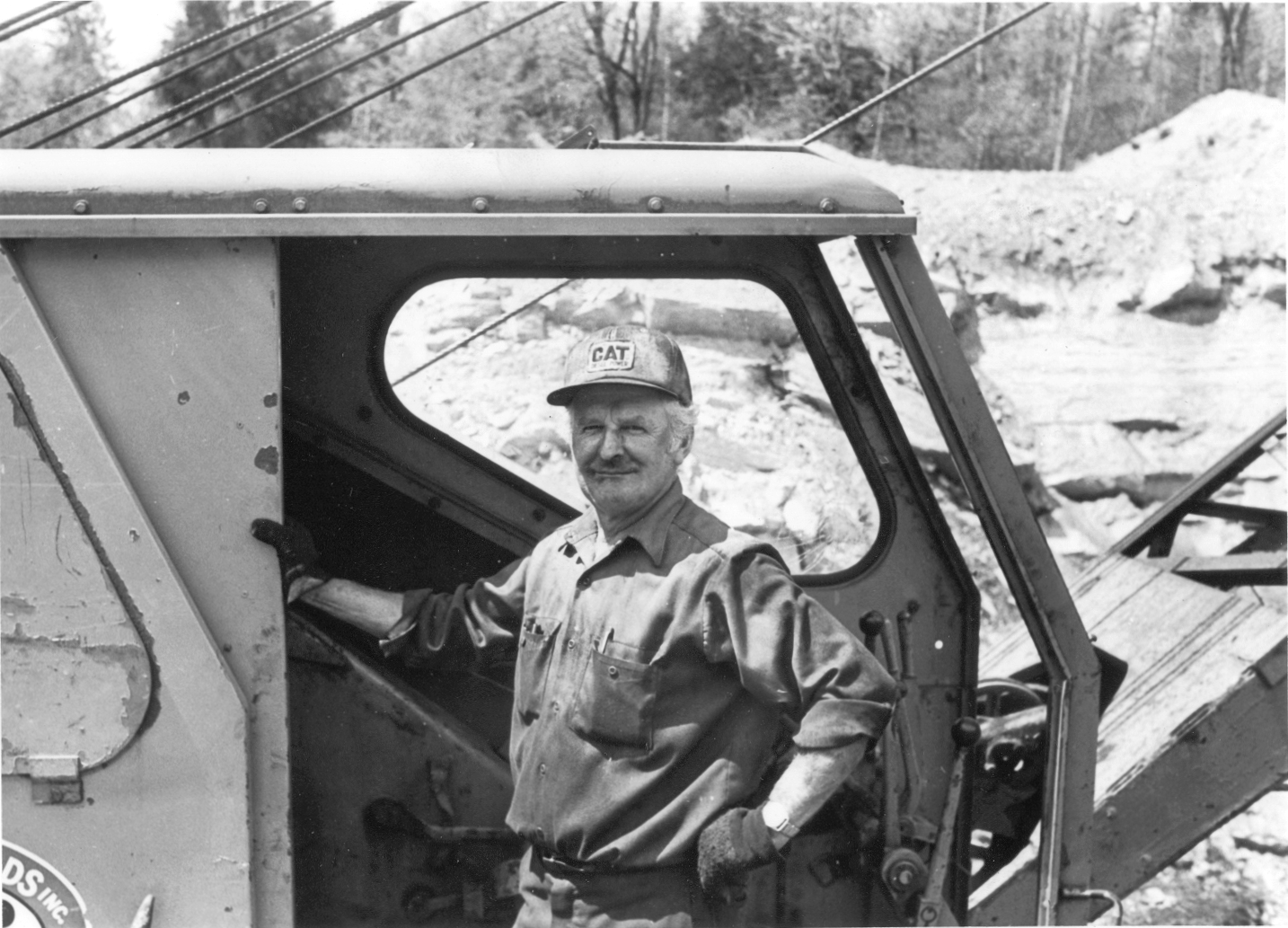
There wasn’t much that Dad liked more than operating the heavy equipment he did until shortly before his death.  Here’s Jack Kombol with a drag-line shovel at the McKay coal seam,on Franklin Hill east of Black Diamond, circa 1977.


Categories
Musings

Abraham, Martin and PCC

In the fall of 1968, Dion released a song that touched my soul.  About the same time, I started working Saturdays at a job that defined my life.  I still work there until March 2022.  This is the story of the song, that job, and a 15-year-old boy.

The Beatles’ single “Hey Jude” backed by “Revolution” dominated the airwaves. The Detroit Tigers, my favorite baseball team would soon play in the World Series. A presidential election heated up following a deadly political year culminating in riots at the Democratic convention in Chicago.

Kris Galvin and I were freshly minted sophomores. Each day after school we played a board game called Mr. President. Two players strategized their way to victory by assembling a majority of votes in the Electoral College.  In the real election, Nixon did just that, defeating Hubert Humphrey while George Wallace carried five states.

In late September, I began a new job at Palmer Coking Coal as their Saturday boy.  After a day of training, I was in charge of the Black Diamond office from 8 a.m. to 12 p.m., though typically worked longer.  I didn’t yet drive so Dad dropped me off each morning, picking me up a little after noon.


The mine office of Palmer Coking Coal on Highway 169, about the time I started working there.

The work consisted of sacking coal, answering phones, and operating a scale—but mostly selling nut and stoker coal to old guys driving pickup trucks.  It was quite a thrill to command an office, poke about in drawers, make change, and run the store.  I earned $1.00 per hour, paid with money drawn from the cash drawer and replaced with a handwritten receipt.

Dad signed for my wages and I’d take a $5 bill out of the drawer. Three years later when I left this job, I was earning $2 per hour. (I found this old receipt 40 years later in a box in the attic at the same mine office where I first started).

It wasn’t always busy so after reading the P-I, I tuned the radio to KJR-95.  My youth’s mind remembers where and what I was doing when certain songs played.  That October, I heard Dion DiMucci sing a gentle folk tribute to the assassinated heroes, “Abraham, Martin and John.”  The final lyrics delivered a stanza for Bobby Kennedy.

“Has anybody here seen my old friend Bobby

Can you tell me where he’s gone?

I thought I saw him walkin’ up over the hill

With Abraham, Martin and John.” Dick Holler

Dion’s single next to Bill Kombol on his first day of high school, Sept. 3, 1968.

I was a fervent reader of newspapers and convinced Mom to buy a subscription to U.S. News & World Report.  On the last day of March 1968, Lyndon Johnson announced he wouldn’t seek re-election to the presidency.  Martin Luther King was shot dead in Memphis four days later.

On June 6th, the Kombol family checked into the Hotel Austria on Fleischmarkt Street in Vienna.  The tragic news of Robert Kennedy’s assassination splashed across the front pages of every paper on the newsstand.  The photo of 17-year-old, Juan Romero cradling the head of a fallen senator in the kitchen of the Ambassador Hotel has haunted me ever since.  An old Austrian woman draped in a black shawl stood in the lobby hissing, practically spitting the words out, “Johnson, Johnson!”

 Kombol family in Austria, L-R: Jeanmarie, Pauline, Bill, Barry, Dana. June 1968.

Dion’s song was poignant and melancholy.  It tugged at my heart while coaxing a tear.  Soon the three-minute radio broadcast was over.  It might be hours until it played.  I wanted to hear it time and again.

Work ended and I was home in the afternoon.  I usually fixed tomato soup and cheese-toast for lunch then listened to the Huskies on the radio.  Only the rarest of U.W. football games were broadcast on television.  Later friends and I might play a game of touch football at the Kibler school playground.  Time passes quickly in adolescence and evening came soon enough.  Dinner was promptly at 6 p.m.  Mom always made hamburgers on Saturday night.

While the song accompanied my introduction to the first months of high school, “Abraham, Martin and John,” made a cameo appearance shortly after graduation.  A collage by Tom Clay joined “What the World Needs Now Is Love” to live broadcasts of the assassinations introduced by snippets from Dion’s hit.  That summer of 1971, I worked long hours selling popsicles east of Kent and often drove home listening to the six-minute spoken word hymn.

I never really left Palmer Coking Coal.  During college, I spent summers as a laborer.  I worked the afternoon shift at the Rogers No. 3 my senior year.  It closed a few months later, the last underground coal mine in Washington.  After graduating, I joined Palmer for employment stints of two and three months when no other adventure called.

On of my  stints working for Palmer involved relocating parts of the Stergion cement plant in Enumclaw to Black Diamond  With money made from those three months, I traveled to Hawaii with my high school buddy, Wayne Podolak, Jan. 1976.

In August 1978, I began full-time employment at PCC, back on the picking table.  A decade of college, loafing, banking, odd jobs, and traveling landed me back where I’d begun 10 years earlier.  Four years later, I was appointed Manager of the company.  The following summer we celebrated Palmer Coking Coal’s 50th anniversary. I was 29-years-old.

In early 1979, I was brought into the office to learn how to run the business. I sat across my uncle Charlie Falk who snapped this picture.  I continued to sit at the same desk for the next 44 years, Summer 1979.

It’s now 40 years down the road.  I’ll soon be leaving full-time employment at PCC.  It’s where I’ve spent all but two years of my working career.  Of these things I’m certain––this job and that tune will forever remain in my heart, intertwined in a romantic ballad where the only constant is change.

I look back with nostalgia yet forward in anticipation.  How these next adventures unfold will be the continuing story of my life.

*  *  *  *  *  *  *

Post Script: Here’s the short story of Dion’s life and the song that changed mine.  Dion DiMucci was born in 1939 to Italian-American parents in the Bronx.  Teaming with friends from Belmont Avenue, Dion and the Belmonts scored their first hit in 1958 with “I Wonder Why.”

While on the 1959 winter concert tour with Buddy Holly, Richie Valens, and the Big Bopper; the bus’s heating system gave out so Holly charted a plane to their next venue.  Dion balked at paying $36, his share for the flight because it was the rent amount his parents struggled to pay each month.  The plane crashed, killing all on board.

Dion split from the Belmonts in 1960, pursuing a solo career with hits like “Run-Around Sue” and “Donna.”  After continually humming Dion’s rendition of “When You Wish Upon a Star,” from the Disney movie Pinocchio, Brian Wilson composed the Beach Boy’s ballad, “Surfer Girl,” in 1963   It was his very first composition.

Dion Now & Then is how I titled my Dion tribute CD compilation.

Dion was one of only two rock artists to appear on the cover of the Beatles’ 1967 album, Sgt. Pepper’s Lonely Hearts Club Band.  Bob Dylan was the other.  With changing tastes from the British Invasion and a growing heroin addiction, Dion started recording blues numbers in the mid-1960s.  His records failed to sell so he lost his contract.

In April 1968, Dion experienced a powerful religious awakening.  He gave up heroin and his label agreed to re-sign him if he’d record “Abraham, Martin and John.”  The single was released that August, reaching #4 on the charts in October.  It was written by Dick Holler, composer of the Royal Guardsman’s novelty hit, “Snoopy vs. the Red Baron.”

In the 1980s, Dion became a born-again Christian, releasing five albums highlighting his evangelical convictions.  In June 2020 at age 81, Dion released his most recent album, “Blues with Friends” featuring a range of artists including Jeff Beck, John Hammond, Van Morrison, Paul Simon, and Bruce Springsteen.

*  *  *  *  *  *  *

Coda: On a warm summer evening in the early 1960s, Billy Kombol stood at the door of the open-air dance pavilion at Barrett’s Lake Retreat resort, mesmerized by the sight of teenagers dancing to the jukebox sounds of Dion and the Belmonts.

Categories
Musings

The Man Who Dredged, Filled, and Sculpted Lake Sawyer

by Bill Kombol

One man was responsible for the vision behind dredging, filling, and sculpted what is now known as Lake Sawyer Park. He lived on Lake Sawyer for nearly two-thirds of his life.  That’s a long time for a 95-year-old who built his lake home in 1961.  His name is Jim Hawk and he’s arguably done more to craft the Lake Sawyer we know today than any other person.

LS065- Lake Sawyer, circa 1985 looking south east. Jim Hawk’s completed project can be seen at the top of this photo at the south end of the lake.

Jim Hawk was born in Seattle on April 27, 1926.  His father, Ray Hawk was of Dutch descent but left his Pennsylvania home at age 13.  His mother, Mary Romano, was the daughter of Italian immigrants.  His grandfather, Sam Romano was blinded by a dynamite blast at age 18, returning to Italy where doctors restored his sight. Sam came back to Seattle and started a family-owned construction company, Romano Engineering which developed the Riverton quarry and built highways, bridges, dams, and other projects.  

The extended family lived in one large home in the Mt. Baker neighborhood of Seattle with Jim’s Italian grandmother, Anna who spoiled Jim and his cousins rotten.  Growing up Jim loved chemistry and inventions.  With money earned from cutting lawns and landscape work, he’d head straight to Scientific Supply Company to buy chemicals and lab equipment.  Often his mother signed permission slips so Jim could purchase ingredients which could only be sold to adults.  Jim was known as the “mad bomber” of the neighborhood making rockets and bombs from his chemistry set. 

Jim graduated from Franklin High School in 1944 and would have been drafted for World War II, but for an automobile accident near Skykomish which left him nearly dead and lying in the river bed.  He spent a long time recovering from a collapsed lung.  That fall he enrolled at Seattle University graduating in 1948 with a degree in chemistry, his childhood hobby.  However, one of his most consequential lessons came from a Jesuit priest in an American history course Jim hadn’t wanted to take, but was required to graduate.  To this day, Jim remembers the opening lecture.  “All history teaches is that we never learn from our mistakes.”  A light came on in Jim’s brain.

After graduating from Seattle University, Jim was accepted into graduate school at the University of Washington.  He joined the chemical engineering program seeking a PhD in electro-chemistry.  Jim demonstrated his early brilliance by proposing an idea of creating fluorocarbons through electrolysis with hydrocarbons.  The professor was amazed as Jim described a process which had only recently been theorized.  However, his graduate studies fizzled when Jim took a heavy load of classes.  One consisted of memorization which didn’t teach him to think; another by a professor who on day one asked his students, “Which course am I teaching?” And the third, who, “Didn’t teach you to think outside the box,” as Jim recalled, “The biggest dud of my life.”

Around this time, the Romano family business began to disintegrate.  His dad, Ray Hawk started Black River Quarry, Inc. mining a rock deposit near Tukwila where the Black River once flowed from Lake Washington into the Green / Duwamish River.  The Black River disappeared in 1916 after Lake Washington was lowered 9 feet and connected to Puget Sound through the Ballard locks.  Ray was having problems running his quarry so reached out to Jim who dropped out of grad school.  He planned to help his Dad for a short time.  Jim easily solved early problems though each day brought new challenges so he stayed on full time.  Eventually Jim took over the business. 

Grand projects like redirecting the White, Black, and Cedar River, plus lowering the level of Lake Washington were common in the early 1900s.

Jim’s talents were always larger than his business life.  In 1953, he filmed a nature movie from the cockpit of his Super Cub float plane.  The movie was professionally shot in 16 millimeter wide-angle, commercial cinemascope, color film with Jim narrating.  He offered the movie to Disney but they declined.  In 1958, Jim married Mary Jo Burns, and by 1961 they’d built the Lake Sawyer home where they still live today.

In February 1966, Jim purchased a 31-acre parcel of primarily swamp land from John D. Nelson for $37,000.  Nelson bought the property in 1945 from Pacific Coast Coal Co. at a price of $820. It was located at the south end of Lake Sawyer with access at the terminus of S.E. 312th Street.  Jim’s vision was to turn the marshy property into a lakefront residential development.

This 1936 aerial view of the south end of Lake Sawyer shows the swampy area where Hawk dredged and filled in the late 1960s. The Lake Sawyer Road is the bright white line to the left. Ravensdale Creek be seen to the north, while Frog Lake through which Rock Creek flowed is southeast of the lake.

Jim’s company, Black River Quarry (BRQ) mined rock, much of which was sold during wet winter months.  But Jim had a problem keeping key employees busy during the slow summer season.  He employed four extremely talented individual who could do just about anything when it came to earthmoving.  Chris Peterson was one of the best shovel operators to be found, even into his 70s.  John Yourkoski was a journeyman bulldozer operator who also ran loader and dragline.  Walt Schoebert was a master mechanic with a knack for tinkering and building machines from component parts.  Don Shay worked in the office and was always ready with sage advice. 

Jim spoke with experts, but nobody had ideas for building a road through a twin-creek delta, that was half swamp with the other half peat bog.  So he read widely about bogs and contacted Leno Bassett who mined peat in the Cottage Lake area.  Bassett provided good advice and Jim’s plans soon took hold. 

Hawk obtained Hydraulic Project Approval from the Department of Game & Fisheries in 1967 for a channel change and excavation of the shore of Lake Sawyer.  The permit allowed dredging of two creeks and the lake’s bottom, with requirements to protect water quality.  Work was done on an intermittent basis to prevent excessive siltation.  Production was prohibited on weekends and holidays to protect recreational users of the lake.

LS015- Southeast end of Lake Sawyer, circa 1968-69. This view shows the early construction of gravel dikes and the dredging of the Ravensdale Creek inlet to the right. Aerial photo by Jim Hawk.

Jim’s plan was to refashion the swamp into 31 acres of dry land surrounded by open water, the two separated by piling and wooden wall panels.  The topography was surveyed by Jim and BRQ employees using probing devices to determine whether they were standing on peat soils that were floating over water.  After the initial survey was complete, a rudimentary plan was developed to build access roads and perimeter dikes throughout the dense jungle of interlocking vegetation. Behind these dikes new dry land would be formed from the dredged and fill material.  Outside the dikes open water would connect Ravensdale Creek and Rock Creek to Lake Sawyer.

To gain access through the marsh, a floating road concept was utilized.  In some places peat and mud extended down over 40 feet before reaching compactible soils.  Downed logs, brush, and debris from clearing were used as a mat that was pushed down into the peat and mud by a bulldozer.  A gravel road several feet thick rested above the “floating vegetation mat” below.  Pit run gravel was obtained from three barrow sites on the property.  Those gravel deposits rose 10-15 feet above surrounding terrain.  Most of the older-growth trees outside the gravel extraction areas were preserved. 

LS026- South end of Lake Sawyer, circa 1968-71. This was the staging area for the piling and panels forming the pier wall which separated land and water. Photo by Jim Hawk.

This floating road needed to be stable enough to support bulldozers and a 53-ton Northwest brand cable-operated shovel.  The shovel doubled as a crane, equipped with a 3/4 cubic yard clam bucket for digging or a dragline bucket for open water dredging.  Other miscellaneous equipment supported the operation.  When remembering the challenge, Jim laughed out loud, “Nobody else in their right mind would have tried it.”

The long-term success of the project depended on using the best bulkhead materials available.  Jim found piling at the Wyckoff Company consisting of hemlock poles, pressure-treated with Chemonite preservative, yet still needed to find a long lasting cable to hold everything in place.  In a stroke of luck, Jim talked to Pacific Iron & Metal who had just come upon 14,000 lineal feet of surplus 3/4” stainless steel cable which could be had for 50-cents a foot.  Jim bought it all.

During the summers of 1967 and 1968, the initial work of building a perimeter road to separate Frog Lake from Lake Sawyer was completed.  The dragline shovel operating from the road excavated mud from the lake and built a containment berm just inside the gravel road.  The pile driver used the same perimeter road to drive treated wood piling until these long poles reached a firm foundation.  The piling were driven at an average 10-foot spacing with treated wooden walls placed between, thereby providing a sturdy barrier between land and water.  

The first phase of the project ended, but the next stage of dredging and pumping was even more challenging.  The dredge–pumps Jim investigated were typically used in oceans and rivers, far too large for a small lake.  Once again he consulted experts but found no clear answers for available technology. 

Ever persevering, Jim and his master mechanic, Walt Schoebert began designing their own machine.  It was a tall order as it had to float; move around the lake; cut through a dense mat of peat, roots, and mud; shred the mixed result; then pump it through pipes into diked areas.  In addition, the machine had to work around and through ancient logs littering the bottom of this jungle-strewn bog.  

LS021- The south end of Lake Sawyer, circa 1969-71. The cutting and dredging machine created by Walt Schoebert and Hawk is parked next to recently installed piling. The gravel dike road is partially covered by water to the right of the piling. Bob Eaton’s white boathouse located at 23232 S.E. 312th (now owned by Adam & Jenna Running) can be seen in the distance. Photo by Jim Hawk.

The next order of business was building a barge consisting of sealed floatation tubes connected by decking where machinery could be housed.  Paddle wheels were installed on each side of the floating wing tubes for propulsion.  A 4-cylinder GM diesel engine was bolted down to power the large hydraulic pump driving the machinery.  A cutting wheel was developed which could be lowered by boom into the muddy vegetated morass.  The cutting knives were protected within a collecting box.  The emulsified cuttings consisted of chopped roots, peat, mud, and wood shreds. 

In order to suck this slurry and water mix, a pump designed for sewage plants was chosen.  That impeller pump thrust the slurry mixture through heavy rubber piping to containment areas behind dikes.  If they hit a log or something impenetrable, the cutting heads stopped and the differential caused the pump to stall.  The boom then lifted the log out of water and resume dredging.  Jim attributed the success of their home-made dredging machinery to his mechanic, “Walt Schoebert could build anything.”

LS029- All of the components of Hawk’s plan can be seen operating in this circa 1969-71 photo. The gravel dikes contain the hydraulically dredged and pumped slurry of lake sediment, while the log booms retain floating debris. Ravensdale Creek enters into the long canal in the center. The large peninsula of pumped sediment is to the right. To the far right is the larger inlet where Frog Lake flows into Lake Sawyer. Aerial photo looking east by Jim Hawk.

The system worked so well you could see clearly the cutting knives through the water when wearing Polarized sun glasses.  In addition, a floating log boom was constructed to curtain off the work zone and ensure no floating debris left the active dredging area.  No complaints were ever registered by lake residents.  Bob Eaton, the closest neighbor in the last residence on S.E. 312th Street was always supportive.  An official from Department of Fisheries and Game once stopped by the job site and declared the operation, “The cleanest lake clean-up we’ve ever seen.” 

The dredging work continued over the next three summers allowing the muddy mix to consolidate during the fall, winter, and spring seasons.  The project was completed by 1972.  During five years of operation there was never an accident or mishap. 

LS032 – This view looking southeast shows Hawk’s work circa 1969 with Frog Lake visible in the center right of the photo and Palmer Coking Coal’s slag pile near Highway 169 in Black Diamond in the far upper right. Aerial photo by Jim Hawk.

The completed land form was ready for development, but the property lacked sewers and wasn’t currently viable as the 31-lot plat Jim envisioned.  So rather than develop the few lots that could be served with septic tanks and drain fields, Hawk pursued other ventures.  When asked why he didn’t move forward, Jim said, “I’d accomplished the job and had no need to sell.  Frankly, we were hoping for something better than just a dozen more homes on Lake Sawyer.”  When asked if he was proud of all he’d accomplished, Jim demurred, “It worked,” then added, “plus it gave me satisfaction to do something that all those experts and soil engineers couldn’t do.” 

This June 1, 1970 aerial photo shows the vast changes completed to date. Hawk’s work was finished the following year.

With his newly developed dredging technology, Jim turned his attention to helping Lake Sawyer residents rid their shorelines of unwelcome milfoil.  This non-native and invasive plant sets down a deep set of tangled roots which envelope shallow areas of the lake.  Using concepts similar to his recently utilized dredging equipment, Jim invented a machine to remove milfoil.  It consisted of a cutting edge on the bottom surrounded by a screened cage allowing excess water to drain.  The machine worked so well, he even received a patent and named it the “Water Bulldozer.” It was mounted on a self-propelled barge.  Jim tested the equipment by cleaning out much of the boot at the north end of Lake Sawyer.  Inspectors from the Department of Fisheries told him it worked great but they would still require each lot owner to apply for a separate hydraulic permit.  Jim lamented, “It was a great idea that didn’t work because of bureaucracy.” 

In 1985, Hawk turned his attention back to the Lake Sawyer jewel he’d sculpted more than a decade earlier.  He installed rockeries along certain shorelines where unprotected gravel bulkheads were eroding. But, the regulatory climate had changed.  The government agencies which had once praised his work refused to issue permits.  King County filed criminal charges against Hawk in Aukeen District Court claiming he’d harmed the environment by failing to secure a hydraulic permit.  Jim hired Alva Long as his defense attorney.  The judge who heard the case declared Hawk’s existing restoration sufficient and Jim was order to pay court costs of $8.  King County and the State Department of Fisheries followed up with letters certifying compliance with permit conditions.

LS184 – In 1985, Hawk undertook additional work on his property, but ran afoul of new regulations. Restoration included adding gravel to shorelines and planting Douglas fir and red cedar trees along the lake shore.

When completed, Jim Hawk had created over one mile (5,600 lineal feet) of Lake Sawyer waterfront in three main sections surrounded by two navigable bodies of water.  But Jim was on to other ventures.  In April 1989, Hawk sold his 31-acre Lake Sawyer property to Palmer Coking Coal Company, who owned 480 surrounding acres.  With proceeds from the sale, Jim assembled acreage to build the Jade Green Golf Course on the Lake Holm Road, east of Black Diamond. 

Ten years later, much of Hawk’s Lake Sawyer improvements became part of a 162-acre acquisition by King County of a planned regional park.  Portions of the park land and open space within city limits were deeded to Black Diamond in 2005.  Today the developed Lake Sawyer waterfront created by Jim Hawk is the focal point of a park through which a future trail connecting the Cedar and Green Rivers will pass.

Jim Hawk in the kitchen of his home on Lake Sawyer. This photo was taken the day of the interview, March 25, 2017.

Perhaps it’s not surprising that Jim Hawk, the son of Pennsylvania Dutch and Italian ancestors constructed this remarkable development at the south end of Lake Sawyer.  After all, it was practical Dutch engineers in the Netherlands who created an incredible system of dikes and canals reclaiming vast areas of that country from the sea.  And in Seattle, it was Italian immigrants, with surnames like Segale, Merlino, Scarsella, Scocollo, Fiorito, Pierotti, and Scalzo who built the vast reach of roads, bridges, cuts and fills throughout the Puget Sound area.

Jim Hawk was never afraid to dream big. In 1983, he directed preparation of drawings showing a series of connected waterways anchored by his earlier work on the south end of Lake Sawyer. Environmental regulations had tightened and the grand ideas envisioned by his Lake Sawyer Project were out of step with the times and never seriously pursued.

This story was written from an interview conducted by Bill Kombol on March 25, 2017.  One key but little discussed element of Jim’s life was recounted by Scott Sandwith, his former son-in-law.  Scott suggests the foundation that enabled Jim to build so much was his wife, Mary Jo’s eternal support for his “brilliant plans and ideas.”  Scott continued, “Mary Jo and Jim are two matched souls who embody what a marriage can be,” that resulted in the amazing and supportive legacy of five children, seven grandchildren, and one great-grandchild.   Jim and Mary Jo Hawk live in the same family home they built in 1961, located at dock #104.

Post script: James Leonard Hawk (Jim) died on May 29, 2021, a few weeks after this story was published.  He was 95-years old.  His obituary appeared in the Seattle Times on June 14, 2021

Jim Hawk’s legacy – his south Lake Sawyer bulkhead shoreline on a peaceful day in late autumn 2022. Photo by Bill Kombol
Categories
History

Dam It! The Untold Story of Vern Cole and the Lake Sawyer Weir

By: Bill Kombol

Before Vern Cole, Lake Sawyer lacked a dam, also known as a weir, to control the level of the lake.  Lake Sawyer is the third-largest public lake in King County, Washington.

Over the years, a number of stories were written about the outlet dam controlling the level of Lake Sawyer.  Most previous versions were steeped in oral history but light on facts.  Many portrayed Vern Cole as a renegade developer and defendant in a lawsuit he lost to Mary Burnett.  Quite the opposite is true.  It’s time to set the record straight on that dam outlet weir where Covington Creek leaves Lake Sawyer.

Like most lakes of the Puget Sound basin, Lake Sawyer was formed about 10,000 years ago near the end of the last glacial period.  Sheets of ice covered the region, reaching heights of 3,000 feet at their thickest.  Retreating glaciers carved the landscape as melting ice deposited thick layers of sand and gravel, including areas around Black Diamond.  This barren landscape gradually supported primeval forests dominated by Douglas fir.   Low areas became ponds and lakes filled with water from meandering creek channels.  Lake Sawyer was fed by two: Ravensdale Creek and Rock Creek.

Water leaving the lake naturally gravitated to its lowest point, the Covington Creek channel located midway along the lake’s western shore.  By the time white settlers homesteaded Lake Sawyer, that channel was filled with several thousand years of logs, trees, roots, branches, and debris, all of which clogged the natural outlet.  Busy beavers no doubt added their contribution to the morass of detritus.  The situation remained unchanged until the 1950s.

Aerial photo of the north and west shores of Lake Sawyer in Aug. 1937, the earliest aerial photograph of the area.

During the 1920s, most land surrounding Lake Sawyer was still held by a few large owners, including Oscar Weisart, the Lochow family, the Neukirchen brothers, Lake Sawyer Lumber Co., Northwest Improvement Co., Pacific Coast Coal Co., and the lake’s first family, the Hansons.  They later operated Enumclaw’s White River Lumber Co., whose prominence became a defining feature of that town.  Carl Hanson’s original 160-acre land grant also boasted the lake’s first home, a log cabin built around 1884. 

In 1884, the first cabin was built on Lake Sawyer upon Carl M. Hanson’s 16-acre homestead.  This photo dates to 1887.  The two girls standing in front are Anna Elizabeth Hanson (age 12 years), Olga Olivia Hanson (10), while standing in the doorway are Ellen Thyra Maria Hanson (8), and Selma Victoria Hanson (6). 

By the mid-1930s, many owners began platting their land into small lots.  Most are now occupied by lakefront homes.  The plat names included Campbell’s Lake Sawyer Campsite; Lochow’s Lake Sawyer Tracts; Lake Sawyer East Shore Tracts; and Lake Sawyer Grove Park (currently the RV resort).  However, the biggest of all was approved in 1939 – the North Shore of Lake Sawyer comprising 139 lots stretching from Hanson Point down to and including a two-acre park dedicated to King County (docks #104 to 189).  The North Shore Plat was owned by the Hanson, Smith, and Olson families, descendants of Carl Hanson, and contained a low spot that periodically flooded.  That area is now referred to as the Boot, owing to its boot-like shape as seen on the plat map.  The Hanson family’s summer home (docks #102 & 103) was built in 1926 in the steep-roof, gabled-style of the day, complete with a caretaker’s cottage next door.   Both home and cottage still grace Hanson Point, named for that pioneer family.  By 1947, the lake hosted 70 families in permanent residences and three times that many with summer homes. 

The Hanson family’s 1939 plat map of the North Shore’s 139 lots, with the Boot anticipated as potential lake frontage. The park deeded by the Hanson family is now the public boat launch.

Further south, the area around the outlet channel remained unplatted and owned by the Lochow family.  In 1950, Ludwig & Mabel Lochow, William & Marjorie Lochow, together with William & Gladys Gordon, filed the West Shore of Lake Sawyer plat.  Their platted tract encompassed 36 acres stretching from the Hanson-donated park (now called Lake Sawyer Boat Launch) all the way south to the present site of the Lake Sawyer RV Resort (docks #191 to 258).  New roads were constructed to service the 73 platted lots, including S.E. 298th Street, S.E. 300th Street, S.E. 302nd Street, and 225th Ave. S.E.  Lot sizes were restricted to a minimum of 6,000 square feet, but most were between 15,000 and 25,000 square feet.  The West Shore plat involved extensive surveying of the outlet channel designated as Covington Creek on the map.  Each lot’s frontage on the canal extended to the centerline of the creek.  

The Gordon-Lochow 1950 plat map of the West Shore’s 73 lots.  The channel was fully surveyed before any dredging took place, most likely in 1951.

However, nature’s ad hoc dam, which governed the lake’s level, remained the same, choked the Covington Creek channel, resulting in periodic episodes of severe flooding.  As seen nearby, the Sperry cabin, located near the old Neukirchen mill site, was inundated during the winter floods of 1946.   In his August 5, 1952, findings of fact from King County Case No. 443504, Superior Court Judge Ward Roney declared, “the residents and property owners abutting Lake Sawyer have been subjected to severe damage and expense during the past flood seasons.”  Roney further ruled “that said Lake constitutes a flood control problem within the meaning of the statutes of the State.”  

The north and west shores of Lake Sawyer in 1942, showing a clogged Covington Creek outlet and ponded water in the Boot area.

Judge Roney’s decision grew out of a petition filed in March 1952 by Mary Burnett, Perry B. Love, Wilbert Bombardier, Rebecca Miles, Frank Horne, William Gordon, Hans Sands, Perry J. Love, Leonard Cleaver, Adolph Samuelson, and David Cook, all owners of real property abutting Lake Sawyer.  As plaintiffs, the 11 individuals sought a judicial order providing specific proposed relief:

  1. To establish the maximum water level for Lake Sawyer; 
  2. To authorize construction of a dam and fish ladders;
  3. To authorize Vern Cole Realty Company, Inc. to install the dam and fish ladder, subject to the approval of King County, Dept. of Fisheries, Dept. of Game, and Supervisor of Hydraulics; and
  4. To authorize the Supervisor of Hydraulics to thereafter regulate and control the maximum water level of the lake.
King County Superior Court Case No. 443504, with Mary Burnett as the first named plaintiff. The March 1952 petition to the court sought a judicial order to fix the level of Lake Sawyer, which led to building the dam and weir later that year.

Named in the action were each and every land and lot owners around the perimeter of Lake Sawyer, with lake frontages of each noted in lineal feet.  Contrary to previous accounts, Vern Cole was not a defendant.  In fact, he was actually an ally and confidant of lead plaintiff, William Gordon, who owned multiple lots in the just-approved West Shore plat.  Vern Cole was described in pleadings as the most competent individual to spearhead efforts for the design and construction of an outlet dam to solve winter flood problems and low summer lake levels.  As opposed to the usual formulation where every lot owner paid his or her proportionate share of design and construction costs, the plaintiffs proposed to pay all those considerable expenses.

To gain perspective, we now indulge in some informed speculation guided by known facts, aerial photos, and the resulting landscape.  Throughout the Puget Sound region, earthmoving operations significantly altered the course of countless rivers, creeks, lakes, and wetlands.  The White River previously flowed into the Green, but was later diverted south to the Puyallup River.  Lake Washington once emptied through the Black River into the Duwamish near Tukwila, but was lowered nine feet after the Ship Canal was dug, providing a connection through Lake Union to Shilshole Bay and the Puget Sound.  The Cedar River was also rechanneled so it no longer left Lake Washington via the Black and Duwamish Rivers, but through Union Bay and the Chittenden locks in Ballard.  Those were but a few of the large projects financed by the government to sculpt local landscapes in pursuit of enhanced waterfront and economic prosperity.

White River was diverted west to the Puyallup in 1906. The Cedar River was re-channeled directly to Lake Washington in 1912. The Black River disappeared when Lake Washington was lowered nine feet, and the lake’s discharge henceforth flowed through the Montlake Cut to Lake Union, then into the locks at Ballard and Puget Sound.  See When Coal Was King, May 4, 2021.

At Lake Sawyer, the goals were modest and the means private – flood control plus fixing the lake’s level with a new dam.  At the end of World War II, lots of surplus earthmoving equipment, including bulldozers, diesel-powered shovels, and draglines, were put to use in nearby mining operations.  In the late 1940s, both Ravensdale and Franklin coal seams were mined for the first time by surface methods, with bulldozers removing overburden while shovels excavated coal into dump trucks.  Previously, almost all coal had been mined underground. 

A similar form of excavation likely took place in the Covington Creek channel and further north in the Boot, a part of the Hanson family’s North Shore plat.  The summer of 1951 is the most likely date for both dredge operations.  The Gordon-Lochow West Shore plat was approved in November 1950, and the lawsuit to fix the lake’s hydraulic problems was initiated in early 1952.  Interrogatories exchanged between plaintiffs and respondents indicate that Vern Cole Realty was hired by the Gordon-Lochow forces to open the channel.  In those same questions and answers, the Gordon-Lochow plaintiffs proposed that Vern Cole construct the dam, spillway, and fish ladder, designed to replace nature’s failing, log-choked outlet.  After the channel was cleared, the lake’s summer level would have been far lower, allowing easy excavation of the Boot. 

A trial without jury was heard on April 10, 1952, before Judge Roney.  Several procedural issues were ruled upon, and the trial continued to May 19 at the King County Courthouse.  Plaintiffs were instructed to serve copies of the Judge’s interim order upon all parties.  A notice of proceedings was published in the Auburn Globe News for a period of two weeks.  A number of prominent Seattle law firms were involved, including Rummens, Griffin & Short, represented by Paul Cressman for the plaintiffs, and Bogle, Bogle & Gates for the respondent, John Nelson, one of the lake’s largest landowners.  Plaintiffs and Respondents attended the trial, as did three State Departments – Game, Fisheries, and Hydraulics.  King County was named in the lawsuit and served notice, but didn’t appear.  Unfortunately, neither the testimony nor the oral proceedings from May 19th were preserved.  But the parties must have agreed on most major points, as Judge Roney’s decision mirrored the plaintiff’s requests, and his order seemingly satisfied all the parties, as no appeals were filed.

On August 5, 1952, Judge Roney issued his final ruling, which included Findings of Fact, Conclusions of Law, and a Decree whose decision included the following:

  • That Covington Creek “is inadequate and incapable of carrying off excess water during flood seasons; that as a result thereof, the residents and property owners abutting Lake Sawyer have been subjected to severe damage and expense during past flood seasons.”
  • That “a maximum lake level be established to control and regulate the flow of water in Covington Creek; that the maximum water level on Lake Sawyer should not exceed 518.94 feet above mean sea level . . . that level is 16” higher, according to foot measurement, than the visible level of the Lake on the 19th of May, 1952 [and] that such a maximum lake level will not endanger or damage any property abutting the shores of Lake Sawyer.”
  • “That the Vern Cole Realty Co. . . . has advised the court it will bear the entire construction cost of a dam or spillway to control and regulate the flow of water from Lake Sawyer and through Covington Creek.”
  • That “Vern Cole has advised the court it is having plans prepared for construction of a suitable dam or spillway” . . . and that said plans be approved by the Departments of Game, Fisheries, and Hydraulics.
  • That the Department of Hydraulics provide regulation of the dam and spillway following construction.

So what did the lake look like by the end of construction?  And how much variance did the lake experience before and after the installation of water control structures in 1952?

The variances experienced in the pre-weir era are not known, but were certainly extreme.  Evidence of severe flooding is seen in the Sperry cabin photo, looking west towards the Hanson home built in 1926.  Jack Sperry believes that the water level was 38” to 40” (between 3 and 4 feet) above today’s typical level.  The lowest pre-weir levels were likely 5 feet below today’s norms, that being the water elevation at the base of the dam.   A number of intact stumps from old trees can still be seen below water level, including one between the two islands in front of the RV Resort.  It has a white buoy attached.  Another stump in front of Eble Point (Dock 12) is about 7 feet below the average level.  These trees were probably Oregon ash or another species which can tolerate long periods of inundation.  These high and low data points suggest that prior to the dam and weir, Lake Sawyer experienced wide variations in water level, as much as 8 to 10 feet.

The Sperry cabin during winter flooding in 1946.  The home on Hanson Point can be seen in the distance, just to the left of the cabin.

Following construction of the weir and dam, the highest recorded water levels in Lake Sawyer occurred in early February 1996.  Heavy rains washed out the dike road between Frog Lake and Lake Sawyer, causing a cascade of water to fill the lake and overwhelm the weir.  Water levels were measured at 26” over the weir compared to a winter average of 6” above.  The lowest recorded water levels occurred in late October 2015 when beaver dams up and down Ravensdale and Rock Creeks cut off almost all surface flow to the lake.  Late autumn is also when groundwater flows ebb, contributing to that record low event.  On Oct. 28, 2015, the water level was 39” below the weir.  Thus, the maximum recorded variance in modern times between these two extremes was 65” or about 5.5 feet.  The typical annual variance between the average high and low water is now about 24” or two feet. 

The best evidence to further piece this puzzle together is aerial photos from 1937 and 1942 showing conditions before lake alterations, and from 1959, seven years after.  In the Boot section of the North Shore plat, the August 1937 photo shows definite farming activities.  Yet, the Hanson’s 1939 plat map clearly depicts that same Boot area within the high water line of the lake.   A pond in the north end of the Boot can be seen in the winter 1942 photo, where summer field harvesting was practiced five years earlier. 

Just as heavy rains facing a clogged Covington Creek channel resulted in severe winter flooding, it’s equally fair to assume that lack of a real dam controlling outflow allowed late summer lake levels to fall precipitously.  That would explain why the Boot could be used for farming in 1937, but on the plat map and in the 1942 photo seen as a potential water basin.  Oral history holds that the Boot was once dredged, an event surely contemporaneous with the Gordon-Lochow dredging of the outlet channel, which created optimum conditions for summer work.  This makes sense given that heavy equipment necessary for one project could easily be redeployed to another. The cleared channel no doubt presented owners with a historic low-water event perfect for carving a future waterfront.

The post-dam era in 1959, seven years after the dredging and construction of a dam at the outlet.  The wakes of motor boats can be seen on the lake.

A close-up of the west shore area in 1959 showing the dredged Covington Creek canal, the weir, and increasing development of homes within the West Shore Plat.

Despite a lawsuit just six months earlier, by late September 1952, all was peaches and honey in the neighborhood.  The Seattle Times reported, “A 94-foot-long dam has been constructed on Lake Sawyer, near Kent, at the mouth of Covington Creek to establish the lake level and improve property values and fishing.  The concrete structure is equipped with five-step fish ladders, which will permit salmon to return to the lake to spawn.”  On October 5th, a joint ceremony was hosted by the Lake Sawyer Community Club and Lake Sawyer Garden Club to mark the completion of the dam.  That dam and weir still faithfully serve lot owners on Lake Sawyer over 68 years later.

Lake Sawyer weir and dam on Covington Creek, Jan. 1956, a few years after dredging.  Photo by Frank Guidetti of Black Diamond

Aerial and plat photo labeling by Oliver Kombol.

Sources:

  • King County Superior Court Case No. 443504 “In the matter of fixing the level of Lake Sawyer” (1952).
  • King County Assessor and Department of Transportation aerial photos from 1937 and 1959.
  • U.S. Army Corps aerial photo from 1942.
  • King County Recorder – Plats of the North Shore and West Shore of Lake Sawyer.
  • Metsker’s 1926 and 1936 atlas of King County.
  • “History of King County” Volume II by C.B. Bagley (1929),
  • Renton News Record, July 17, 1947 – News of Maple Valley.
  • Seattle Sunday Times, Sept. 28, 1952 – page 20.
  • Jack Sperry, lake resident – oral communication.
  • Bob Edelman, lake resident – email communication, July 9, 2020.
  • Bob Edelman – “How the Lake is Measured.”
  • The Man Who Sculpted Lake Sawyer – BillBored.org

Vern Cole (1887 – 1970)

Though characterized as a villain in some early and inaccurate stories about the construction of the Lake Sawyer dam, Vern Cole was one of the driving forces behind designing the weir and creating the stabilized lake level residents enjoy today.  Born in 1887 to a pioneer family from Baker, Oregon, they immigrated to Canada when Vern was six-years-old.  After discharge from the British Navy, he joined the Vancouver, B.C. Police at age 21 serving as a Constable Patrol Officer.  Cole moved to Seattle during World War I and became a salesman for a motorcar company.  He was later commissioned as a Washington State Patrol officer.  It’s unclear when Cole first pursued real estate as an endeavor, but he ended up running a very successful business known as Vern Cole Realty Co., which specialized in lakefront homes, acreage, and view tracts.

Vern Cole as Patrol Officer in Vancouver, B.C., 1908.

Cole became involved with the Lochow-Gordon plat of the West Shore of Lake Sawyer in the early 1950s.  However, at the start of the 1952 legal action by Lochow, Gordon, and others, Vern’s wife of 45 years, Hazel (Downing), died.  Perhaps in grief, Cole poured himself into completing the lake’s transformation, which he had helped set in motion.  A year later, he remarried a widow, Edna Buckingham Raborn, and the two of them lived on his 105-foot yacht moored at Shilshole Bay, just outside the Ballard Locks.  Vern Alexander Cole died in 1970 at age 83.  His obituary states he was an active yachtsman and member of the Elks and Masonic bodies. 

The Home on Hanson Point

One of the oldest homes on Lake Sawyer was built by the pioneering Hanson family on a peninsula of land that was part of their original homestead claim.  The patriarch, Carl M. Hanson, owned a sawmill in his native Sweden before immigrating to the U.S. in 1883, after hearing of Washington’s vast timber tracts.  For a year, he cleared land in Seattle before moving to Lake Sawyer, where he filed for ownership of 160 acres under the 1862 Homestead Act.  Carl built a log cabin, proved up his claim, and in 1891 was issued a deed personally signed by President Benjamin Harrison. 

For several years, Carl and members of the extended family worked at the coal mines in Black Diamond and Franklin before building sawmills, first at Summit (Four Corners) and later at Lake Wilderness.  Both were operated in association with his three sons, Axel, Charles, and Frank.  The Wilderness mill was owned until 1897, when the family moved operations to Enumclaw following the purchase of the White River Mill.  That enterprise was renamed White River Lumber Company and thrived under Hanson family management.  Within a decade, the firm employed over 500 men, by far the biggest employer in Enumclaw.  The company increased its land holding to 50,000 acres and later initiated a cooperative agreement with Weyerhaeuser.  In 1900, Frederick Weyerhaeuser purchased 900,000 acres of timber from railway magnate James J. Hill.  The two companies, White River Lumber and Weyerhaeuser, fully merged operations in 1949.

King County Assessor photo taken Dec. 20, 1939. The home still looks remarkably the same.

The Hanson family built this summer home on Lake Sawyer in 1926, and next to it a caretaker’s cottage.  In 1939, Rufus Smith and L.G. Olson, grandsons of Carl Hanson, filed a plat named the North Shore of Lake Sawyer.  The lake front portion of the family’s 160-acre homestead was platted into 139 lots and included the dedication of the two-acre park now owned by Black Diamond and called Lake Sawyer Boat Launch.  Their summer home, which sits on 17 acres (docks #102 & 103), was not part of the plat but remained with the extended Hanson family until 1997, when it was sold to David & Maryanne Tagney Jones for $2.2 million.  A recreational guest house was added to the estate in 2007.  This December 20, 1939, photo of tax parcel 042106-9001 comes courtesy of the King County Assessor held at the Puget Sound Regional Archives in Eastgate. 

This history of the dam was originally published in the Lake Sawyer Community Club Newsletter, Spring 2021. Additional photos have been added to this version.