Categories
Musings

A Single Moment Captured

In September 1975, I moved to the Oregon Coast. I was fresh out of college, grew a beard, long hair, and bought a motorcycle. I wasn’t looking for work, just loafing. I collected weekly unemployment checks of $93 from a coal mining job I’d quit six months earlier. I then dodged Employment Security rules by only seeking jobs for which I was miserably unqualified. It was a practice upon which my parents rightfully frowned.

The summer crowds had gone home. It was just me, my Honda 360, and a head full of dreams living at the Lincoln City cabin my parents inherited from my grandfather. I walked for miles along empty beaches to out-of-the-way places.  On a long hike to the most secluded stretch of beach imaginable, I found a Japanese floating glass ball. I fixed grits for breakfast, upon which I slathered thick slices of butter.  I learned to bake cheesecakes and ate them over the next few days.  There was no shower at the cabin, so I took long, hot baths and contemplated in silence.

My grandfather, John H. Morris, purchased the Lincoln City home in 1968, and my parents inherited it after his 1973 death.

Some pages of history are best left unturned, but not this one.  I was stupid. The third night there, I decided to make popcorn the old-fashioned way, so I heated cooking oil in a pot and left the lid on.  It got hot!  While lifting the lid, the oil caught fire.  I panicked and badly burned the knuckles of my left hand.  That night, I slept on the sofa with my hand in a gallon-sized jar filled with ice water to stem the pain. By morning, the burned skin had filled with liquid and grown to the size of a lemon.  Foolishly, I sought no medical treatment but lived with it for days until poking a sterile needle through the skin at the base of the burn to slowly release excess fluid.  Months after healing, the skin was still stained a reddish hue that took years to fade to beige.

An organic food co-op had opened in 1973,  a few doors up from the Old Oregon.  It was a thrown-together, hippie-type place with barrels, buckets, and jars of grains, nuts, fruits, and vegetables.  The co-op was operated by volunteers, and after several visits, I offered to help.

I joined the staff and one day reorganized shelves to better display the myriad jars of grains.  I had grown close to a guy named David Morgan, who was part of the co-op structure.  When I mentioned to him my layout improvement, David admonished my boastfulness.  The co-op’s ethos was to not take credit for personal accomplishments but to subdue one’s ego for the advancement of the common good.

David was in his early 30s, charismatic, with a kindly wife and daughter.  He invited me to join his family at the Taft Tigers high school football game on several Friday nights. It was just like being back home in Enumclaw.

The food co-op morphed into the Lincoln City Cracker Barrel store that was managed by Harold Christiansen, who assumed ownership in 1993.  The name was later changed to Trillium Natural Foods.  Today’s store is located across the street from the outlet mall, but still sells bulk grains, flours, nuts, and fresh organic produce.  It’s now owned by Harold’s son, Carl Christiansen, who operates the store with hints of the original co-op ethos still lingering in the air.

I watched movies at the Lakeside Theater (now the Bijou), but many nights, I just walked to the Old Oregon and hung out with the hippies and long hairs that populated the tavern. There were two pool tables and a jukebox loaded with good 45s.  On some weekends, a local rock band occupied a spot in the corner and patrons danced. Usually, I  can recall the times and places by which songs were popular, but the only ones I remember that fall were Bruce Springsteen’s “Born to Run” and the Eagles’ “Lyin’ Eyes.”  Mostly, I listened to old Beatles albums on a record player in the cabin.

One night at the Old Oregon, I made the acquaintance of two carpenters, Dave and Rick, who were building a home on the Salishan spit.  We joined for breakfast the next morning, where I drank my first cup of coffee.  Even with cream and sugar, I could stomach its bitter taste.  Afterward, we drove to the house they were framing, where I hung out for half the day. Mostly, I wanted to access this long spit of land forming Siletz Bay that was only accessible through a private gated community.

In mid-October, I geared up to watch every inning of the 1975 World Series between Boston and Cincinnati. For years, World Series games were played during the day when I was in school, so I could only watch on weekends.  With no work or school obligations, this series would be different.  To prepare, I bought copies of Sporting News and Sports Illustrated, reading every article.  I got lucky because that showdown is often called one of baseball’s greatest.  If you’ve forgotten, Carlton Fisk’s game-six walk-off homerun tied the series for Boston, but Cincinnati’s Big Red Machine won the seventh game.  My parents visited for a couple of days that week, picking up Danica on their way. She was in her first year of college at Lewis & Clark.

Generally alone, I found solace at the Driftwood Library. It was a three-block walk to this ramshackle building of uneven floors and narrow passageways.  The library was like an overstuffed bookstore – the kind with a sleeping cat in a window – except this repository observed the Dewey decimal system.  I mostly read classics like John Steinbeck, Jane Austen, Somerset Maugham, and Isaac Asimov’s science fiction.

Bolstered by my recent World Series fascination, I read Roger Kahn’s classic, “The Boys of Summer,” joining the author’s love of the Brooklyn Dodgers.  I explored the poetry of Robinson Jeffers and wrote a few lines myself.  I spent long afternoons reading in front of the cabin’s picture windows with stunning ocean views. I absorbed “Jonathan Livingston Seagull” and stared in wonder at the birds on the beach.

But that autumn’s most surprising literary leap was Albert Einstein’s “General Theory of Relativity.”

Albert Einstein and his Theory of Relativity.

It’s not a difficult book to comprehend.  Einstein’s genius was to use thought experiments to illustrate scientific principles. There in Bern, he formulated his theory of relativity while employed as an examiner in a Swiss patent office. He simplified the speed of light by conjuring the image of a streetcar rushing away from a clock tower.  Einstein surmised that as the streetcar gained velocity, time for the human rider slowed relative to the hands of that clock in Bern.  As the tram approached the speed of light, the second hand on the clock would appear to stop – at least to the passenger with telescopic eyes looking back.  But, the passenger’s clock in Einstein’s streetcar beat normally.

A storm broke loose in Einstein’s mind after realizing that time elapsed at different rates depending upon how fast the observer moves through space.  Upon arriving at his theory, Einstein insisted that he’d tapped into ‘God’s thoughts.’

The Bern clock tower, with Einstein’s thought experiment, is briefly explained.

As for my thoughts, I’d grown lonesome and figured this current life experiment hadn’t produced satisfactory results.  Cashing unemployment checks, alone at a movie theater, reading books, and endless beach walks are interesting diversions, but not the foundation for a gainful life.  Volunteering at the food co-op for an hour or so reminded me how much I enjoyed working with others.  My months of seclusion needed to end, so I packed my bag and rode my motorcycle home, arriving the week before Thanksgiving.

The best buddy trip of my life was about to launch.  I’m not quite sure how it came together, but Keith Hanson, then working at Almac-Stroum planned a one-week vacation and invited Bill Wheeler and me to join.  Wheels secured his dad’s Lincoln Continental Mark IV with ‘Eugene Wheeler’ engraved on the dashboard.  That plaque was a solid fatherly reminder to three guys in their early 20s as to whose car we were driving.  We left the day after Thanksgiving.

Bill Wheeler, Bill Kombol, Keith Hanson, late November 1975 standing in front of the Lincoln Continental in the Kombol family driveway at 1737 Franklin Street.

On Friday morning, November 28, 1975, Mom captured our mid-70s fashion with several photos in the driveway. For most of the trip, I sat in the back seat while Keith and Wheels traded driving duties.  On that first day, we traveled all night through a snowstorm to Reno, arriving Saturday morning to a cheap breakfast and games of Keno. There we played blackjack and roulette, then tested our luck with dice. Wheels and I stayed out very late, only to be awakened abruptly Sunday morning when Keith, a fan since his North Dakota days, turned on the Vikings game.

We drove south for L.A., stopping at the Joshua Tree desert on our way to an adventure in Disneyland.  After that, we twisted north along Highway 1, admiring Big Sur scenery and listening to the 8-track Beach Boys tapes we’d bought in San Luis Obispo.  After picking up my sister, Danica, in San Francisco, we toured the Sonoma wine country, getting buzzed on Chenin Blanc and other blends, then, lest we wear out our welcome, drove north along Highway 101.  We continued up the Oregon coast, driving all night through rainstorms that never stopped, arriving back home the following morning.  It was a road trip that, more than anything, solidified the bonds of friendship we’ve shared for five decades.

Back home, I hung out with Wayne Podolak, who was similarly out of college and unemployed.  That December, we played tennis on the Junior High courts, during which we hatched a plan for a long trip to Hawaii in the spring.

I hadn’t yet digested how my months of solitude added up.  I didn’t keep a journal back then, but each day I typed out lists of words and their definitions to improve my vocabulary. I was inspired by Uncle Evan Morris, who gave me the handwritten pages of words he memorized thirty years earlier while in college.

At the time, poetry seemed the best way to convey thoughts and feelings I couldn’t yet fully articulate.  There in the warmth of my childhood bedroom on a fog-bound day with Christmas fast approaching, I penned the first draft of a poem initially called “Beaming.”

The original poem, titled Beaming, was rewritten later that day as “A Single Moment Captured.”

Channeling the Bern tram car of Einstein’s thought experiment, I rewrote the poem and gave it a new title:

A Single Moment Captured

Traveling on a beam of light
bound to live until
a single moment captured
motionless and still.

A simple thought now trapped in time
caught within that wave
a glimpse of yesterday revealed
now listlessly engaged.

Light, oh light shine on from here
and never stop to rest
your brightest beam will one day find
its destiny no less.

Bill Kombol – Dec. 18, 1975

Post Script: I was trying to make sense of the uncertainties as to where life was taking me.  At the moment, the tram car I was riding had no particular destination.  But I found comfort in believing it had a destiny.

Categories
History Musings

The Longest Cab Ride or How I Fell in Love with Lincoln City

The veil lifts slowly like summer fog from a morning beach. Memories creep back but only in fits and spurts.  I still can’t piece it all together, but the puzzle recently unfolded after discovery of chronicles from his probate.  Yet a teenager I was to play a bit part in the tragicomedy that became my grandfather’s final years.  His Oregon Coast beach cabin was center stage and like any drama the site of my several scenes.  This magical place was destined to play an ongoing role in my life.     

My first stay in Lincoln City was nearly two weeks long in June 1971.  There’d be more visits to that cabin on a knoll Grandpa increasingly called home.  Twenty months later I was attending his funeral.  This is an incomplete tale of those days, his decline, and the first stirrings of my love affair with Lincoln City.  Some bits are lost through mists of time but the central story is intact.  For me it all began a few days after graduating from high school.

The Lincoln City cabin on a knoll in the early 1970s.

A long bus ride from Enumclaw delivered me to the DeLake bowling alley.  It’s still there just a stone’s throw past the bridge over the D River, advertised as the World’s Shortest – river that is, not bridge.  DeLake was one of five merged towns rechristening themselves Lincoln City on the 100th anniversary of their namesake’s death.  The place even had an amusement park of sorts built around an eatery called Pixie Kitchen.  Grandpa picked me up in his Lincoln Continental.  He liked big, luxury cars.  My cousin Dave Falk was at his side. 

My grandfather John H. Morris circa 1971, but most contemporaries called him Jack.

The man of whom I speak was John H. Morris, but most adults called him Jack.   I called him Grandpa.  Through my teen years he played an active part in our family’s life particularly after his wife of five decades entered a nursing home for three years of mental decline.  Her room at Bethesda Manor on Jensen Street was a couple blocks from our Enumclaw home.  Even as a boy I’d noticed signs of fading memory. The sweet grandmother who once bathed me and later taught me pinochle, slowly lost her ability to think.  As she quietly slipped into a private prison of mindlessness, she no longer knew the people she loved.  My Mom called it “hardening of the arteries.”  Today we call it Alzheimer’s. 

During her internment, Grandpa sought camaraderie from our family.  He treated us, especially Barry and me to recurring weekend dinners at Anton’s in Puyallup, Harold’s in Enumclaw, or the Elks in Auburn.  Dining out with Grandpa held few limits – anything on the menu, plus a Roy Rogers or Shirley Temple to accompany the cocktail he’d order.  Life with Grandpa was all about motion: sleepovers at his big home; drives to Wilkeson as he reminisced of his youth; or trips to San Francisco to catch a few Giants’ games, ride cable cars, and feed pigeons in Union Square.  

Once he took us to Carson hot springs on the Wind River in Oregon.  It was a 200-mile drive to a dated resort which hadn’t changed since the 1930s.  A dozen small cabins lined the road leading to a stately two-story Hotel St. Martin with a dining room featuring meat and potato dinners, served family-style at large tables to a clientele of geriatrics – except two teenagers: Barry and me. 

We took hot mineral baths in cast iron tubs resting on immaculate tile floors which looked every bit the part of a bygone European spa. We gagged down sulfuric-tasting water to “help sweat the poison out,” as Grandpa put it.  Occasional bouts of gout from rich food and high living no doubt contributed to his need.  At age 15, I felt no particular passion for sweating poison, but went along with the ritual and succumbed to the jelly-fish induced numbness of the hot bath experience.  In our sparse cabin without television or radio, we played cribbage games under a bare hundred-watt bulb and waited for old-fashioned dinners, sure to include gravy and string beans.    

The Hotel St. Martin at Carson hot springs in the 1930s, though not much had changed when we paid a visit with Grandpa in the late 1960s.

Marie Morris (his wife and my grandmother) died on the last day of summer 1967.  Without job or spouse Grandpa sought new horizons.  He traveled south spending time in the desert with old friends and meeting new ones.  He visited the homes of his four children, all living nearby.   He indulged the 19 grandchildren they spawned.  His grand white house on the west end of McHugh Avenue, where Jack and Marie raised four children and once hosted large family parties, was now a lonely outpost.  His days there were reduced to caring for the lawn and tending dahlias. 

Not much remained in that empty home and he knew it.  Always on the go, he couldn’t let go.  A burning drive for control thrust him towards new vistas.  So he found new ways to satisfy his wanderlust. But that took money, which a lifetime of business success handsomely provided.

Grandpa Jack & Grandma Marie enjoy a night on the town in San Francisco, March 1959.

Friendly with the ladies he enjoyed the companionship of several women. Maud, an attractive descendant of Columbia River Native Americans fancied his company as he did hers.  But Maud remained a friend.  He fell for another named Kathleen who went by Kay, and discovered too late that business acumen doesn’t necessarily extend to second wives.  What developed was an oft-told story.  Rich man, lonely upon his wife’s death falls under the spell of a gold-digging widow whose chief skill consists of convincing him to spend money on her.  He suspects too late her ulterior motives as she cashes tickets to wealth.  As to the particularities of any of this, I was yet unaware.

Back at Lincoln City in June 1971, Grandpa found himself in the company of two grandsons and oozed the charismatic charm I’d known him for all my life.  The grandfather upon whose lap I sat as a child, sipping beer from his 6-oz. glass.  The grandpa I joined on enchanting trips to San Francisco with stays at the businessman’s hotel where his greatest deals were forged a decade earlier.  The seasoned card player who carved a fine hand of cribbage and taught me the basic skill points, but more importantly the pace and banter of the game.  The grandpa I admired, but whose fiery temper could turn on a dime.  

The three of us made an odd party –– a 17-year-old, freshly graduated senior; a 27-year-old bachelor with no particular direction; and the 76-year-old retired businessman with a scheming second wife, from whom he alternately sought comfort or escape.  Sometimes he’d secrete himself in the bedroom for long conversations.  Back then I didn’t know with whom he spoke or why. 

Each morning Grandpa walked uptown for coffee at the bakery.  And back to the cabin relaxing with Dave, who was out of the Navy, on unemployment, and loafing.  They waited patiently for me to arise for I was fully capable of sleeping till 11 am.  We were frequently visited by Jimmy, a six-year-old boy who lived next door with his single mother in a crumbling 400-square foot cabin, a rental relic from the 1920s. 

Grandpa bought his 1,200-square foot Lincoln City home with a stunning ocean view in August 1969 for $16,500. The purchase was made during one of many estrangements from his covetous new wife.  That summer Barry cleaned out the contents from the 1926 home, filled with boxes of memories from former owners, as he helped Grandpa move in.

Jones’ Colonial Barker on Hwy 101. It’s still there but now called My Petite Sweet.

Grandpa, Dave and I led an unhurried existence – scenic drives up and down those “twenty miracle miles” of coastline in his Lincoln Continental, followed by games of cribbage, walks on the beach, and afternoon siestas.  I skim-boarded the flat sandy beach and braved cold Pacific waves just to prove I could.  By day, we lived on a diet of cheese, crackers, peanuts, and fresh crab from Barnacle Bill’s.  Grandpa and Dave drank their afternoon beer.  I drank my Pepsi’s poured into a Pilsner glass kept cold in the freezer. 

By early evening we drove to classic old restaurants for dinner – those kinds of places where retirees enjoyed highballs before a steak dinner or seafood platter.  We rotated our meals between a small circle of staid establishments including Mrs. Miller’s, Surf Rider, and the Spouting Horn Inn in Depot Bay.  But Pixie Kitchen with its kitsch atmosphere and deep-fried seafood was my favorite, and Grandpa was happy to oblige.  It was a style of living to which one could easily grow accustomed.  The weather on the coast even cooperated showcasing fair skies and warm sunshine which burned the morning fog to submission. 

Pixieland on Hwy 101 in the 1960s. Its main attraction was the Pixie Kitchen.

Seven years retired, Grandpa’s business drive remained.  He mused of buying the storied Jones’ Colonial Bakery, the quaint corner cafe on Hwy 101 which had served the Ocean Lake district of Lincoln City since 1946.  Grandpa contemplated installing his grandson as baker.  His acquisitive self was certainly getting the better of his senses.  Didn’t he notice a late adolescent who rather enjoyed sleeping in?  Didn’t he realize his 17-year-old grandson was bound for college in three short months and held no dreams of awaking before the sun to bake bread?  Whose chief interest in baking was eating the Colonial Bakery’s signature treat – Sailor Jack muffins? 

As his bakery dream waned so did my senior trip.  I couldn’t have ordered up a better fortnight.  I said goodbye to Lincoln City, having fallen for its beach town charms.  Days later I began my summer job selling popsicles from a three-wheeled Cushman scooter, and then off to my first year of college.  Three more times I ventured to Lincoln City in the company of Grandpa, and once without.  I was to become his part-time minder and he would be my ward.  But that wasn’t apparent to me then.

A year earlier, second-wife Kay convinced Grandpa to sell his family home of 35 years and redeploy proceeds towards two new homes, one at her native Marysville and the other in Palm Springs.  Fur coats, cars, and jewelry were similarly acquired as community property with Jack providing the property and Kay claiming community.  She persuaded him to buy quite a few things she was destined to enjoy.  A woman on her fourth husband possesses certain advantages in this sort of game. 

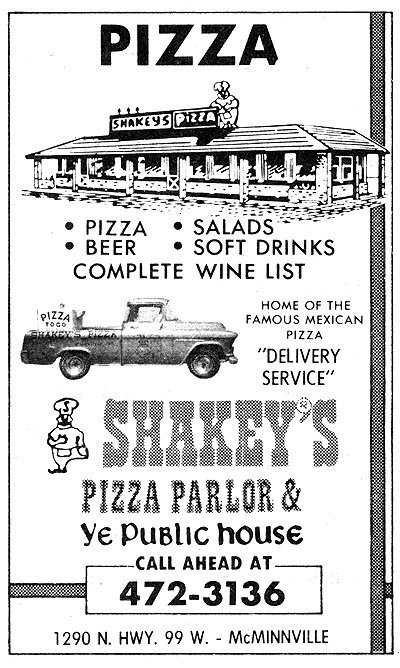
In late summer before starting college, cousin, Dave and I headed south in his Triumph TR6.  We traveled Oregon 99-West and stopped in McMinnville where I looked up Patti Sloss, an EHS classmate and college freshman at Linfield where school started early.  Dave and I dined at one of those old-time Shakey’s Pizza parlors.  It was dark inside as we sat on heavy wood benches eating pizza off rustic tables and watching Laurel & Hardy movies played continuously. 

In Lincoln City I was anxious to join Dave at the nearby Old Oregon tavern, then a hangout for long hairs and hippies.  He gifted me his old Navy identification; a worn piece of green paper which served my fake ID needs during my first year of college even though my alleged age was 28 and my hair color red. 

On our next rendezvous, Grandpa was without car, having gifted his Lincoln Continental to satisfy his wife’s birthday wish.  Here’s how Kay put it in a later court filing: “Nov. 21, 1971 – My birthday present was a transfer of Lincoln car title to me.”  A few weeks earlier Barry and I visited Grandpa and met his new wife at their new home in Marysville. This was the first time this new wife was news to me, though they’d married in January 1968, a mere four months after Grandma’s passing. That afternoon in Marysville, I saw Grandpa quiver like a trapped bird.  This wasn’t the dynamic man I’d spent a pleasant vacation with in Lincoln City five months earlier.

That Christmas, Grandpa joined our family and a plan was hatched for me to drive him to the coast for a week.  He often sought sanctuary in that cherished retreat as the cabin was purchased in his name alone.  Its modest furnishings suggested Kay never spent time there.  I hold no memory of that trip, if not for this brief diary entry Mom produced during the ensuing legal battle following her dad’s death: “Dec. 26, 1971, Bill & Dad went to L.C. – stayed with him until Jan. 2, 1972.” 

Three months later I finished my winter quarter at U.W.  Grandpa had lately escaped Kay and Palm Springs when word filtered back that he might be Lincoln City bound.  Less than a year away from his deathbed, a hobbling dotage was creeping in. How he found his way to Lincoln City remained unclear.  Before his arrival I joined four college girls from Central led by my cousin, Robbie Falk as we traveled to the coast.  They were on a planned spring break trip, while my mission was to intercept Grandpa and bring him home. 

We rolled in late one night and the next morning set off for an adventure up the south side of the Siletz River on a narrow dirt road to find the river home used for filming “Sometimes a Great Notion” starring Paul Newman.  A young boy, perhaps 8 or 9 gave an impromptu tour explaining which scenes were filmed where.  His parents were remodeling the shell Hollywood producers had built as a backdrop for the movie and used some for interior scenes. 

Early that evening as Robbie, Chris, Cathy, Janet and I relaxed in the living room, in through the front door blows Grandpa.  A stern, shocked look on his face sent shivers down our spines, but following a short tense moment Grandpa smiles, invites us all to dinner, and down we traipsed to Mrs. Miller’s cozy restaurant whose featured dish was a crab, butter, and wine medley, eaten with toasted French bread. 

The river home on the Siletz River used in the 1971 film, “Sometimes a Great Notion” directed by Paul Newman.

Robbie and her Central girlfriends continued south on their spring break road trip.  Since Grandpa and I were without vehicle I don’t recall how we got to Portland, perhaps by bus is my best guess.  What’s clearly remembered was visiting a Toyota dealership where we test drove a Celica, then in its first year of production.  The Celica was a sporty model alright, but Grandpa had difficulty getting in and out of the car.  Plus, he no longer drove so trying out a sports car made little sense.  Lots of things were no longer making sense.  It was late so we checked into the Benson Hotel.  Grandpa always stayed at the Benson when in Portland.

The next morning in a hurry to Enumclaw, he directs the hotel clerk to summon a cab.  We hop in and the cabbie asks, “Where ya going?” Grandpa says, “Just across the river a little past Vancouver.”  North of Vancouver the same cabbie question and similar Grandpa answer, “It’s a bit further north.”  With each new fib I slink lower in the back seat.  Somewhere near Kelso the cabbie pulls over and demands, “Now where the hell are you two going?” Grandpa confesses, “Enumclaw, in the vicinity of Auburn.”  The cabbie examines his map and shouts, “That’s another 100 miles!”  A radio call is placed followed by wrangling with dispatch, until permission was granted and back on the freeway we cruised.

Two hours later the cab stops in front of our Enumclaw home.  I go to get money from Mom while the cabbie keeps Grandpa for collateral.  The fare ran to something like $130, which was a cab full of money back then.  With cabbie dismissed, Mom snaps a blurry picture preserving the moment. Around the kitchen table Grandpa and I tell the tale of how we convinced the cab to drive us from Portland to Enumclaw.  In a day or so everyone thinks it’s the funniest story ever or at least pretends to.  For me, it was an erratic adventure with an eerie premonition that a chapter in his life was ending.  Days later I was back in college for spring quarter of my freshman year.

Mom’s blurry photo of me right after the cab left our home at 1737 Franklin St.

In June, Kay coaxed Jack back to Palm Springs where his check book could be better put to use.  Their on-again, off-again relationship reconciled for a couple weeks.  But he broke and cut his toe which landed him in the Desert Hospital.  The ensuing infection triggered a health decline that first slowed and finally lassoed him. 

Dashing to escape, he checked out of the hospital, cleaned papers and belongings from their Palm Springs home, and retreated north.  Kay followed and soon filed a court action seeking guardianship of her fleeing husband.  Jack entered Seattle’s Virginia Mason for further toe treatment.  A dramatic hospital showdown between Kay and his son Evan played out in soap opera fashion.  Amidst allegations and recriminations Grandpa chose to go home to his family. 

He spent July 1972 at the compound of waterfront lots on Lake Sawyer he’d gifted his children and a favored nephew more than a decade earlier.  Our summer cabin was within that domain so he visited often.  Somewhat rejuvenated, Grandpa asked to go back to Lincoln City.  Again I was enlisted to drive south, this time with my 13-year-old cousin, Evan Jr. in tow. 

We took rides down Hwy 101, but Grandpa soon fell asleep.  We dined out, but his diabetes flared as his health faded.  Many hours were spent soaking his infected toe in Epsom salts.  We came back home a few days later.  It proved to be his last trip to the Oregon Coast and the cabin he loved.  In a week or so Grandpa was placed at a Mercer Island nursing home.

In late November, his granddaughter Roberta visited him there.  Grandpa quickly asked how she liked his new apartment.  Then in a conspiratorial voice, he explained a need to head north followed by a whispered suggestion that she could bring her car round and provide his getaway.  Robbie knew better, for she understood he wouldn’t be leaving.  But she also saw his schemes to escape that gilded cage as the only thing keeping him alive.  She speculated on how hard it must be for that hard-charging businessman to resist the call of the road and attend to business that needs tending.  She reflected on a pensive thought, “Will he ever let go of the reins?”

On February 15, 1973, John H. Morris let go of the reins.  A large funeral was held.  The coal mines he’d opened shut down for a day.  Most every coal miner who ever worked for him came to pay their respects.  A bitter probate battle emerged between the parasitic wife and his four children.  The lawsuit featured contested Wills and was fought for years.  Lawyers swallowed a fair portion of his estate before settlement was reached.  Mom received his Lincoln City home in probate; as I did from her 45 years hence. 

That’s me leaving Enumclaw in late summer 1975 to go and live in Lincoln City.

A few months following graduation from college, I moved to Lincoln City with my motorcycle and a backpack of belongings.  I collected unemployment checks as had my cousin Dave four years earlier.  I drifted aimlessly along empty beaches, and wandered through ramshackle corridors of the nearby public library.  I volunteered at the hippie food co-op by day and quaffed beers at the Old Oregon by night.  I ate the Colonial Bakery’s Sailor Jack muffins for breakfast and baked cheese cakes at home for dessert.  I watched every inning of the 1975 Cincinnati-Boston World Series.  I read novels and wrote poetry, and learned how to be alone.  After several months of introspection I returned home to Enumclaw. 

Upon leaving that house on a hill, overlooking the Pacific Ocean whose waves regularly crashed onto rocks below, I realized a tiny bit of home would always be waiting for me there.  I still do.

The home on the hill, circa 2018.

Banner photo by Oliver Kombol.

Exit mobile version