Categories
Uncategorized

A Farewell to Mike

It was a dark and stormy night.  Coastal rains pounded the Oregon Coast.  STOP!

Mike Wickre would have ridiculed this opening, but Mike Wickre is gone, so I’ll write it my way, mindful of his dismissive wisecracks from beyond.

With little notice, an old friend passes away.  A Facebook message warned of Mike’s imminent demise.  Days later, a concluding text informed his life was over.  Then silence. Whoosh! Gone!! Only his Facebook page remains – that’s death in the digital world.

Word leaked out, there would be no service.  Mike didn’t want one.  No gathering of friends to bid adieu to an old pal.  No farewells, no sharing of memories, none of those anecdotes and stories that lessen our collective loss.  A fading remembrance swallowed by emptiness.  As Jeff Lynne poignantly asked in the best ELO song that nobody’s heard, “Is this the way life’s meant to be?”

I regret there being no funeral or Celebration of Life.  Rituals are important for saying goodbye.  The world is a poorer place, if as it seems they’re going out of fashion.  The deceased’s wishes are usually respected, though with Wickre, I’m tempted to disregard his desire – to poke back, as he so often poked others.

Most would agree – Mike was a difficult individual.  Kristofferson described him best – a walking contradiction, partly truth, and partly fiction.  Need I add: eccentric, bombastic, irreverent, nutty, sarcastic, and cynical, with an over-arching egotistical approach to life.

But he had a charm and charisma that’s hard to ignore.  At the end of the day, he made me a better person.  But half the time aggravated the hell out of me.

Mike Wickre’s 1973 Enumclaw High School graduation photo.

The obituary nobody else wrote, so I did

Michael Irwin Wickre was born to Marilyn (Smith) and Raymond Wickre in Bremerton, Washington on Oct. 3, 1955.  His grandmother was a Lakota Sioux.  Mike took pride in his Native American heritage.  He said she was “white as china,” and died without a clue. Fittingly the family moved to Lakota Beach in Federal Way where Mike attended Lakota Middle School.  There he became close friends with Brad Broberg, who remained one for the rest of his life.

The Wickres moved to Enumclaw in 1969 when Mike was in 8th grade. They lived on S.E. 408th Street in the foothills east of Veazie Valley. Mike’s younger brother, Alan described their small farm as “the last house before the hill. We had cows, horses, ducks, chickens, rabbits, and geese.  From the creek, there was a pipe to our man-made pond.  It was a great place to be a kid.”

One of Mike’s first Enumclaw friends was Joe Cerne who remembered his dry-witted humor and quick tongue.  “Mike was the funniest guy around,” Joe recalled, “I never laughed louder than being with him.”  Kevin Rustvold remembered how he loved playing pinball and foosball, but remained a serious germ-a-phobe all of his life.  Mike’s class became the first 9th graders to attend high school since the new building opened in 1962.

Mike graduated in 1973 and found work at Weyerhaeuser, saving money to attend a four-year college. He was proud of his time in the woods and shared plenty of stories about planting trees and setting chokers.  He also worked at Hygrade’s meat packing plant on the Tacoma tide flats and chronicled the time he shoveled pig guts into the grinder.  He remembered the plant as “a five-story pile of filth on a site so toxic it is still uninhabitable for rats,” then added, “It got worse.”

Mike Wickre’s description of his injury while working for Weyerhaeuser: “Got caught in the bite . . . the haul-back was side-washed and stretched out of plumb . . . it snapped and the mainline caught me just below my man stuff. It sent me downhill riding the butt rigging . . . felt like getting my leg caught in a car door.
Saved enough money to go back to school. Pretty fun memories and good friends . . . most loggers are very nice men underneath their Copenhagen stains. Loggers chew because it’s too danger to smoke cigs or weed while setting chokers. Plus you need a little ‘something’ out there.”

Mike labored at gritty jobs and took classes at Green River Community College.  He hung out with Enumclaw classmates, Tony Pedrini, Kevin Rustvold, John Kochevar, Mike Shook, and Steve Dunning.  Most were involved with the Enumclaw Soccer Club and played for the G.R.C.C. Gators.  (Mike and Steve are seen photobombing the team in a nearby picture.)  Mike had an entrepreneurial spirit. He started a company called Acme Hornet Hunters, whose business was to remove wasp and hornet nests while selling bees to high school biology classes. It wasn’t a stinging success.

Enumclaw Soccer Club 1972-73. 1st Row, L-R: Tony Pedrini, Ted Klahn, Ricky Thompson, unknown. 2nd Row, L-R: Pete Bowman, Kenny Cowells, John Kochevar, Paul Raine, Mike ?, Bobby Remein. 3rd Row, L-R: Kevin Rustvold, Theron ?, Mike Shook, Coach Alf Meubauer, Frank Nichols. Photobombing from behind the fence: Steve Dunning and Mike Wickre.

After earning enough money and Green River credits, Mike enrolled at Western Washington University in Bellingham. He majored in journalism and wrote for the Western Front student newspaper.  Mike was always attracted to the bizarre and enjoyed his first big journalistic success with a Feb. 10, 1978 article about human cloning. It was picked up by wire services.  He graduated from Western in December 1979 and moved home, throwing himself into the Enumclaw scene.

Mike joined Greg Lovell and Tony Pedrini in renting a house on Griffin Street across from where the new Four Seasons restaurant was being built.  They called their bachelor pad the No-Tell Motel.  He sang backup in Kevin Rustvold’s band named Sphincter.

The band Sphincter, circa 1977. 1st frame, clockwise: Les Walthers on keyboards, Mike Wickre clapping, Mike Hanson on bass, Kevin Rustvold on guitar, and Mike Shook kneeling with microphone. 2nd frame, L-R: Dave Reynolds, Kevin Rustvold, Mike Hanson, Mike Shook.

With Pedrini and Rustvold, he coached Jack’s Scrappers, an Enumclaw girls’ softball team.  After-game parties at the No-Tell Motel featured Rainer beer.  They collected the empty bottles until a pickup load generated enough funds to purchase a refrigerated keg tap.  Celebrations typically started Thursday night after softball and often extended till Friday.  The No-Tell bachelor party ended two years after it began.

Jack’s Scrappers, the women’s softball team that Tony, Kevin, and Mike coached went undefeated that season. From the July 21, 1977 Enumclaw Courier-Herald.
L-R: Greg Lovell in blue shirt and white tie, and Mike Wickre pointing to the pickup load of Rainier beer bottles while carrying a BB gun.

In September 1980, he joined the Enumclaw Courier-Herald and worked under its legendary editor, Robert “Bud” Olson.  Mike was the paper’s only reporter.   Small-town newspapers don’t pay much, so he quit the Courier-Herald in April 1981 and joined a marketing guru who showed him the ropes for selling advertising.  The job fit his journalistic background and business initiative.  That training propelled Mike to a very successful career selling newspaper, TV, and radio ads.

On Sept. 18, 1982, Mike married Nancy Ann Johnson, a Dakota Indian. She was the adopted daughter of an English author, Emilie Johnson who wrote “My China Odyssey.” Mike and Nancy bought a home in Northshore between Tacoma and Federal Way.  With what he learned about selling ads, Mike opened his own marketing firm, AdStrategies, LLC, which he later operated out of a condo just above the Tacoma Dome.  He earned bucket loads of money as a one-man advertising agency for auto dealers, car shows, and RV sales firms like Baydo’s.

Mike and Nancy’s marriage fell apart in the 2010s when Mike moved full-time into his Tacoma condo.  Nancy died in October 2015.  Three years later, Mike met Jacinta Mwihaki Njeri online, a nurse who goes by the name Dee.  She was attracted to his humor and found him to be a very funny guy, as almost everyone did.

The couple married on Sept. 19, 2020.  Dee told me that Mike liked to cook and was a good one.  He also enjoyed watching sports on TV, especially baseball, and also World War II histories.  A few months before he died, Mike wrote, “In case I croak, I am on record. Greg Wasell and Steve Bunker were the funniest guys I ever met. Greg was always thinking ahead for a prank. Bunker made planting 800 trees a day fun.”

In early December 2023, Mike fell, hitting his head which caused bleeding in the brain.  He lapsed into a coma and died at Tacoma General Hospital on Dec. 29, 2023, at age 68.  Michael Irwin Wickre is survived by his wife, Jacinta (known as Dee), his mother, Marilyn, a sister, Marla Wickrefujimoto, and two brothers, Alan Wickre and Ryan Wickre.

Mike’s ashes are buried at the family’s Tokeland cabin with a lilac tree planted above. Really, Mike?   Planted beneath a lilac tree? After the last shovel full of dirt was stomped on his remains, Wickre’s ghost whispered a snarky retort, then spit a wad of chew on the grave.

The Wickre I Knew

I first met Mike Wickre in the spring of 1975, the last quarter of my senior year of college. I was living at home and worked afternoons at a coal mining job in Ravensdale.  When the job ended I found myself with lots of extra time.

It was good to be back in The Claw.  I was taking a tennis class so walked the block to my elementary school, J.J. Smith, to hit balls against a cinder block wall.  One day Mike stopped by and struck up a conversation.  He remembered me from school.  Two of his friends, Scott Veenhuizen and Jeff Wasell shared a small rental a couple blocks away. Mike invited me over to hang out and play Foosball.  The evening gatherings typically consisted of beer, pot, Foos, and banter.

We became friends … sort of.  With Mike, you never really knew where you stood, except you were standing beside a guy with an engaging smile and captivating personality.

In the mid-1970s, a commune-influenced, all-you-need-is-Love, whole-grain aura still burned astrologically bright within the faux hippy crowd around Enumclaw.  But Mike’s bruising personality tolerated no such sentimentality.  He was a tough-minded logger who worked in the woods and shoveled pig guts at a packing house.  Yet behind his barking bravado lived a literary wannabe.  And even deeper lurked a misfit hiding his awkwardness.  Mike once confessed, “Yes I know I am socially retarded.   Let me know if you can work with me – your friend, Mike.”

A college classmate, Bruce Hyland reflected on the dichotomy, “An interesting thing about Mike … he seemed to have one foot in the hard-scrabble, Enumclaw working man’s life and the other in the civilized world of writer/soccer player/college life. And he didn’t quite fit in either.  He always straddled between the workingman and the effete world of journalism.”

I never grew close to Mike because, at some primal level, I feared his explosive outbursts. Still, I liked being around him. Mike was that kind of guy – a cunning sense of humor delivered with a biting tongue.  Mike’s favorite quote, one by Winston Churchill captured his antagonistic personality, “He has all the virtues I dislike, and none of the vices I admire.”  Wickre loved Monty Python’s skit, “The Argument Clinic.”

Like many great friendships, ours blossomed on the sporting field.  Mike invited me to join the Dolezal Chiropractic slow-pitch softball team that Ken Prince captained. By the spring of 1977, I was working as a management trainee at a bank and living in Seattle. I drove an hour to Enumclaw for late afternoon games.  We kicked off the season on April 23, playing a double-header on Saturday, one morning game and one in the afternoon.

The Dolezal soft-ball team, circa 1977. Mike is barely visible in the back row with a hat and shaded face. Other are Ken Prince, Tony Pedrini, Bruce Radford, Alan Wicker, Chris Coppin, and Bill Kombol, front row, second from right.

After the second game, we celebrated our loss at the Logger’s Inn in Buckley.  It was Wayne Podolak’s 24th birthday which entitled him to a free 72-ounce birthday mug. We all got slowly plowed.  Mike, Greg & Jeff Wasell, and I ended up at Lioce’s in Auburn for more beer and pizza. We nearly ended the night in a bar fight.  Mike was the kind of guy you wanted by your side in a bar fight.  That’s how you built friendships in your twenties.

A few months later I recorded our team’s lineup in a June 13 diary entry:

Catcher –Mike Ackershot and me
Pitcher – Ken Prince
1B – Chris Coppin
2B – Dan Darby
3B – Donnie Robinson
SS – Wayne Podolak
LF – Mike Wickre
LC – Dave
RC – Jeff Wasell
RF – Greg Wasell

Les Hall also played but was absent.  That day we lost to the Lee Restaurant roster headed by Keith Fugate, Kim Kuro, and Stan Fornalski.

At the plate, Mike belonged to the “go big or go home” school of thought.  Every swing was for the fences.  The guy could hit softballs a mile and often did.  Win or lose, the real team bonding started afterward at one of many local drinking dives.  That night we ended up at the Alcove Tavern.  Enumclaw had five or six downtown saloons within a block’s walk, all of the same ilk – neon-lit, smoke-filled, fading posters, pull tabs, pickled eggs.

That summer we waterskied at Lake Sawyer where Mike was witness to a bee flying up my nose and stinging me.  As Mom applied meat tenderizer to my nostril, Mike lost control laughing. He never let me forget it.  That same afternoon Mike got sick after drinking too much beer and vomited on the deck.  Afterward, he marveled at how nice my mother was, “She didn’t even yell at me.  She was always smiling.”

A week or so later, I wrote in my diary, “Friendship is nothing more than shared experience.”  Mike was a shared experience.

He began joining other events with our gang of friends.  We played poker with a longstanding circle of my pals.  Here’s how Mike described us:

“I played with you old bastards – Keith Hanson, Jim Clem, Pode, Lester, Wheels – smart guys, smart asses. I don’t know if I ever laughed so hard.  I had just started a business, scared stiff, no income, playing poker.  And for about three hours, an escape for me, it meant a lot. Old Rugged Cross, high-low split – best game ever.  I sure would like a rematch with those guys.”

It was Mike who introduced us to Old Rugged Cross, a card game we still play to this day.  In a February 2021 message, Mike continued with memories from high school:

“Nothing but respect for all of them.  I had to hit Jim Ewalt in the balls in high school choir, but he respected my authority.  In the bass section, those guys were big – Ewalt, good ol’ Bill Tuk, and Randy Verhoeve took turns punching me in the seeds during breathing exercises.  And it always hurt.  But within a week I had hit them all in their egg bags.  I lived to talk about it.  That’s why I respect those guys because they respected a coward like me.”

Wickre also joined our last two beer smorgasbords in 1978 and ‘79.  What’s a beer smorgasbord?  When a bunch of guys bring assigned half racks of beer to a party whose purpose is to blind taste test the most popular brands until everyone’s blind drunk.  Mike was proud to be there and later bragged:

“It’s important to note my early successes amongst you old bastards. That night I was ‘Rookie of the Year’ and ‘MVP’ for identifying three of 15 beers. We ate saltines, and Podolak, Copperman, and you danced on the balcony in your underwear to celebrate Dale Troy going ‘In the Navy.’  It was also the night my incredibly rich, hot fiancé left me on the Veazie Flats, and that was that.”

Mike Wickre, left and Lester Hall opposite in yellow shirt at the 1979 Beer Smorgasbord at Lake Sawyer.

He added a concluding coda: “Les Hall drank a pitcher of beer through his jockstrap, which he proudly never washed – for several years judging by the stains.”

In February 1980, Mike called me from the Courier-Herald.  The nation was in one of its periodic freak-out moments with 53 Americans held hostage in Iran and energy costs soaring.  I worked for Palmer Coking Coal Company in Black Diamond. We were experiencing a surge in demand selling coal for home heating.  Wickre came to our sales yard and interviewed my uncle Carl Falk and me.  Mike was a sharp reporter who quickly grasped our market position and wrote a fitting article.  He even doubled as the Courier-Herald’s photographer and took several photos he used in a story appearing on the front page of their Feb. 28, 1980 issue.

In time Mike joined our golf group, the Duffers’ Golf Association (DGA) winning the four-round summer tournament in 1988.  The winner was awarded a passed-along Green Jacket that he kept in the trunk of his car that winter, where it was ruined by battery acid.

A mid-1980s DGA foursome. L-R: Tom Noltenmeyer, Jay Carbon, Tom Cerne, Mike Wickre.

Most of the golfers attended the Mariner home opener. Before carpooling to the Kingdome, we assembled at a convenient south-side tavern for pre-game warm-ups.  Mike drove that night, joined by my cousin-in-law, Ron Thompson, and me. Mike proudly wore a new Mariner hat.  From the backseat, Ron snatched the cap from his head.  Mike sternly asked for its prompt return as a drunken Ron Thompson mocked him. Mistake!

Tensions flared. Ron raced from the car with Mike in fast pursuit.  He chased him with a ferocity that scared the living daylights out of me. Wickre’s primal anger gave me the chills.  I interceded with a patient pleading and Ron was spared a thrashing. You could give Mike the business, but crossed a line at your own risk.  I never came close to crossing it.

Mike’s sporting life

Mike often reminisced about his high school years. In order to tell a coherent story, I’ve parsed through his blather and bluster in various Facebook missives and private messages. Let’s call it Wickre lore.

The school yearbook lists his 9th-grade activities as choir and French club, but he also joined the baseball squad under Coach Ron Miller.  Mike told the story of having to give his up uniform mid-season to Mark Vannatter, a classmate and son of school administrator Don Vannatter. Wickre growled, “I like baseball.  I just don’t like baseball coaches.”

As a sophomore in 1970, Mike turned out for both basketball and baseball, and continued with choir.  On the baseball diamond, he bristled under head coach Frank Osborne’s dictatorial style, but was mesmerized by his instruction.  Like most players, Mike called him by his initials, “My mentor, F.O. taught me life lessons, and how to hit. He turned me into a varsity pitcher.  But he didn’t understand that I won’t back down. You could have made a movie of me and Frank.”

Mike called Osborne his Oedipal coach, a Freudian reference to jealous feelings a son has towards his father.  As a sophomore, Mike was the team’s fourth pitcher which meant Fungo bats and shagging balls.  He recalled Coach Osborne’s superstitious nature, “If you shagged infield balls and the team won . . . guess what?  Wickre’s shagging balls for the rest of the season.”

One of Mike’s true joys was being around that year’s top pitcher and Hornet team leader, Jim Clem.  Wickre called Clem “his all-time mentor.”  Mike laid it out in a private message:

“I have a little manic attack going on.  I have to tell someone this tale to stop laughing.  I was a gangling sophomore.  I played baseball in the 4th grade and said ‘No mas.’  So here I am, geekier than geek, and I sit down next to Jim Clem.  Like sitting next to one of the Apostles. He talks to me.  I think he was wearing an ascot.  I am having a legend speak to me – my eyes wider than my ears.  When I found out Clem was going to be my coach, I did three somersaults. Then he leans over and lets me in on a secret, ‘F.O. is the biggest prick you’ll ever meet.’”

“My two finest coaches were Doug Baldwin, wrestling at Lakota Jr. High, and Jim Clem, baseball at Enumclaw High.  Both encouraged … not a negative word.  Blessings to both for turning a boy into a man.  I hope I can pass it along.  And actually try to be like Clem who told me his simple mantra, ‘Wick, I get better and better every day.’”

His senior year Mike joined the baseball team but didn’t finish the season.  Here’s how he described that truncated experience.  “Irony is fun when you play along.  F.O. kicked me off the Varsity Hornet baseball squad because I had long hair.  Now, I have no hair.  Karma’s . . . a bitch.”

Which Mike Wickre

Bruce Hyland, a friend from college made a number of acute observations about Mike.

“We met at Western in the journalism program. I had moved from upstate New York after the service and was going to school on the G.I. Bill.  Most everybody else seemed young and soft … Wick, on the other hand, was clearly more worldly wise … audacious, witty, with no B.S.  We clicked from Day One.”

Three decades and a whole lot of changes passed before Bruce reunited with his college friend.

“When I finally came out for a visit after some 30 years, Mike put me up at his place, gave me a car to use, fed me, and lost to me at Cribbage (just like in college).  We went to a college newspaper gang reunion at a Tacoma night spot that some alums organized because I was visiting. We had a great time.  Played a round of golf the following day.  He was seeing (and I met) an assortment of sketchy women who knew that old saw about God giving men two heads, but only enough blood to run one at a time. A good friend in every way.”

By autumn 2016, some six years later, when he returned for a college newspaper gang reunion, Bruce encountered a changed Wickre:

“He’d been on meds for some kind of operation plus he was taking something to help him sleep.  He’s virtually medicated all the time. And weed was legal so he was always tokin’ up. Lives a very isolated life … seems to be getting more irrational.  He was wary and even paranoid … accusing me of screwing up his seriously screwed-up car.  A very different personality.”

Two of Mike’s favorite Facebook profile pictures. Left – Hunkpapa Lakota Chief Sitting Bull, circa 1885.  Right – Mike Ring-a-ling, March 2015.

Mike made me a better writer

I hadn’t seen Mike for over a decade.  We last crossed paths around 2010 at Gold Mountain and made plans to connect on the golf course.  Instead, we connected on Facebook.  Mike discovered my interest in writing, which I practice on that illiterate social medium called Fakebook.

Now I could enjoy the fullness of Mike’s wickedness. As the Prince of putdowns berates me publicly for overusing personal pronouns – I, me, my.  And says my sentences are too long.  “Keep your sentences short, like Hemingway.” And my paragraphs needed to be shorter.  “Let the words breathe,” Mike counseled.

This typical Wickre response came after reading one of my essays:

“As you know, I usually embarrass you worldwide.  So this is just us boys.  I consider you a great friend, and an easy target. Put Billsie on the tee, and I will give him a proper whack.

“I like tightened copy.  Reporters in the type era were paid by the published inch.  Copy editors were paid to cut words.  See last sentence.  So these idiots that worked for newspapers had to get to the point, tout suite (French for immediately).”

Then a few weeks later:

“Look at you improving your writing.  Paragraphs are fun, every 30 words, just easier to read.  I like when you reach out a bit more in your descriptive – you are on the right track – push the edges and you will get there.  I want to see fire … rage … laughter, tears, and resolution … 1,000 words, no plagiarism or misspelled words.  Lean into this manifesto … don’t let me down.”

And more encouragement:

“I like your tighter writing. You might enjoy the down-to-bones approach of Hunter Thompson and Mark Twain.  Avoid Faulkner, who is verbose.  Flowery puff is just not good.  Capote wrote tight. Condense.  Hemingway wrote some books I am told. Use short sentences with vigorous language. You have the skills but your writing is generally weak and in the passive voice. Your facts can’t be questioned. Use active verbs, and avoid the word ‘I’. You are smart enough to do better.  I have hope.”

Plus advice on what to read and why:

“If you haven’t read it, try Ken Kesey’s “Sometimes a Great Notion” – about loggers. Best book I have read outside the Bible. Read both three times. Some of it stuck. You will get lost in it. It’s set in Oregon, but could have been Enumclaw. But, a crappy movie.”

You’re on my bucket list

For the last five years of his life, I tried to set up a dinner to reconnect.  My efforts began in 2019 with offers to host a restaurant meal with two close friends, Jim Clem and Tom Cerne.  Then came Covid, which tanked plans for nearly two years, much of it due to Mike’s germ-a-phobe consternation.  He kept dodging my efforts with outrageous requests and changing demands.  By the fall of 2024, we made progress toward our long-planned get-together which I thought was getting close.  It didn’t happen – my sad regret.

One of Mike’s last messages to me: “You’re on my bucket list.”  Now I’m left with the loneliest words in the English language, “If only.”  Our dinner reunion will never be realized.  If you have plans to meet an old friend someday, remember John Fogerty’s fateful song, “Someday Never Comes.”

A Farewell to Mike

It was a dark and stormy night.  Coastal rains pounded the Oregon Coast.  My wife and I made our way to Kyllo’s, a seafood grill in Lincoln City where the D River flows into the ocean.  When guided to our table, we passed a nautical display featuring an Ernest Hemingway quote.  I snapped this photo knowing Hemingway was Mike’s favorite writer.

The Ernest Hemingway display in Kyllo’s on the D River in Lincoln City.

Later that Saturday night I sent it to Mike via Facebook Messenger. He replied within a minute, “Listen to Ernest …”  On Sunday afternoon, Dec. 10, 2023,  Mike wrote his final Facebook post, “Thanks to Bill Kombol.”  I didn’t see that post until after he died.

Mike Wickre’s last Facebook post, Dec. 10, 2023.

The title photo standing atop this essay came from “A Farewell to Arms.”  At our Lincoln City home, we have accumulated a nice collection of decades-old books, among them a first-edition hardcover of Ernest Hemingway’s 1929 novel.  Its binding is secured with black tape and the inside cover is stamped ‘Discard.’  The imprint of Enumclaw Public Library is scratched over by a black crayon.

I researched the quote from the restaurant display hoping it might be from “A Farewell to Arms.”

“Try to learn to breathe deeply, really to taste food when you eat, and when you sleep, really to sleep.  Try as much as possible to be wholly alive with all your might, and when you laugh, laugh like hell.  And when you get angry, get good and angry.  Try to be alive.  You will be dead soon enough.”

Here’s an irony Mike would fully enjoy, it isn’t a Hemingway quote.  It’s by William Saroyan, a novelist, playwright, and short story writer of the same era.

Sometimes a Great Notion

On numerous occasions, Mike urged me to read Ken Kesey’s “Sometimes a Great Notion.”  I’ll be honest – he practically bludgeoned me.  Mike read it three times.  The best book he ever read besides the Bible.

Several years before he died, I bought the Audible version of Kesey’s second novel.  Many critics consider it his greatest.  Tom Wolfe, who later chronicled Kesey’s exploits with the Merry Prankster, took note of its brilliance.  After seeing its 28-hour length, I promptly lost interest and the recording collected digital dust.  When Mike died, I knew what must be done.

Sometimes a Great Notion, audiobook by Ken Kesey.

“Sometimes a Great Notion” tells the story of an Oregon family of gypo loggers.  They are led by a hard-headed patriarch, Henry Stamper who has two sons, Hank the stubborn first-born, and Leland, the sensitive half-brother, from a second and much younger wife.  Leland moves east with his mother, attends Yale, but returns to the family logging show to settle scores.  Conflicts between father, brothers, workers, and log mills brew in the old-growth forests as union forces seek to stamp out the family’s independent ways.

Upon finishing the book, I began to see why this novel so appealed to Mike.  Resistance to authority, the life of loggers, a college man’s struggle against convention, a consciousness-raising literary style – it’s all there.

I finally understood why he so wanted me to read it.  I began to glimpse the specter of the boy he was.  And perhaps the man he wanted to be.  Reading “Sometimes a Great Notion” became my requiem for the repose of Mike’s memory.

Rest in Peace, Mike – under that lilac tree.

Mike and his family: “Sometimes I mind my own snarky business, a hate-filled wretched old P.O.S. Then sometimes the best time of your life sneaks in and makes it all worthwhile.
Pictured L-R: Tarzan the chess wizard, my love Jacinta (Dee), my brother Alan, Edith Finley, my lovely mom (Marilyn), and Beth of the beach who is my new B.F.F. I ate four Dungeness crabs, just polished off the last two.” — Mike’s Facebook post Sept. 3, 2018.


Categories
Uncategorized

Waiting for Charlotte

Place de Contrescarpe                                                                              Friday, April 12, 2024, 10 am

In the square below our room, a film company had set up in the early morning hours.  The crew of seven placed cameras and mic booms around a decorated table with a young man seated behind, as if he were holding court.  It was a sun-dappled spring day in Paris.

The view of the film set from our second-floor room on the plaza. Jennifer took the photo while I was being interviewed.

Curious, I wandered around the set near the middle of the plaza.  A young woman approached.  She was part of the crew.  I greeted her with my best “Bon jour,” and she replied likewise, continuing in French.  I apologized, admitting to only speaking English.  She smiled and replied, inviting me to take a seat at the table for an interview – an impromptu, man-on-the-street sort of thing.  I hesitated repeating, “I only speak English.”  She responded quickly, “He does also,” and escorted me to the table where I took a seat.  The handsome, dark-haired host was conversing with an older French lady and after a few moments, turned to me and spoke.

He introduced himself as Jules and asked my name.  Jules explained he was waiting for the love of his life to arrive.  Her name was Charlotte and she lived nearby.  With a penetrating glance, he inquired, “Do you believe there is one true love of your life?”  I offered a fractured version of how I met Jennifer nearly 40 years prior.  I questioned if Charlotte knew he was waiting for her, and where?  Jules replied vaguely but hopeful she would appear.

On the tabletop before us were books, flowers, and various mementos that obviously spoke to Jules and Charlotte’s relationship.  I pressed Jules on the various item’s meanings, and he spoke of poems by Baudelaire, favorite movies, and other keepsakes that filled his folding table.

Jules and assistant, Sara seated at the memento-covered table interviewing another passerby.

Our conversation turned to songs that moved us, philosophies that inspired us, authors we admired and books we were reading.  I explained the rationale behind my current novel, “Sometimes a Great Notion” by Ken Kesey, and how reading it was inspired by the recent death of a good friend.  Jules dug deeper, so I offered my general philosophy of life – that every moment is a choice and one’s life is a compilation of those collected choices.  For example, the choices that landed the two of us together in Paris at the Place de Contrescarpe on a Friday morning in April.  I added, “However, the most important choices we make are how we react to events beyond our control.”

In time, Pasquele, the French woman seated to his right reentered the conversation in English.  Pasquele took exception to a literary point I’d made that, “Men’s reading is comprised of 80% non-fiction and women’s 80% fiction.”  Pasquele countered, “Not in France where men read far more fiction.”

The three of us enjoyed a pleasant discussion of literary habits before Jules re-engaged, asking about life’s meaning and where lies happiness.  I repeated the wisdom passed to me by my high school humanities teacher, Mr. Worthington.  He explained to the class that the rest of our lives would concern answering four fundamental questions: “Who am I?  Where am I going?  Where did I come from? and What is the meaning of life?”  All the while the camera whirled and the crew scurried about moving mic booms and filming our conversation from different angles.  Just feet away, a drunk lay down near a grate where warm air blew, while those passing by paused to observe the happening.

A drunk happened by and laid down near a grate blowing warm air.

I came back to Charlotte and questioned if he was certain she would show.  Jules answered, “It depends on whether our love was meant to be.”  I pressed him about where she lived and whether she knew he was waiting in the square.  Jules replied that she lived nearby and was quite possibly aware.

We’d been speaking for more than 20 minutes, when I apologized for consuming so much of his interview and offered my place to another.  But Jules insisted that I stay so we talked on, heart to heart.   He asked what the components of a happy life were.  So I offered Rod Stewart’s observation that a man needs an occupation, a sport, and a hobby.  Then I continued with Somerset Maugham’s dictum that one must have sufficient resources for a comfortable living, “Money is the sixth sense without which you cannot make complete use of the other five.”  Still, Jules dug deeper wondering, “What is a successful life?”  I offered Tom Stoppard’s declaration: “The secret of life . . . is . . . this is not a drill.”

Part of the film crew which scurried about moving cameras and mic booms for different angles.

By 10:30 the Parisian sun beat down upon the square. Though two days earlier a biting chill filled the air, I began to regret the wool sweater I wore.  Jules and I continued talking like two college kids at midnight.  On my cell phone I played him one of my favorite French songs, “Les Bicyclettes de Belsize,” about two friends riding bicycles all through the day, wheels spinning round and around.  Jules smiled in appreciation.

From the apartment window above came a call from Henry, his third in rapid succession. I’d felt the two prior buzzes, as my iPhone was silenced.  I apologized to Jules, explained it was my son, and took the call.  Henry needed a security code for two-factor authentication to purchase train tickets.  I read back the code and returned to address Jules.  I again apologized that we must soon be going for we had plans to visit the Rodin Sculpture Garden Museum.  We would bicycle there to see Rodin’s masterpiece, The Thinker, and other sculpted art.

Auguste Rodins’ Le Penseur, quite possibly the most famous statute in the world.

I offered Jules one final hope that Charlotte would indeed show and they would be united in love.  Jules finally confessed – he was in fact an actor playing the part of Jules for the experimental film being shot.  His real name is Raphael Dulcet and he’d recently accepted the role.  The production was a staged happening, something like “Waiting for Godot,” an absurdist play by Samuel Beckett.  While Raphael and the film crew knew the set-up, those they interviewed didn’t.  They figured passersby would be more likely to share true thoughts on the nature of love and personal strategies for happiness.

Raphael is 26 and like many young actors, he’s often unemployed.  He answered an online advertisement for the job.  Though he wasn’t paid, this was an opportunity to meet others trying to get into the film industry, and form new connections.  Members of the crew were similarly situated – post-graduates from a nearby film school, all trying to break into the business.  I asked how long they’d be in the plaza and he replied, likely until early evening.  We parted as friends and I promised to drop in when we got back.

After our bike ride and self-guided tour of the Rodin Garden, Jennifer and I enjoyed a late lunch at La Coupole, a famous brasserie in Montparnasse that writers and artists frequented in the 1920s.  Each of us, Henry, Rachel, Jennifer, and I had chosen one special thing to do on the trip, and that was mine.  Forty-six years earlier, during five months of wandering through Europe, I periodically dined at La Coupole and always ordered the same meal – a bowl of French onion soup and a beer.  It came with a demi-baguette and a reasonably cheap price that even a 24-year-old, budget-conscious traveler like me could savor.

A late afternoon lunch at La Coupole in Montparnasse.

Upon returning to the square, we locked our bikes and I spotted Raphael nearby, still playing the part of Jules.  I yelled across the square, “Did Charlotte show?” and he smiled broadly.  We greeted each other like old friends and continued our philosophical ping-pong match.  I felt like Owen Wilson in the fantasy comedy, “Midnight in Paris” cavorting with Hemingway, Fitzgerald, and Stein.  It happened to be one of Raphael’s favorite movies too.  He asked about my day, so I repeated the phrase Tom Cerne and I regularly share with each other, “It’s the greatest day of my life . . . so far.”

Raphael Dulcet and Bill Kombol before our final goodbye, hoping to one day meet again.

Before exchanging goodbyes we exchanged our final thoughts.  When all is said and done, I disclosed, the key to a good life is to cultivate thankfulness, and thanked him for coming into my life.  Raphael suggested that fate may one day reunite us.  I hoped so.  Leaving the plaza, I climbed the two flights of stairs to our apartment and rested.  That evening we visited the Arc de Triomphe, scaled the top, and enjoyed the gorgeous sunset.  The day felt complete.

Henry, Jennifer, and I atop the Arc de Triomphe at twilight.
Categories
History Musings

The Longest Cab Ride or How I Fell in Love with Lincoln City

The veil lifts slowly like summer fog from a morning beach. Memories creep back but only in fits and spurts.  I still can’t piece it all together, but the puzzle recently unfolded after discovery of chronicles from his probate.  Yet a teenager I was to play a bit part in the tragicomedy that became my grandfather’s final years.  His Oregon Coast beach cabin was center stage and like any drama the site of my several scenes.  This magical place was destined to play an ongoing role in my life.     

My first stay in Lincoln City was nearly two weeks long in June 1971.  There’d be more visits to that cabin on a knoll Grandpa increasingly called home.  Twenty months later I was attending his funeral.  This is an incomplete tale of those days, his decline, and the first stirrings of my love affair with Lincoln City.  Some bits are lost through mists of time but the central story is intact.  For me it all began a few days after graduating from high school.

The Lincoln City cabin on a knoll in the early 1970s.

A long bus ride from Enumclaw delivered me to the DeLake bowling alley.  It’s still there just a stone’s throw past the bridge over the D River, advertised as the World’s Shortest – river that is, not bridge.  DeLake was one of five merged towns rechristening themselves Lincoln City on the 100th anniversary of their namesake’s death.  The place even had an amusement park of sorts built around an eatery called Pixie Kitchen.  Grandpa picked me up in his Lincoln Continental.  He liked big, luxury cars.  My cousin Dave Falk was at his side. 

My grandfather John H. Morris circa 1971, but most contemporaries called him Jack.

The man of whom I speak was John H. Morris, but most adults called him Jack.   I called him Grandpa.  Through my teen years he played an active part in our family’s life particularly after his wife of five decades entered a nursing home for three years of mental decline.  Her room at Bethesda Manor on Jensen Street was a couple blocks from our Enumclaw home.  Even as a boy I’d noticed signs of fading memory. The sweet grandmother who once bathed me and later taught me pinochle, slowly lost her ability to think.  As she quietly slipped into a private prison of mindlessness, she no longer knew the people she loved.  My Mom called it “hardening of the arteries.”  Today we call it Alzheimer’s. 

During her internment, Grandpa sought camaraderie from our family.  He treated us, especially Barry and me to recurring weekend dinners at Anton’s in Puyallup, Harold’s in Enumclaw, or the Elks in Auburn.  Dining out with Grandpa held few limits – anything on the menu, plus a Roy Rogers or Shirley Temple to accompany the cocktail he’d order.  Life with Grandpa was all about motion: sleepovers at his big home; drives to Wilkeson as he reminisced of his youth; or trips to San Francisco to catch a few Giants’ games, ride cable cars, and feed pigeons in Union Square.  

Once he took us to Carson hot springs on the Wind River in Oregon.  It was a 200-mile drive to a dated resort which hadn’t changed since the 1930s.  A dozen small cabins lined the road leading to a stately two-story Hotel St. Martin with a dining room featuring meat and potato dinners, served family-style at large tables to a clientele of geriatrics – except two teenagers: Barry and me. 

We took hot mineral baths in cast iron tubs resting on immaculate tile floors which looked every bit the part of a bygone European spa. We gagged down sulfuric-tasting water to “help sweat the poison out,” as Grandpa put it.  Occasional bouts of gout from rich food and high living no doubt contributed to his need.  At age 15, I felt no particular passion for sweating poison, but went along with the ritual and succumbed to the jelly-fish induced numbness of the hot bath experience.  In our sparse cabin without television or radio, we played cribbage games under a bare hundred-watt bulb and waited for old-fashioned dinners, sure to include gravy and string beans.    

The Hotel St. Martin at Carson hot springs in the 1930s, though not much had changed when we paid a visit with Grandpa in the late 1960s.

Marie Morris (his wife and my grandmother) died on the last day of summer 1967.  Without job or spouse Grandpa sought new horizons.  He traveled south spending time in the desert with old friends and meeting new ones.  He visited the homes of his four children, all living nearby.   He indulged the 19 grandchildren they spawned.  His grand white house on the west end of McHugh Avenue, where Jack and Marie raised four children and once hosted large family parties, was now a lonely outpost.  His days there were reduced to caring for the lawn and tending dahlias. 

Not much remained in that empty home and he knew it.  Always on the go, he couldn’t let go.  A burning drive for control thrust him towards new vistas.  So he found new ways to satisfy his wanderlust. But that took money, which a lifetime of business success handsomely provided.

Grandpa Jack & Grandma Marie enjoy a night on the town in San Francisco, March 1959.

Friendly with the ladies he enjoyed the companionship of several women. Maud, an attractive descendant of Columbia River Native Americans fancied his company as he did hers.  But Maud remained a friend.  He fell for another named Kathleen who went by Kay, and discovered too late that business acumen doesn’t necessarily extend to second wives.  What developed was an oft-told story.  Rich man, lonely upon his wife’s death falls under the spell of a gold-digging widow whose chief skill consists of convincing him to spend money on her.  He suspects too late her ulterior motives as she cashes tickets to wealth.  As to the particularities of any of this, I was yet unaware.

Back at Lincoln City in June 1971, Grandpa found himself in the company of two grandsons and oozed the charismatic charm I’d known him for all my life.  The grandfather upon whose lap I sat as a child, sipping beer from his 6-oz. glass.  The grandpa I joined on enchanting trips to San Francisco with stays at the businessman’s hotel where his greatest deals were forged a decade earlier.  The seasoned card player who carved a fine hand of cribbage and taught me the basic skill points, but more importantly the pace and banter of the game.  The grandpa I admired, but whose fiery temper could turn on a dime.  

The three of us made an odd party –– a 17-year-old, freshly graduated senior; a 27-year-old bachelor with no particular direction; and the 76-year-old retired businessman with a scheming second wife, from whom he alternately sought comfort or escape.  Sometimes he’d secrete himself in the bedroom for long conversations.  Back then I didn’t know with whom he spoke or why. 

Each morning Grandpa walked uptown for coffee at the bakery.  And back to the cabin relaxing with Dave, who was out of the Navy, on unemployment, and loafing.  They waited patiently for me to arise for I was fully capable of sleeping till 11 am.  We were frequently visited by Jimmy, a six-year-old boy who lived next door with his single mother in a crumbling 400-square foot cabin, a rental relic from the 1920s. 

Grandpa bought his 1,200-square foot Lincoln City home with a stunning ocean view in August 1969 for $16,500. The purchase was made during one of many estrangements from his covetous new wife.  That summer Barry cleaned out the contents from the 1926 home, filled with boxes of memories from former owners, as he helped Grandpa move in.

Jones’ Colonial Barker on Hwy 101. It’s still there but now called My Petite Sweet.

Grandpa, Dave and I led an unhurried existence – scenic drives up and down those “twenty miracle miles” of coastline in his Lincoln Continental, followed by games of cribbage, walks on the beach, and afternoon siestas.  I skim-boarded the flat sandy beach and braved cold Pacific waves just to prove I could.  By day, we lived on a diet of cheese, crackers, peanuts, and fresh crab from Barnacle Bill’s.  Grandpa and Dave drank their afternoon beer.  I drank my Pepsi’s poured into a Pilsner glass kept cold in the freezer. 

By early evening we drove to classic old restaurants for dinner – those kinds of places where retirees enjoyed highballs before a steak dinner or seafood platter.  We rotated our meals between a small circle of staid establishments including Mrs. Miller’s, Surf Rider, and the Spouting Horn Inn in Depot Bay.  But Pixie Kitchen with its kitsch atmosphere and deep-fried seafood was my favorite, and Grandpa was happy to oblige.  It was a style of living to which one could easily grow accustomed.  The weather on the coast even cooperated showcasing fair skies and warm sunshine which burned the morning fog to submission. 

Pixieland on Hwy 101 in the 1960s. Its main attraction was the Pixie Kitchen.

Seven years retired, Grandpa’s business drive remained.  He mused of buying the storied Jones’ Colonial Bakery, the quaint corner cafe on Hwy 101 which had served the Ocean Lake district of Lincoln City since 1946.  Grandpa contemplated installing his grandson as baker.  His acquisitive self was certainly getting the better of his senses.  Didn’t he notice a late adolescent who rather enjoyed sleeping in?  Didn’t he realize his 17-year-old grandson was bound for college in three short months and held no dreams of awaking before the sun to bake bread?  Whose chief interest in baking was eating the Colonial Bakery’s signature treat – Sailor Jack muffins? 

As his bakery dream waned so did my senior trip.  I couldn’t have ordered up a better fortnight.  I said goodbye to Lincoln City, having fallen for its beach town charms.  Days later I began my summer job selling popsicles from a three-wheeled Cushman scooter, and then off to my first year of college.  Three more times I ventured to Lincoln City in the company of Grandpa, and once without.  I was to become his part-time minder and he would be my ward.  But that wasn’t apparent to me then.

A year earlier, second-wife Kay convinced Grandpa to sell his family home of 35 years and redeploy proceeds towards two new homes, one at her native Marysville and the other in Palm Springs.  Fur coats, cars, and jewelry were similarly acquired as community property with Jack providing the property and Kay claiming community.  She persuaded him to buy quite a few things she was destined to enjoy.  A woman on her fourth husband possesses certain advantages in this sort of game. 

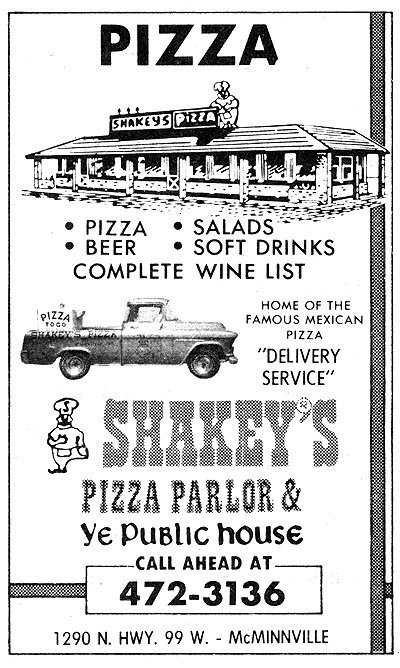
In late summer before starting college, cousin, Dave and I headed south in his Triumph TR6.  We traveled Oregon 99-West and stopped in McMinnville where I looked up Patti Sloss, an EHS classmate and college freshman at Linfield where school started early.  Dave and I dined at one of those old-time Shakey’s Pizza parlors.  It was dark inside as we sat on heavy wood benches eating pizza off rustic tables and watching Laurel & Hardy movies played continuously. 

In Lincoln City I was anxious to join Dave at the nearby Old Oregon tavern, then a hangout for long hairs and hippies.  He gifted me his old Navy identification; a worn piece of green paper which served my fake ID needs during my first year of college even though my alleged age was 28 and my hair color red. 

On our next rendezvous, Grandpa was without car, having gifted his Lincoln Continental to satisfy his wife’s birthday wish.  Here’s how Kay put it in a later court filing: “Nov. 21, 1971 – My birthday present was a transfer of Lincoln car title to me.”  A few weeks earlier Barry and I visited Grandpa and met his new wife at their new home in Marysville. This was the first time this new wife was news to me, though they’d married in January 1968, a mere four months after Grandma’s passing. That afternoon in Marysville, I saw Grandpa quiver like a trapped bird.  This wasn’t the dynamic man I’d spent a pleasant vacation with in Lincoln City five months earlier.

That Christmas, Grandpa joined our family and a plan was hatched for me to drive him to the coast for a week.  He often sought sanctuary in that cherished retreat as the cabin was purchased in his name alone.  Its modest furnishings suggested Kay never spent time there.  I hold no memory of that trip, if not for this brief diary entry Mom produced during the ensuing legal battle following her dad’s death: “Dec. 26, 1971, Bill & Dad went to L.C. – stayed with him until Jan. 2, 1972.” 

Three months later I finished my winter quarter at U.W.  Grandpa had lately escaped Kay and Palm Springs when word filtered back that he might be Lincoln City bound.  Less than a year away from his deathbed, a hobbling dotage was creeping in. How he found his way to Lincoln City remained unclear.  Before his arrival I joined four college girls from Central led by my cousin, Robbie Falk as we traveled to the coast.  They were on a planned spring break trip, while my mission was to intercept Grandpa and bring him home. 

We rolled in late one night and the next morning set off for an adventure up the south side of the Siletz River on a narrow dirt road to find the river home used for filming “Sometimes a Great Notion” starring Paul Newman.  A young boy, perhaps 8 or 9 gave an impromptu tour explaining which scenes were filmed where.  His parents were remodeling the shell Hollywood producers had built as a backdrop for the movie and used some for interior scenes. 

Early that evening as Robbie, Chris, Cathy, Janet and I relaxed in the living room, in through the front door blows Grandpa.  A stern, shocked look on his face sent shivers down our spines, but following a short tense moment Grandpa smiles, invites us all to dinner, and down we traipsed to Mrs. Miller’s cozy restaurant whose featured dish was a crab, butter, and wine medley, eaten with toasted French bread. 

The river home on the Siletz River used in the 1971 film, “Sometimes a Great Notion” directed by Paul Newman.

Robbie and her Central girlfriends continued south on their spring break road trip.  Since Grandpa and I were without vehicle I don’t recall how we got to Portland, perhaps by bus is my best guess.  What’s clearly remembered was visiting a Toyota dealership where we test drove a Celica, then in its first year of production.  The Celica was a sporty model alright, but Grandpa had difficulty getting in and out of the car.  Plus, he no longer drove so trying out a sports car made little sense.  Lots of things were no longer making sense.  It was late so we checked into the Benson Hotel.  Grandpa always stayed at the Benson when in Portland.

The next morning in a hurry to Enumclaw, he directs the hotel clerk to summon a cab.  We hop in and the cabbie asks, “Where ya going?” Grandpa says, “Just across the river a little past Vancouver.”  North of Vancouver the same cabbie question and similar Grandpa answer, “It’s a bit further north.”  With each new fib I slink lower in the back seat.  Somewhere near Kelso the cabbie pulls over and demands, “Now where the hell are you two going?” Grandpa confesses, “Enumclaw, in the vicinity of Auburn.”  The cabbie examines his map and shouts, “That’s another 100 miles!”  A radio call is placed followed by wrangling with dispatch, until permission was granted and back on the freeway we cruised.

Two hours later the cab stops in front of our Enumclaw home.  I go to get money from Mom while the cabbie keeps Grandpa for collateral.  The fare ran to something like $130, which was a cab full of money back then.  With cabbie dismissed, Mom snaps a blurry picture preserving the moment. Around the kitchen table Grandpa and I tell the tale of how we convinced the cab to drive us from Portland to Enumclaw.  In a day or so everyone thinks it’s the funniest story ever or at least pretends to.  For me, it was an erratic adventure with an eerie premonition that a chapter in his life was ending.  Days later I was back in college for spring quarter of my freshman year.

Mom’s blurry photo of me right after the cab left our home at 1737 Franklin St.

In June, Kay coaxed Jack back to Palm Springs where his check book could be better put to use.  Their on-again, off-again relationship reconciled for a couple weeks.  But he broke and cut his toe which landed him in the Desert Hospital.  The ensuing infection triggered a health decline that first slowed and finally lassoed him. 

Dashing to escape, he checked out of the hospital, cleaned papers and belongings from their Palm Springs home, and retreated north.  Kay followed and soon filed a court action seeking guardianship of her fleeing husband.  Jack entered Seattle’s Virginia Mason for further toe treatment.  A dramatic hospital showdown between Kay and his son Evan played out in soap opera fashion.  Amidst allegations and recriminations Grandpa chose to go home to his family. 

He spent July 1972 at the compound of waterfront lots on Lake Sawyer he’d gifted his children and a favored nephew more than a decade earlier.  Our summer cabin was within that domain so he visited often.  Somewhat rejuvenated, Grandpa asked to go back to Lincoln City.  Again I was enlisted to drive south, this time with my 13-year-old cousin, Evan Jr. in tow. 

We took rides down Hwy 101, but Grandpa soon fell asleep.  We dined out, but his diabetes flared as his health faded.  Many hours were spent soaking his infected toe in Epsom salts.  We came back home a few days later.  It proved to be his last trip to the Oregon Coast and the cabin he loved.  In a week or so Grandpa was placed at a Mercer Island nursing home.

In late November, his granddaughter Roberta visited him there.  Grandpa quickly asked how she liked his new apartment.  Then in a conspiratorial voice, he explained a need to head north followed by a whispered suggestion that she could bring her car round and provide his getaway.  Robbie knew better, for she understood he wouldn’t be leaving.  But she also saw his schemes to escape that gilded cage as the only thing keeping him alive.  She speculated on how hard it must be for that hard-charging businessman to resist the call of the road and attend to business that needs tending.  She reflected on a pensive thought, “Will he ever let go of the reins?”

On February 15, 1973, John H. Morris let go of the reins.  A large funeral was held.  The coal mines he’d opened shut down for a day.  Most every coal miner who ever worked for him came to pay their respects.  A bitter probate battle emerged between the parasitic wife and his four children.  The lawsuit featured contested Wills and was fought for years.  Lawyers swallowed a fair portion of his estate before settlement was reached.  Mom received his Lincoln City home in probate; as I did from her 45 years hence. 

That’s me leaving Enumclaw in late summer 1975 to go and live in Lincoln City.

A few months following graduation from college, I moved to Lincoln City with my motorcycle and a backpack of belongings.  I collected unemployment checks as had my cousin Dave four years earlier.  I drifted aimlessly along empty beaches, and wandered through ramshackle corridors of the nearby public library.  I volunteered at the hippie food co-op by day and quaffed beers at the Old Oregon by night.  I ate the Colonial Bakery’s Sailor Jack muffins for breakfast and baked cheese cakes at home for dessert.  I watched every inning of the 1975 Cincinnati-Boston World Series.  I read novels and wrote poetry, and learned how to be alone.  After several months of introspection I returned home to Enumclaw. 

Upon leaving that house on a hill, overlooking the Pacific Ocean whose waves regularly crashed onto rocks below, I realized a tiny bit of home would always be waiting for me there.  I still do.

The home on the hill, circa 2018.
Banner photo by Oliver Kombol.

Exit mobile version