Categories
Uncategorized

Spring Fever, Cedar River Boat Racing, & Bob Morris

The spring quarter of college, 1975, was upon me. I needed one more credit to graduate.  A new life was opening after 17 years of schooling. I had no interest in grad school, getting a job, or even thinking about one.  My ambition was to embrace a newfound freedom and focus on learning outside the classroom. My immediate goal was to live the good life.  Let’s call it spring fever with one foot in and one foot out.

That spring brightened my life in several ways.  Being discharged from the night shift, picking table job at the coal mine opened up 45 hours each week.  I supercharged my liberation by only scheduling classes on Mondays, Wednesdays, and Fridays, eliminating two travel days between Enumclaw and Seattle.  After being laid off, I applied for unemployment, but the $93 weekly checks wouldn’t start until school ended.

In addition to a new appreciation for live drama detailed in a previous essay, “My Living Theater,” I took up tennis for an easy credit (only three P.E. credits counted toward a degree, and two were in the bag). Two finance classes and one Home Ec rounded out my schedule.

My Spring Quarter, 1975 schedule.

I also aimed to improve my vocabulary by studying the dozens of handwritten pages gifted to me the prior summer by Uncle Evan Morris.  With plenty of extra time plus proficiency on my Olympia portable typewriter, I typed nearly 2,000-word definitions, plus pithy aphorisms and quotations from the notebook Evan kept by his side at Washington State during the early years of World War II.   Whenever he came across an unfamiliar word or catchy phrase, he wrote it down and later looked up and copied a short dictionary definition.  I set forth to assimilate all of them.

I’d been interested in healthy eating, so took a class in nutrition.  During my first years of college, with little awareness of the food sciences, I experimented with different diets.  After convincing myself milk was the closest thing to a perfect food, over four days straight I drank nothing but, until a constipated intestinal system convinced me otherwise.  Next, I dined only on eggs with similarly baleful consequences.  For the most part, I ate well enough, but needed a better understanding of dietetics.

Collaterally, a class in the Home Economics department meant a preponderance of students would be girls.  I hadn’t had a girlfriend during college.  And with so much extra time, I wasn’t averse to finding one.  I didn’t!

The two-credit Home Econ class was right up my alley.  Judging by my notes, I spent an inordinate time focused on all aspects of food – digestion, carbs, fats, proteins, calories, vitamins, minerals, additives, and metabolism.  I became fixated on food quality and ordered all manner of free pamphlets and information from the Department of Agriculture.

One assignment was to record everything we ate for two consecutive days.  Looking back on my food intake for May 13 and 14, 1975, it’s surprisingly similar to my eating habits five decades later – a large breakfast of fruits and cereals, then a light or skipped lunch, concluding with a hearty assortment of meats and vegetables for dinner.  And even back then, I always rewarded myself with dessert.

Cedar River Boat Racing

Outside the classroom, that spring steadily became dominated by boat racing on the Cedar River.  My cousin Bob Morris, whom I’d worked with at the mine for the past nine months, needed a first mate and asked me to join him.

The narrow boats he and others raced looked like two-man canoes on steroids.  I was planted upfront, wielding a double-bladed paddle and scouting downstream waters, while Bob faced backward and pulled oars from a sliding seat that fully engaged his arms and legs in propulsion.

Bill Kombol in front, with paddle, and Bob Morris in back, with oars, Cedar River Boat Race, June 14, 1975.

I chose the route and barked orders back to Bob, “Left – right – steady – pull hard.”  Bob knew the river well and taught me the best lanes. He’d raced the two prior years and practically knew it by heart.  His former partner, Jim Thompson joined a new boat with Jim Bain, so Bob asked me to sign on as a rookie.  I had lots to learn.

The Cedar River Boat Race was the biggest event of the annual Maple Valley Days celebration.  It’s always held on the second Saturday in June.  This year it celebrates its 75th anniversary, marking a milestone that began with its 25th commemoration in 1975.

The festivities’ origins centered around a group of Maple Valley men who built flat-bottom boats and organized a race to determine which team could post the fastest time navigating the wild Cedar River from the Landsburg Bridge to Cedar Grove.  The race was conducted using staggered starts, as many currents were only wide enough for one boat to pass at a time.

This photo is from a different stretch of river and appeared in the Voice of the Valley the following week.  The caption was wrong – Bob and I finished second.  Our boat was sponsored by TRM Wood Products, which is still located at Four Corners.

Spring flows present the perfect challenge. Successful racers need to avoid boulders, log jams, and cross-currents while choosing the fastest navigable waters. Getting caught in the wrong eddy or whirlpool might flip your boat sideways or even capsize it.  Hidden snags beneath the water’s surface are an ever-present danger.  Choosing the fastest rapid is tricky and fraught with error.

Two or three days each week, Bob and I practiced by running the river.  Bob was still working day shift, so our trial runs were in the late afternoon.  Bob kept his boat in the mine office basement at Palmer Coking Coal.  During our spare time, we patched cracks and leaks with fiberglass and applied fresh varnish for a frictionless bottom.

The boat was transported atop a homemade pickup rack.  Bob’s girlfriend, Rafaela Wright rode between us to the Landsburg Bridge.  After setting sail, Rafaela drove to the Cedar Grove finish line to pick us up. After practice, we’d have dinner in their tiny travel trailer off Maxwell Road or at the Four Corner’s E-Z Eatin’ café. Rafaela was one of the prettiest girls I’ve ever known.

The E-Z Eatin’ Cafe at Four Corners, though at the time of this 1973 photo it was called Grace & Eddy’s.

The 11-mile route typically took 70 to 90 minutes to navigate.  It all depended on how much water Seattle Public Utilities released from Chester Morse Lake to fill their Lake Young reservoir.  As water flows changed, so did currents and channels.  Every river day was different.  Last week’s log jam might be this week’s causeway.  If the river were three inches lower, a boulder we previously passed over smoothly might slow us down or hang us up.

Maple Valley’s newspaper, Voice of the Valley provided comprehensive coverage of the race and M.V. Days activities. This photo was taken during the 1976 race.

Race day coincided with Maple Valley’s festival, which included a parade, country fair, and community picnic.  That year’s event was slated for June 14, the same day as U.W. commencement ceremonies.  I skipped graduation. My diploma arrived in the mail four months later.  By then, I was loafing in Lincoln City and wouldn’t see the signed parchment for another month.  It didn’t really interest me – I’d left that world behind.

The race started at 2 p.m., two hours after the women contested a shortened course.  Many families living along the Cedar River threw parties each year to coincide with Maple Valley Days.  As we paddled downstream, cheers arose from the shore as intoxicated revelers raised beers and drinks in salute.

Crowds gathered beneath the old RR trestle across the Cedar River (near SR 169) to watch the boats race by.  One boat is visible. – June 14, 1975.

The 1975 race featured 13 teams. Only nine of the 13 boats crossed the finish line.  The previous year’s winners, Bill Niord and Bill Furlong, broke an oar and pulled out to protect their craft.  The Last Chance, manned by Terry Morris and Ted Turpin, crashed into a rock and sank under the Maple Valley Bridge.  As they made their way safely to shore, chunks of the boat and gear floated haphazardly downstream.

For the 14th time in the past 15 years, brothers Bob and Ben Soushek captured the title.  Bob and I finished second with an elapsed time of 1 hour, 14 minutes, and 12 seconds, a full three minutes behind the perennial winners.  The trophy presentation was at Royal Arch Park at 5 p.m.

Bob Morris, left, and Bill Kombol, right, accept their trophies after the 1976 race.

I raced the following year with Bob, and in 1976, we placed third with a time of 1 hour, 17 minutes, and 21 seconds.  Two weeks later, I fell 25 feet from a Douglas fir tree in front of my parents’ Lake Sawyer cabin while trimming branches.  I landed in Valley General Hospital for eight days with compressed vertebrae and a digestive tract that shut down.

I spent the Bicentennial Fourth of July watching televised coverage of the historic celebration from a hospital bed.  I turned 23 the next day.  My back would never be the same.  I gave up Cedar River boat racing, but not my friendship with Bob.

Bob Morris

If I were to name the most important role models in my life, Bob Morris would undoubtedly be in the mix.  Bob was four years and four days my senior.  I looked up to him.  We worked together for nearly a year at the mine.  During slow nights when no coal was being pulled for me to process, I’d wander down to the hoist room when Bob was working the night shift. During dinner break, we often listened to the CBS Radio Mystery Theater.

On April 30, 1975, Saigon fell, and U.S. involvement in the Vietnam War came to an end.  After graduating from Tahoma in 1967, Bob worked for several months before enlisting in the Marines in January 1968.  He deliberately chose the toughest corps because that’s the kind of guy Bob was and has always been.  After his San Diego boot camp, Bob shipped out to Vietnam in April 1968.

He ended up about 30 miles south of Da Nang.  During the first three months, he was a grunt, but soon rose to corporal and became the platoon radioman, always close to the unit’s lieutenant.  He was later promoted to company radioman and assigned to the captain.  Though generally out of harm’s way, a number of times Bob’s company found themselves under fire.  One battle found them in extreme danger, probably the closest he came to death.

At the end of a 13-month tour of duty, Bob returned to the U.S. in June 1969, just as anti-Vietnam War demonstrations peaked.  Anyone who lived through those days knows that returning servicemen were not treated with respect.

While working at the mine or later during our boat racing days, I frequently spoke with Bob about the war.  When it came to an end, I asked him how he felt.  To Bob, the fall of Saigon didn’t mean much.  He’d served his country, done his job, and for him, “The war was in the rearview mirror.”  To this day, Bob meets annually with his Marine brothers.  There is much to admire about Bob Morris.

Bob Morris, left, and Bill Kombol right during their lunch break, January 1976.  The photo was take in Enumclaw when the two were helping Palmer Coking Coal Co. move Stergion Cement’s storage bins to PCC’s mine yard in Black Diamond.

Three years later, in August 1978, I rejoined Palmer Coking Coal, once again.  I was back at the picking table, the lowest job at the mine.  I worked beside Bob, who taught me most of what I learned about operating equipment, running the mine yard, and getting jobs done.

I liked working under Bob.  He was a good teacher and a practiced taskmaster who imposed a tough workload not only on others but on himself.  Bob was no slouch and expected the same from those who worked with him.  Yet, he usually found ways to make dull tasks competitively fun.

Though I was neither as strong as Bob nor as knowledgeable, I thrived under his exacting foremanship.  He was one of the best teachers a future Manager of the company could have. Seven years later, Bob asked me to be the best man at his July 1985 wedding to Jill Kranz.  For the past six years, I’d worked side-by-side with Jill as she was Palmer’s bookkeeper and all-around office gal.

Bob Morris, left, and Bill Kombol, right, at a retirement party for fellow coal miners, July 21, 1981.

In addition to boat racing, I began writing poetry.  It provided a release from the blue-book blues of college midterms and finals.  I also accepted an invitation from another older cousin, Dave Falk, for a 500-mile summer bicycle ride from Lincoln City north along the Oregon and Washington coasts to Canada.  A few weeks after the boat race, I purchased a 10-speed Motobecane touring bike and began preparations on the backcountry roads between Enumclaw and Selleck for our big ride.

Epilogue

The day I heard news of Saigon’s impending fall, I wrote this poem.  It was an early effort at verse and not particularly good.  But somehow it seemed a fitting way to end this essay about spring fever, Cedar River boat racing, and how Bob Morris helped shape my life.

One Too Many Times – 4-29-1975

The last two young Americans have perished in the war
They’ve lost their lives for nothing, like fifty-six thousand before.
My heart goes out to all the dead and oh so many more.
But then, one too many times is not enough.

I hate to do it to you, but then how can we forget
You’ve almost got to brood and cry about these past events
I hate the war and every minute spent in useless argument
But, one too many times is not enough.

Sometimes I dream of the wonderful creations in this world
Of green plants flowing to the stars in some fantastic mural.
And standing in the middle, uncorrupted boys and girls
I hope, one too many times was quite enough. – WJK

The original poem in pencil from my notebook of poetry.
Categories
History Musings

The Longest Cab Ride or How I Fell in Love with Lincoln City

The veil lifts slowly like summer fog from a morning beach. Memories creep back but only in fits and spurts.  I still can’t piece it all together, but the puzzle recently unfolded after discovery of chronicles from his probate.  Yet a teenager I was to play a bit part in the tragicomedy that became my grandfather’s final years.  His Oregon Coast beach cabin was center stage and like any drama the site of my several scenes.  This magical place was destined to play an ongoing role in my life.     

My first stay in Lincoln City was nearly two weeks long in June 1971.  There’d be more visits to that cabin on a knoll Grandpa increasingly called home.  Twenty months later I was attending his funeral.  This is an incomplete tale of those days, his decline, and the first stirrings of my love affair with Lincoln City.  Some bits are lost through mists of time but the central story is intact.  For me it all began a few days after graduating from high school.

The Lincoln City cabin on a knoll in the early 1970s.

A long bus ride from Enumclaw delivered me to the DeLake bowling alley.  It’s still there just a stone’s throw past the bridge over the D River, advertised as the World’s Shortest – river that is, not bridge.  DeLake was one of five merged towns rechristening themselves Lincoln City on the 100th anniversary of their namesake’s death.  The place even had an amusement park of sorts built around an eatery called Pixie Kitchen.  Grandpa picked me up in his Lincoln Continental.  He liked big, luxury cars.  My cousin Dave Falk was at his side. 

My grandfather John H. Morris circa 1971, but most contemporaries called him Jack.

The man of whom I speak was John H. Morris, but most adults called him Jack.   I called him Grandpa.  Through my teen years he played an active part in our family’s life particularly after his wife of five decades entered a nursing home for three years of mental decline.  Her room at Bethesda Manor on Jensen Street was a couple blocks from our Enumclaw home.  Even as a boy I’d noticed signs of fading memory. The sweet grandmother who once bathed me and later taught me pinochle, slowly lost her ability to think.  As she quietly slipped into a private prison of mindlessness, she no longer knew the people she loved.  My Mom called it “hardening of the arteries.”  Today we call it Alzheimer’s. 

During her internment, Grandpa sought camaraderie from our family.  He treated us, especially Barry and me to recurring weekend dinners at Anton’s in Puyallup, Harold’s in Enumclaw, or the Elks in Auburn.  Dining out with Grandpa held few limits – anything on the menu, plus a Roy Rogers or Shirley Temple to accompany the cocktail he’d order.  Life with Grandpa was all about motion: sleepovers at his big home; drives to Wilkeson as he reminisced of his youth; or trips to San Francisco to catch a few Giants’ games, ride cable cars, and feed pigeons in Union Square.  

Once he took us to Carson hot springs on the Wind River in Oregon.  It was a 200-mile drive to a dated resort which hadn’t changed since the 1930s.  A dozen small cabins lined the road leading to a stately two-story Hotel St. Martin with a dining room featuring meat and potato dinners, served family-style at large tables to a clientele of geriatrics – except two teenagers: Barry and me. 

We took hot mineral baths in cast iron tubs resting on immaculate tile floors which looked every bit the part of a bygone European spa. We gagged down sulfuric-tasting water to “help sweat the poison out,” as Grandpa put it.  Occasional bouts of gout from rich food and high living no doubt contributed to his need.  At age 15, I felt no particular passion for sweating poison, but went along with the ritual and succumbed to the jelly-fish induced numbness of the hot bath experience.  In our sparse cabin without television or radio, we played cribbage games under a bare hundred-watt bulb and waited for old-fashioned dinners, sure to include gravy and string beans.    

The Hotel St. Martin at Carson hot springs in the 1930s, though not much had changed when we paid a visit with Grandpa in the late 1960s.

Marie Morris (his wife and my grandmother) died on the last day of summer 1967.  Without job or spouse Grandpa sought new horizons.  He traveled south spending time in the desert with old friends and meeting new ones.  He visited the homes of his four children, all living nearby.   He indulged the 19 grandchildren they spawned.  His grand white house on the west end of McHugh Avenue, where Jack and Marie raised four children and once hosted large family parties, was now a lonely outpost.  His days there were reduced to caring for the lawn and tending dahlias. 

Not much remained in that empty home and he knew it.  Always on the go, he couldn’t let go.  A burning drive for control thrust him towards new vistas.  So he found new ways to satisfy his wanderlust. But that took money, which a lifetime of business success handsomely provided.

Grandpa Jack & Grandma Marie enjoy a night on the town in San Francisco, March 1959.

Friendly with the ladies he enjoyed the companionship of several women. Maud, an attractive descendant of Columbia River Native Americans fancied his company as he did hers.  But Maud remained a friend.  He fell for another named Kathleen who went by Kay, and discovered too late that business acumen doesn’t necessarily extend to second wives.  What developed was an oft-told story.  Rich man, lonely upon his wife’s death falls under the spell of a gold-digging widow whose chief skill consists of convincing him to spend money on her.  He suspects too late her ulterior motives as she cashes tickets to wealth.  As to the particularities of any of this, I was yet unaware.

Back at Lincoln City in June 1971, Grandpa found himself in the company of two grandsons and oozed the charismatic charm I’d known him for all my life.  The grandfather upon whose lap I sat as a child, sipping beer from his 6-oz. glass.  The grandpa I joined on enchanting trips to San Francisco with stays at the businessman’s hotel where his greatest deals were forged a decade earlier.  The seasoned card player who carved a fine hand of cribbage and taught me the basic skill points, but more importantly the pace and banter of the game.  The grandpa I admired, but whose fiery temper could turn on a dime.  

The three of us made an odd party –– a 17-year-old, freshly graduated senior; a 27-year-old bachelor with no particular direction; and the 76-year-old retired businessman with a scheming second wife, from whom he alternately sought comfort or escape.  Sometimes he’d secrete himself in the bedroom for long conversations.  Back then I didn’t know with whom he spoke or why. 

Each morning Grandpa walked uptown for coffee at the bakery.  And back to the cabin relaxing with Dave, who was out of the Navy, on unemployment, and loafing.  They waited patiently for me to arise for I was fully capable of sleeping till 11 am.  We were frequently visited by Jimmy, a six-year-old boy who lived next door with his single mother in a crumbling 400-square foot cabin, a rental relic from the 1920s. 

Grandpa bought his 1,200-square foot Lincoln City home with a stunning ocean view in August 1969 for $16,500. The purchase was made during one of many estrangements from his covetous new wife.  That summer Barry cleaned out the contents from the 1926 home, filled with boxes of memories from former owners, as he helped Grandpa move in.

Jones’ Colonial Barker on Hwy 101. It’s still there but now called My Petite Sweet.

Grandpa, Dave and I led an unhurried existence – scenic drives up and down those “twenty miracle miles” of coastline in his Lincoln Continental, followed by games of cribbage, walks on the beach, and afternoon siestas.  I skim-boarded the flat sandy beach and braved cold Pacific waves just to prove I could.  By day, we lived on a diet of cheese, crackers, peanuts, and fresh crab from Barnacle Bill’s.  Grandpa and Dave drank their afternoon beer.  I drank my Pepsi’s poured into a Pilsner glass kept cold in the freezer. 

By early evening we drove to classic old restaurants for dinner – those kinds of places where retirees enjoyed highballs before a steak dinner or seafood platter.  We rotated our meals between a small circle of staid establishments including Mrs. Miller’s, Surf Rider, and the Spouting Horn Inn in Depot Bay.  But Pixie Kitchen with its kitsch atmosphere and deep-fried seafood was my favorite, and Grandpa was happy to oblige.  It was a style of living to which one could easily grow accustomed.  The weather on the coast even cooperated showcasing fair skies and warm sunshine which burned the morning fog to submission. 

Pixieland on Hwy 101 in the 1960s. Its main attraction was the Pixie Kitchen.

Seven years retired, Grandpa’s business drive remained.  He mused of buying the storied Jones’ Colonial Bakery, the quaint corner cafe on Hwy 101 which had served the Ocean Lake district of Lincoln City since 1946.  Grandpa contemplated installing his grandson as baker.  His acquisitive self was certainly getting the better of his senses.  Didn’t he notice a late adolescent who rather enjoyed sleeping in?  Didn’t he realize his 17-year-old grandson was bound for college in three short months and held no dreams of awaking before the sun to bake bread?  Whose chief interest in baking was eating the Colonial Bakery’s signature treat – Sailor Jack muffins? 

As his bakery dream waned so did my senior trip.  I couldn’t have ordered up a better fortnight.  I said goodbye to Lincoln City, having fallen for its beach town charms.  Days later I began my summer job selling popsicles from a three-wheeled Cushman scooter, and then off to my first year of college.  Three more times I ventured to Lincoln City in the company of Grandpa, and once without.  I was to become his part-time minder and he would be my ward.  But that wasn’t apparent to me then.

A year earlier, second-wife Kay convinced Grandpa to sell his family home of 35 years and redeploy proceeds towards two new homes, one at her native Marysville and the other in Palm Springs.  Fur coats, cars, and jewelry were similarly acquired as community property with Jack providing the property and Kay claiming community.  She persuaded him to buy quite a few things she was destined to enjoy.  A woman on her fourth husband possesses certain advantages in this sort of game. 

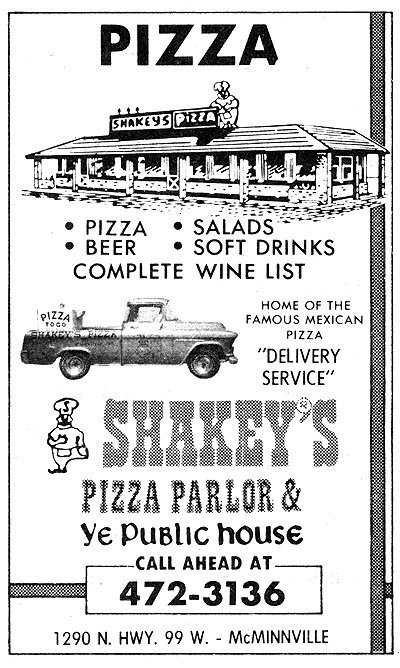
In late summer before starting college, cousin, Dave and I headed south in his Triumph TR6.  We traveled Oregon 99-West and stopped in McMinnville where I looked up Patti Sloss, an EHS classmate and college freshman at Linfield where school started early.  Dave and I dined at one of those old-time Shakey’s Pizza parlors.  It was dark inside as we sat on heavy wood benches eating pizza off rustic tables and watching Laurel & Hardy movies played continuously. 

In Lincoln City I was anxious to join Dave at the nearby Old Oregon tavern, then a hangout for long hairs and hippies.  He gifted me his old Navy identification; a worn piece of green paper which served my fake ID needs during my first year of college even though my alleged age was 28 and my hair color red. 

On our next rendezvous, Grandpa was without car, having gifted his Lincoln Continental to satisfy his wife’s birthday wish.  Here’s how Kay put it in a later court filing: “Nov. 21, 1971 – My birthday present was a transfer of Lincoln car title to me.”  A few weeks earlier Barry and I visited Grandpa and met his new wife at their new home in Marysville. This was the first time this new wife was news to me, though they’d married in January 1968, a mere four months after Grandma’s passing. That afternoon in Marysville, I saw Grandpa quiver like a trapped bird.  This wasn’t the dynamic man I’d spent a pleasant vacation with in Lincoln City five months earlier.

That Christmas, Grandpa joined our family and a plan was hatched for me to drive him to the coast for a week.  He often sought sanctuary in that cherished retreat as the cabin was purchased in his name alone.  Its modest furnishings suggested Kay never spent time there.  I hold no memory of that trip, if not for this brief diary entry Mom produced during the ensuing legal battle following her dad’s death: “Dec. 26, 1971, Bill & Dad went to L.C. – stayed with him until Jan. 2, 1972.” 

Three months later I finished my winter quarter at U.W.  Grandpa had lately escaped Kay and Palm Springs when word filtered back that he might be Lincoln City bound.  Less than a year away from his deathbed, a hobbling dotage was creeping in. How he found his way to Lincoln City remained unclear.  Before his arrival I joined four college girls from Central led by my cousin, Robbie Falk as we traveled to the coast.  They were on a planned spring break trip, while my mission was to intercept Grandpa and bring him home. 

We rolled in late one night and the next morning set off for an adventure up the south side of the Siletz River on a narrow dirt road to find the river home used for filming “Sometimes a Great Notion” starring Paul Newman.  A young boy, perhaps 8 or 9 gave an impromptu tour explaining which scenes were filmed where.  His parents were remodeling the shell Hollywood producers had built as a backdrop for the movie and used some for interior scenes. 

Early that evening as Robbie, Chris, Cathy, Janet and I relaxed in the living room, in through the front door blows Grandpa.  A stern, shocked look on his face sent shivers down our spines, but following a short tense moment Grandpa smiles, invites us all to dinner, and down we traipsed to Mrs. Miller’s cozy restaurant whose featured dish was a crab, butter, and wine medley, eaten with toasted French bread. 

The river home on the Siletz River used in the 1971 film, “Sometimes a Great Notion” directed by Paul Newman.

Robbie and her Central girlfriends continued south on their spring break road trip.  Since Grandpa and I were without vehicle I don’t recall how we got to Portland, perhaps by bus is my best guess.  What’s clearly remembered was visiting a Toyota dealership where we test drove a Celica, then in its first year of production.  The Celica was a sporty model alright, but Grandpa had difficulty getting in and out of the car.  Plus, he no longer drove so trying out a sports car made little sense.  Lots of things were no longer making sense.  It was late so we checked into the Benson Hotel.  Grandpa always stayed at the Benson when in Portland.

The next morning in a hurry to Enumclaw, he directs the hotel clerk to summon a cab.  We hop in and the cabbie asks, “Where ya going?” Grandpa says, “Just across the river a little past Vancouver.”  North of Vancouver the same cabbie question and similar Grandpa answer, “It’s a bit further north.”  With each new fib I slink lower in the back seat.  Somewhere near Kelso the cabbie pulls over and demands, “Now where the hell are you two going?” Grandpa confesses, “Enumclaw, in the vicinity of Auburn.”  The cabbie examines his map and shouts, “That’s another 100 miles!”  A radio call is placed followed by wrangling with dispatch, until permission was granted and back on the freeway we cruised.

Two hours later the cab stops in front of our Enumclaw home.  I go to get money from Mom while the cabbie keeps Grandpa for collateral.  The fare ran to something like $130, which was a cab full of money back then.  With cabbie dismissed, Mom snaps a blurry picture preserving the moment. Around the kitchen table Grandpa and I tell the tale of how we convinced the cab to drive us from Portland to Enumclaw.  In a day or so everyone thinks it’s the funniest story ever or at least pretends to.  For me, it was an erratic adventure with an eerie premonition that a chapter in his life was ending.  Days later I was back in college for spring quarter of my freshman year.

Mom’s blurry photo of me right after the cab left our home at 1737 Franklin St.

In June, Kay coaxed Jack back to Palm Springs where his check book could be better put to use.  Their on-again, off-again relationship reconciled for a couple weeks.  But he broke and cut his toe which landed him in the Desert Hospital.  The ensuing infection triggered a health decline that first slowed and finally lassoed him. 

Dashing to escape, he checked out of the hospital, cleaned papers and belongings from their Palm Springs home, and retreated north.  Kay followed and soon filed a court action seeking guardianship of her fleeing husband.  Jack entered Seattle’s Virginia Mason for further toe treatment.  A dramatic hospital showdown between Kay and his son Evan played out in soap opera fashion.  Amidst allegations and recriminations Grandpa chose to go home to his family. 

He spent July 1972 at the compound of waterfront lots on Lake Sawyer he’d gifted his children and a favored nephew more than a decade earlier.  Our summer cabin was within that domain so he visited often.  Somewhat rejuvenated, Grandpa asked to go back to Lincoln City.  Again I was enlisted to drive south, this time with my 13-year-old cousin, Evan Jr. in tow. 

We took rides down Hwy 101, but Grandpa soon fell asleep.  We dined out, but his diabetes flared as his health faded.  Many hours were spent soaking his infected toe in Epsom salts.  We came back home a few days later.  It proved to be his last trip to the Oregon Coast and the cabin he loved.  In a week or so Grandpa was placed at a Mercer Island nursing home.

In late November, his granddaughter Roberta visited him there.  Grandpa quickly asked how she liked his new apartment.  Then in a conspiratorial voice, he explained a need to head north followed by a whispered suggestion that she could bring her car round and provide his getaway.  Robbie knew better, for she understood he wouldn’t be leaving.  But she also saw his schemes to escape that gilded cage as the only thing keeping him alive.  She speculated on how hard it must be for that hard-charging businessman to resist the call of the road and attend to business that needs tending.  She reflected on a pensive thought, “Will he ever let go of the reins?”

On February 15, 1973, John H. Morris let go of the reins.  A large funeral was held.  The coal mines he’d opened shut down for a day.  Most every coal miner who ever worked for him came to pay their respects.  A bitter probate battle emerged between the parasitic wife and his four children.  The lawsuit featured contested Wills and was fought for years.  Lawyers swallowed a fair portion of his estate before settlement was reached.  Mom received his Lincoln City home in probate; as I did from her 45 years hence. 

That’s me leaving Enumclaw in late summer 1975 to go and live in Lincoln City.

A few months following graduation from college, I moved to Lincoln City with my motorcycle and a backpack of belongings.  I collected unemployment checks as had my cousin Dave four years earlier.  I drifted aimlessly along empty beaches, and wandered through ramshackle corridors of the nearby public library.  I volunteered at the hippie food co-op by day and quaffed beers at the Old Oregon by night.  I ate the Colonial Bakery’s Sailor Jack muffins for breakfast and baked cheese cakes at home for dessert.  I watched every inning of the 1975 Cincinnati-Boston World Series.  I read novels and wrote poetry, and learned how to be alone.  After several months of introspection I returned home to Enumclaw. 

Upon leaving that house on a hill, overlooking the Pacific Ocean whose waves regularly crashed onto rocks below, I realized a tiny bit of home would always be waiting for me there.  I still do.

The home on the hill, circa 2018.

Banner photo by Oliver Kombol.