Categories
History

Jack and Tony Kombol – Coal Miners

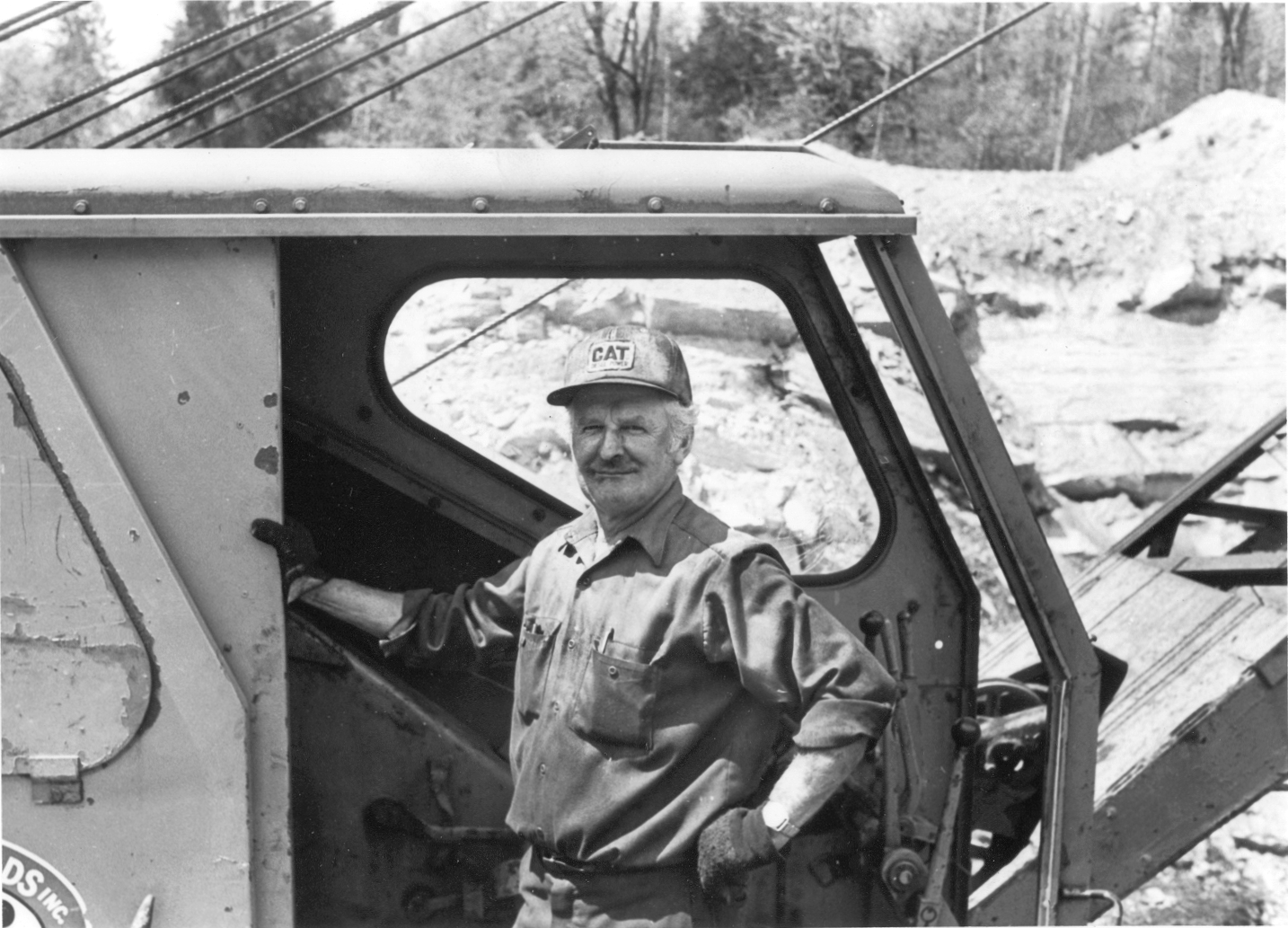
In this 1977 photo on Franklin Hill, east of Black Diamond, Jack Kombol stands beside the dragline he operated for Palmer Coking Coal (Palmer) at the McKay-Section 18 surface coal mine.  The Koehring 405 had an excavating shovel bucket to move overburden and extract coal.  The light-colored rock in the background was the sandstone bedrock laying above and below the McKay coal seam that tilted at about 45 degrees to the surface.  This photo comes courtesy of Lou Corsaletti, who authored several articles about the coal industry in southeast King County.

After closing the last underground coal mine in Washington, Palmer began surface mining this seam to supply Washington State with fuel to heat institutions like the Shelton Correction Center, and Monroe Reformatory.

Jack Kombol was born at his family’s rental home in the tiny and short-lived town of Hiawatha.  The homes were provided by Northwest Improvement Company (NWI) to house workers at their Hiawatha coal mine located midway between Kanaskat and Kangley.  The mine was designed to replace the Ravensdale Mine, whose Nov. 16, 1915 explosion claimed the lives of 31 miners.  Jack’s father, Tony Kombol, worked at the Ravensdale mine but was sent home early that dreadful Tuesday.  Like many unemployed coal miners, Tony Kombol left Ravensdale and found work in Arizona and Montana copper mines.  Jack’s mother, Lulu (Shircliff) Kombol, was a Ravensdale school teacher who similarly lost her job.

The growing Kombol family returned to Washington in early 1919, when Tony rejoined NWI at their new Hiawatha mine.  However, the mine was riddled with problems and dangers.  Two miners, Joseph Ripoli, Italian, and John Panotas, Greek, suffered fatal accidents during the mine’s brief five-year history that produced meager amounts of coal.  Tony Kombol, who at age 17 emigrated to the U.S. from Croatia in 1902, soon found work at the nearby Parkin Kangley Coal Company mine.  It was located less than a mile north of the Hiawatha home that the family of seven continued to rent from NWI.

On August 7, 1925, Tony Kombol was severely disabled when an errant dynamite explosion blinded him at the Parkin Kangley mine.  He spent 30 days in the hospital but couldn’t return to work due to a full disability for which he received a $40 monthly pension plus a $35 monthly stipend for five children, all under the age of 10.  Lulu Kombol returned to work as a school teacher in Selleck and Cumberland to support the family.

A year or so later his second son, and fourth child, Jack contracted polio at age six or seven forcing an absence from school that lasted nearly two years.  After recovering, one of Jack’s legs was shorter than the other.  He attended Selleck school through the 8th grade then went to Enumclaw High School.  Being two years older than fellow students and not particularly academic, he dropped out during his junior year.

Because of a polio-shortened leg, Jack was unfit for service during World War II and moved to Seattle where he drove garbage, tanker, and tow trucks.  After the war, he primarily worked in the woods where he drove log trucks and operated equipment for his brother’s logging company, Bernell Kombol & D.L. Holcomb, and at his cousin-in-law’s firm, Woodrow Gauthier of Gauthier Brothers Lumber and Logging.

Kombol found a new logging job in Northern California and relocated there in early 1950.  Pauline Morris, an Enumclaw girl whose father and uncles owned Palmer Coking Coal, soon followed.  The couple married in Crescent City later that year.  Jack joined Palmer in 1952 and worked for the company until his death in April 1979 at age 57.

Jack and Pauline’s son, Bill Kombol began writing “When Coal Was King” in May 2007.  The position evolved after his youngest son’s Cub Scout troop visited the Maple Valley newspaper, Voice of the Valley.  There, Bill learned that the publisher had recently lost a columnist and volunteered for the job.

And the rest, as they say, is History.

This story originally appeared in the July 17, 2023 issue, Voice of the Valley, which would have been Jack Kombol’s 103rd birthday.


Categories
Musings

I wrote this letter to Mom & Dad

Forty-five years ago, I wrote this letter to Mom & Dad.  I was in Paris near the end of my first of five months in Europe.  My sister Danica (then known as Dana) was studying at the Sorbonne for a year so my parents decided to visit her during an extended vacation.

I quit my job at Seattle Trust & Savings Bank and decided to start fresh and discover my future.  I’d explore Europe – alone, for months, with little direction and no particular plan or focus, and somehow at the end of it all at age 24, find myself.

I came to Paris a few days before my parents arrived.  On Feb. 6, 1978, we began a 25-day auto tour of Lyon, Nice, Monte Carlo, Pula, Zagreb, and Vienna, highlighted by visits with several sets of Croatian relatives.

Mom and Dad left for home on March 3rd and several days later I penned this Aerogramme letter.

One of several letters to Mom and Dad written on light-weight, air-mail, self-sealing envelopes.

March 6, 1978

Dear Mom & Dad –

I don’t quite know what to say.  I hope you weren’t disappointed that I didn’t express my gratitude as much as I could, but you’ll understand that the ‘thank-yous’ would have been so numerous as to make one thank-you seem inconsequential.  So, I guess what I want to say is thank you a thousand times for everything.  I hope I was acceptable as a traveling companion as I sure enjoyed your company and now miss it.

Jack & Pauline’s passport photo for their 1978 trip through Europe.

You’ll never guess what we did Saturday.  Oh, this was ten times better than the sewer system.  Dana and I visited the Catacombs of Paris.  I wish I could send you a postcard (I sent one to Clinton) so you could get the visual impact of seeing these millions of human bones stacked like kindling in tunnels several hundred feet below the streets of Paris.  They were placed there when several Paris cemeteries were torn up to make room for the city’s expansion in the late 18th and early 19th centuries.  It’s a bit morbid at first but fascinating nonetheless.  Got some good pictures (ha ha).

Bill at the Paris Catacombs, March 4, 1978
Danica in the Paris Catacombs, March 4, 1978.

Yesterday, Sunday, Dana and I visited the Rodin museum.  Rodin was the famous sculptor who did the “Thinker” – the piece with the man sitting, chin on his head and elbow on his knee in a very thoughtful moment.  The gardens were beautiful as was the weather yesterday and today.  The skies are now a bright blue and the sun shines hard.  The temperature though has dipped and it’s rather cold outside.

Today, I visited the Paris stock exchange which was extremely interesting, particularly after having seen the commodity exchange in Chicago.  I almost wish I’d seen the Paris exchange first, as it is so calm compared to the unruly Chicago market.  There’s still lots of shouting and such but nothing compared to the screaming in the commodity pits.  Here in Paris, I was able to actually walk on the floor of the exchange, though I did get a couple of stares (no doubt due to my casual attire in the midst of a sea of suits).  But the amazing thing was that I was walking on the floor of France’s equivalent of the N.Y.S.E.

Their exchange system is quite different from the American counterparts, as prices seemed to be established more by consensus than by the bid-ask system in the U.S.  This probably explains the calmer stance as that all-important need to scream your order and acceptance of the other bidder’s order doesn’t really need to exist here.  An interesting sidelight was at one point during the bond market when all the men broke into a song they sang humorously for half a minute.

Writing as small and legibly as possible, you could tell a good story on an Aerogramme (plus there was 1/3 of a panel on the back).

I moved into this hostel for Protestant students.  It’s a dormitory situation, but I get a bed, breakfast, and hot showers all included for 20 francs a night (about $4).  Almost half the people here are French, a quarter English, and the rest Americans.  In fact, before I finished the previous sentence I was engaged in an extended conversation with John Leeson, an Irishman who now lives in Oxford and is teaching French here in Paris.  And, this letter might begin to sound a bit disjointed as I’m sharing my bottle of Yugoslavian wine with John and Jeff Alford, an American from Newport Beach, California.  We’re listening to Radio Luxembourg (Europe’s Top 40 station).

I met Dana’s good (best) friend Carrie, the one whose parents were here over Christmas.  She’s red-headed and quite nice, the exact opposite of Jana.  Dana even admits that Jana is a bit too much.  Much of the time her stories are B.S. and it can even get to Dana at times.

I ate dinner at Dana’s one night and can understand the source of many of her culinary complaints.  The food is horrible.  I had spinach – not the fresh green vegetable I’m used to, but a dull, sickly green blob of something that if you didn’t know it was food, you wouldn’t touch it with a ten-foot pole.  The best I can say was that it was barely edible.

Well, say hello to Barry and Cathy for me (and tell Cathy thank you for the Valentine’s card).  Also, tell her I’m sorry I didn’t send her one but I actually forgot when I was making a list of everyone I sent one to.  Also, if you happen to see Wheels, tell him that his cassette deck is in my room.

Thank you for everything.

Love, Bill

Post Script: I wrote several more letters to Mom and Dad on that trip.  Mom kept a keepsake box for each of her four children where after her death I found that letter and many other treasures.

Jack and Bill Kombol, Feb. 8, 1978. I know the date because my efficient Mother kept a detailed travelogue of our journey.

During those four weeks we spent together, I grew closer to my Dad than perhaps I’d ever been.  He worked hard all his life and in later years found numerous ways to give back to the community.  He helped the old oddballs to whom he rented tiny apartments on the second-floor above Steve’s Shoe Store at the corner of Griffin and Cole in downtown Enumclaw.  He was elected to the school board and as such handed me my diploma when I graduated from high school.

Jack Kombol hands me my diploma, June 2, 1971.

Jack Kombol passed away April 11, 1979, not even a year after coming home from our trip to Europe.  He died on a Wednesday, I wrote a poem on Thursday, and read it at his funeral on Saturday.  I was 25-years-old, channeling feelings from the 14th year of my life when two grandparents, Dad’s father and Mom’s mother died on the same day:

Tears We Have

The last day we expected was the morning that we feared
the nights we cried so long ago have come to rest right here.

We gazed in one another’s eyes
We prayed that we might cope
We stared through nature’s loneliness
and filled our days with hope.

Every day brings forth each night from which dawns each new day
longings fill the times between with thoughts from yesterday.

We’ll never let our smiles down
We’ll never lose our faith
We’ll never touch the world beyond
or see tomorrow’s face.

The news it comes so suddenly, the sadness travels far
raindrops fall from blossomed eyes as we touched who we are.

We realized the sorrow
We understood the pain
We felt the empty feelings
yet prayed no prayers in vain.

And so we’ll cry these tears of pain from sorrow we must store
the tears we have are tears we’ve cried a thousand times before.

There wasn’t much that Dad liked more than operating the heavy equipment he did until shortly before his death.  Here’s Jack Kombol with a drag-line shovel at the McKay coal seam,on Franklin Hill east of Black Diamond, circa 1977.


Exit mobile version